Table of Contents
- Why Provider Vetting Is Non-Negotiable
- The 10 Questions and What Good Answers Look Like
- Red Flags in Provider Responses
- How to Structure a Meaningful Test Order
- What SLAs Should Look Like for a Professional Service
- The Provider Evaluation Scorecard
- FAQ
- Conclusion
Key Takeaways
- A legitimate PBN service will answer all ten questions openly and specifically — vague or evasive responses are the most reliable red flag available.
- Test orders (1–3 links) are essential before committing to volume purchases from any new provider.
- Professional PBN services should offer explicit replacement policies, indexation confirmation, and domain-level metrics at delivery.
- The scorecard at the end of this guide provides a structured comparison tool for evaluating multiple providers against consistent criteria.
- Price should never be the primary selection criterion — a cheap service with one red-flag response is more costly than an expensive service that answers all ten questions correctly.
The decision to use a PBN backlinks service is not made once — it is remade every time you consider a new provider, every time a current provider quality dips, and every time you scale a campaign. This guide gives buyers a repeatable evaluation framework: ten specific questions any buyer should ask any PBN service before placing an order, with a clear guide to what constitutes a trustworthy answer versus a warning sign response. It also covers how to structure a small test order, what SLAs should look like, and an evaluation scorecard for comparing providers.
Why Provider Vetting Is Non-Negotiable
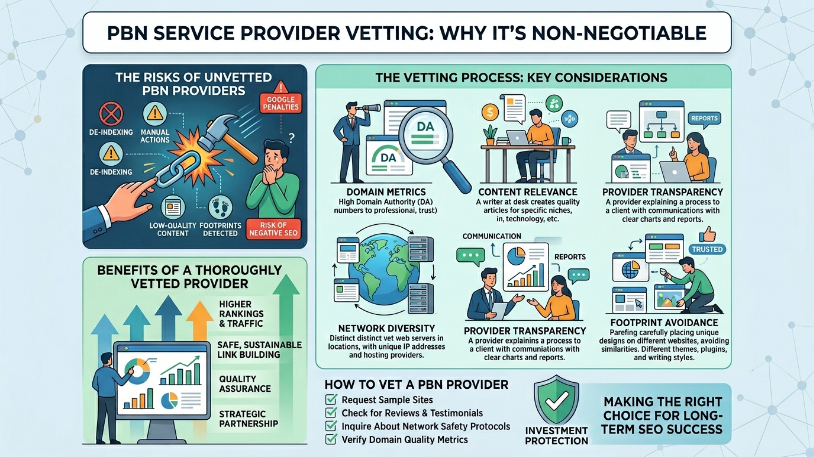
The PBN Backlink Service market has no regulatory standard, no accreditation process, and no independent quality verification mechanism. Every seller describes their service as high-quality, safe, and effective. The only mechanism for evaluating these claims is direct questioning — and the quality of a provider’s responses to direct questions is one of the most reliable predictors of their actual service quality.
Providers who genuinely maintain quality networks have nothing to hide. They know their domains, they understand their content processes, they can explain their IP diversity setup, and they have replacement policies because they maintain quality standards that reduce replacement frequency. Providers operating low-quality networks are evasive because their answers would expose operational shortcuts they know are unacceptable.
The ten questions below are not designed to catch providers in lies — they are designed to elicit the information that helps you make an informed purchasing decision. The quality of the information provided is itself a quality signal.
The 10 Questions and What Good Answers Look Like
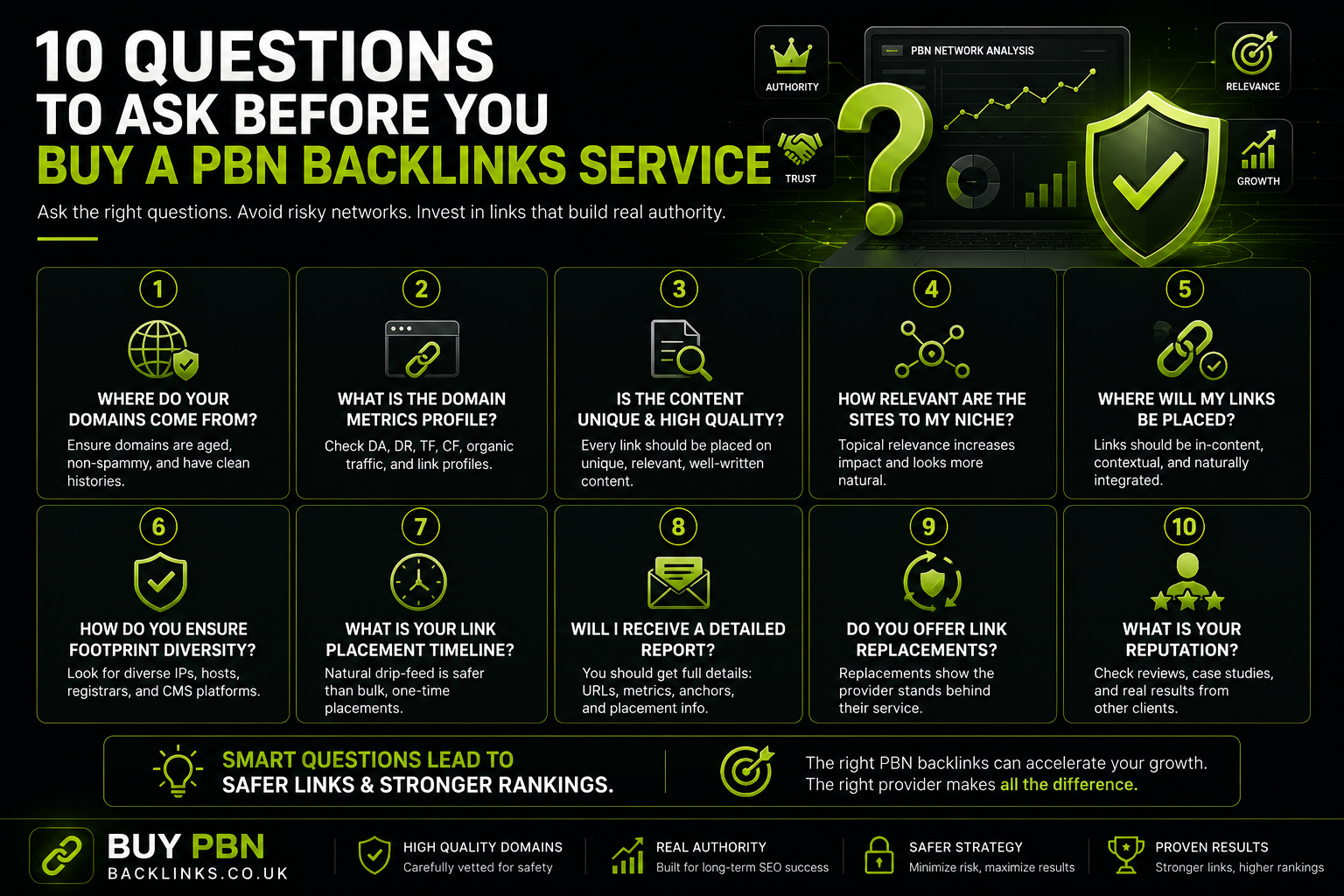
Question 1: Can you provide sample domain URLs before I pay?
What you are testing: Whether the provider has real, verifiable inventory — and whether they trust their own domains enough to let you check them.
Good answer: “Yes, here are three to five URLs from domains in our inventory that match your niche. Please check them in Ahrefs before deciding.” Followed by actual URLs.
Red flag answer: “We don’t share domain lists before purchase,” “Our domains are confidential,” or “You can see sample metrics but not the actual domains.”
Question 2: What are the typical DR, TF, and organic traffic ranges for your placements?
What you are testing: Whether the provider understands the metrics that matter and can describe their inventory accurately.
Good answer: Specific ranges with context: “Our mid-tier placements typically sit at DR20–35, TF15–25, and 30–200 monthly organic visits. We can filter for specific ranges if your campaign requires it.”
Red flag answer: Only quotes DA without specifying the tool, gives suspiciously round numbers (DR40 for all sites), or cannot differentiate between metric types.
Question 3: How do you ensure IP diversity across your network?
What you are testing: Whether the provider understands footprint management and actively maintains it.
Good answer: Describes a specific process: “Each domain is hosted on a separate hosting account with different providers. We currently use a mix of SiteGround, Namecheap hosting, DigitalOcean, and several regional hosting providers. We can confirm the hosting IP for any domain before placement.”
Red flag answer: Vague assurances (“we use many different hosts”), inability to describe the specific process, or confirmation that all sites are on a single shared hosting account.
Question 4: Who writes the content for placements?
What you are testing: Whether content quality is maintained through a real process or auto-generated.
Good answer: “We use a team of niche-focused writers. Articles are reviewed by an editor before publication. Minimum length is 500 words with contextual internal linking. You can see a sample of our content quality on request.”
Red flag answer: “We use AI-generated content,” “Content is created automatically,” or an unwillingness to share sample articles.
Question 5: What is your indexation process?
What you are testing: Whether the provider ensures placements are actually indexed — and pass value.
Good answer: “We submit new articles to Google Search Console, use an indexation PBN Backlinks service, and confirm indexed status before marking the order complete. If a page is not indexed within 14 days, we resubmit and escalate.”
Red flag answer: “All our sites are indexed,” “Google will find it naturally,” or inability to describe any indexation confirmation process.
Question 6: What is your replacement policy for deindexed placements?
What you are testing: Whether the provider backs their quality with a meaningful commitment.
Good answer: “If a placed article is deindexed within [6–12 months], we replace it with a placement of equivalent or superior metrics at no charge within 30 days of notification.”
Red flag answer: No replacement policy, replacement offered only at additional cost, or an extremely short window (30 days) that is too brief to identify most deindexation events.
Question 7: What niches does your network cover, and do you have topically relevant domains for my industry?
What you are testing: Whether the provider can genuinely match placements to your niche or just places links on whatever sites they have.
Good answer: Describes the topical coverage of their inventory with specific niche categories, and can filter their inventory to show domains relevant to your industry before placement.
Red flag answer: “We accept all niches,” “Our sites are relevant to everything,” or inability to distinguish topical placement from generic placement.
Question 8: What is your turnaround time and what does the process involve?
What you are testing: Whether the delivery timeline reflects a genuine manual process.
Good answer: “Typical turnaround is 3–7 business days. This includes domain selection based on your brief, article creation, editorial review, publication, and indexation confirmation. Rush orders of 2–3 days are possible for an additional fee.”
Red flag answer: Same-day or 2-hour delivery promises, inability to describe the steps involved, or turnaround that does not allow time for content creation.
Question 9: What documentation do I receive at delivery?
What you are testing: Whether delivery is transparent and accountable.
Good answer: “You receive the live article URL, anchor text confirmation, the full article text, a screenshot of the link in context, domain metrics at delivery, and indexed status confirmation.”
Red flag answer: “We send you a report,” “You’ll get the URL,” or delivery that is clearly templated and not specific to your placement.
Question 10: How do you handle complaints or disputes?
What you are testing: Whether the provider has a functioning customer service process and how they handle situations where delivery does not meet expectations.
Good answer: Describes a specific escalation process, a named contact or support channel, and references their replacement policy as the resolution mechanism for quality issues.
Red flag answer: Deflection, no clear process, or previous orders described as non-refundable regardless of delivery quality.
Red Flags in Provider Responses
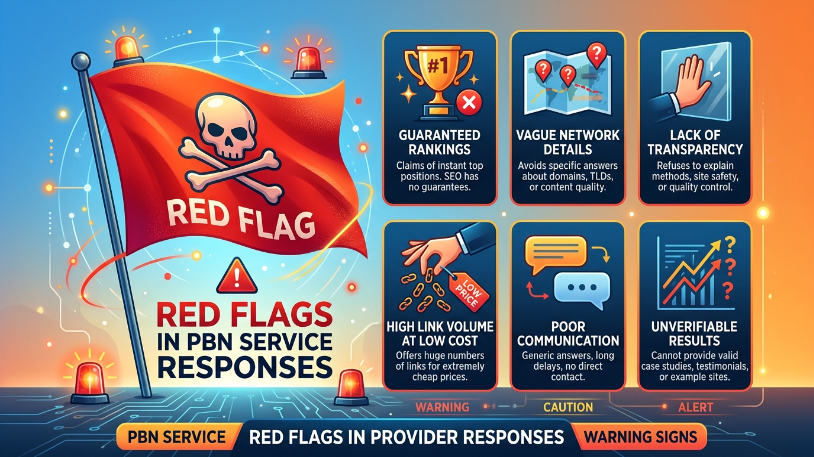
Beyond specific question responses, watch for these patterns across the full communication:
Defensive or dismissive tone when asked specific questions. A provider who treats quality questions as an insult rather than a normal due diligence process does not have confidence in their own product.
Inconsistent information. If a provider’s website claims DR40+ placements but their direct response describes DR20–30, someone is not being accurate.
Inability to provide references or case studies. While client confidentiality is legitimate, a complete inability to point to any verifiable evidence of results — even anonymised — is worth noting.
Pressure to decide quickly. “This offer expires tonight” or “We only have a few spots left” applied to a standardised PBN Backlinks service has no basis in reality. Urgency pressure is a conversion tactic, not a genuine constraint.
Excessive guarantees without substance. “100% ranking guaranteed” or “never get penalised” are commitments no legitimate service can make. Providers who make them are selling confidence, not quality.
How to Structure a Meaningful Test Order
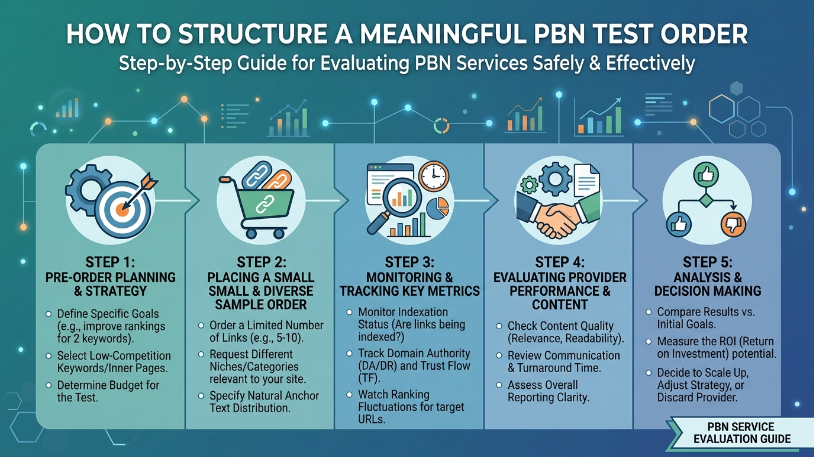
Before committing to a volume order from any new provider, run a structured test that genuinely evaluates their delivery quality.
The Minimal Valid Test
Order 2–3 links targeting:
- The same money site target page you intend to use for the full campaign
- Specific anchor text from your intended strategy (not random anchors)
- Your specified niche
This means the test is evaluating exactly what the full campaign would require — not an easier or less constrained version of the PBN Backlinks service.
What to Evaluate After the Test
Within 24 hours of delivery:
- Verify the live article URL is accessible
- Confirm the anchor text matches your specification
- Check domain metrics in Ahrefs — do they match what was quoted?
Within 7–14 days:
- Confirm the article page is indexed in Google
- Verify the link is contextually placed in relevant content, not force-fitted
Within 4–6 weeks:
- Check for any early ranking movement on the target page
- Note whether the linking domain has maintained its metrics
If any of these checks fail, the provider’s full-scale PBN Backlinks service will likely have the same issues at volume. Only proceed with a volume order if the test passes all three stages.
The Provider Evaluation Scorecard
Score each question 0–2 (0 = red flag, 1 = vague, 2 = specific and satisfactory). Total out of 20: 18–20 = excellent, proceed with test order; 14–17 = good, flag weak answers before ordering; 10–13 = test order only; below 10 = do not use.
FAQ
What is the most important question to ask a PBN service?
Q1 — whether they will share domain URLs before payment. A provider sharing verifiable domain information before payment has nothing to hide.
Should I always run a test order before committing to volume?
Yes, unless you have a strong referral from a practitioner who has used the specific provider recently. Test orders protect you from committing significant budget to a provider whose quality does not match their claims.
What should I do if a provider fails the test order evaluation?
Do not escalate to a volume order. Communicate specific delivery failures. If the issues are systemic, move on. The test order has served its purpose.
How do I evaluate a provider if their quality seems to be declining?
Re-run Questions 1, 2, and 5 on recent placements. Check whether metrics at delivery still match what was quoted, whether recent placements are indexed, and whether content quality has changed.
Is it worth paying more for a provider who answers all ten questions well?
Yes, almost always. The cost of a low-quality placement includes opportunity cost of rankings not achieved, replacement management time, and potential algorithmic suppression risk.
Conclusion
The ten questions in this guide transform PBN service evaluation from a guessing game into a structured due diligence process with objective scoring. For a PBN backlinks service that can answer all ten questions specifically and satisfactorily with domain-level transparency, written replacement policies, and complete delivery documentation, explore the available options and apply this framework to your evaluation.
About the Author
Louis Dobbler is a PBN link building strategist and off-page SEO specialist at BuyPBNBacklinks, with deep expertise in private blog network construction, domain acquisition, and authority link campaigns.

Louis Dobbler is a PBN link building strategist and off page SEO specialist with deep expertise in private blog network construction, domain acquisition, and authority link campaigns. With years of experience working across competitive verticals including iGaming, crypto, finance, and CBD, Louis has helped hundreds of SEO agencies and affiliate marketers engineer rankings that hold through every Google core update.
At BuyPBNBacklinks, Louis oversees network quality, domain vetting, and campaign strategy ensuring every PBN backlink placed meets the highest standards for authority, footprint safety, and long term SEO performance.