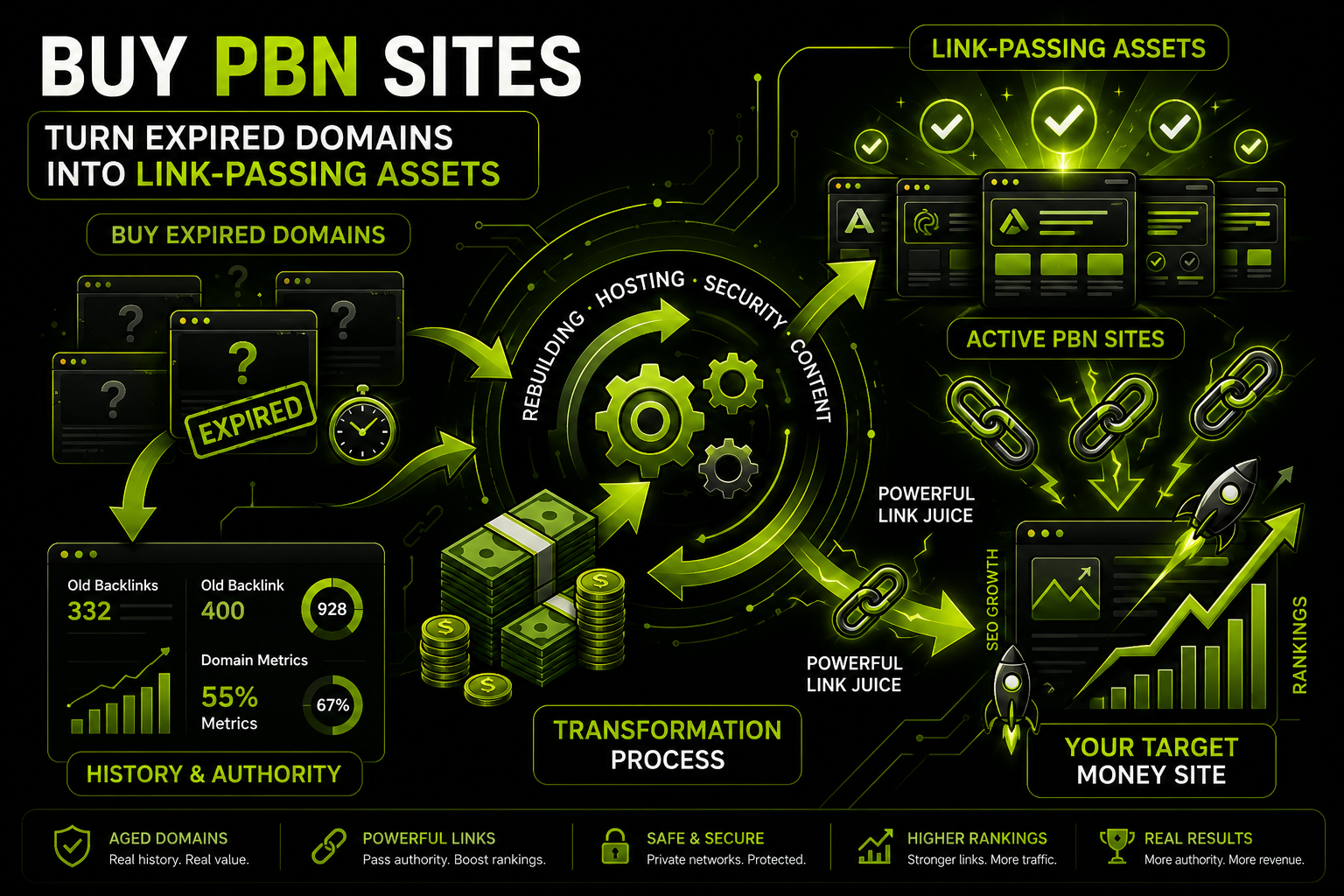
When practitioners talk about buy PBN sites, they typically mean one of two things: acquiring expired or expiring domains and rebuilding them as link-passing properties, or purchasing already-built, ready-to-use PBN sites from operators who have done the construction work. Both routes have distinct economics, risks, and time-to-value profiles. This guide covers the full picture — what makes a PBN site genuinely ready to use versus what makes it a construction project in disguise, the content strategy decisions that determine whether a site passes authority or attracts Google scrutiny, hosting setup best practices, and a detailed cost comparison between buying turnkey sites and building from scratch.
Key Takeaways
- A genuinely ready-to-use PBN site has indexed content, verified organic traffic, a clean backlink profile, and no footprint issues.
- Thin content under 300 words, AI-spun, or topically incoherent is the fastest route to PBN site deindexation.
- Hosting setup requires unique IPs, separate registrars, and distinct nameservers per site — shortcuts here undermine every other quality investment.
- Turnkey PBN site prices range from £150–£800 per site depending on quality tier; building from scratch costs £250–£1,500+ in hard costs plus significant time.
- The most important pre-purchase check is not domain metrics — it is whether the site has been previously used for link placement and whether those placements create footprint risk.
Ready-to-Use vs. Requiring Work: What the Difference Actually Costs
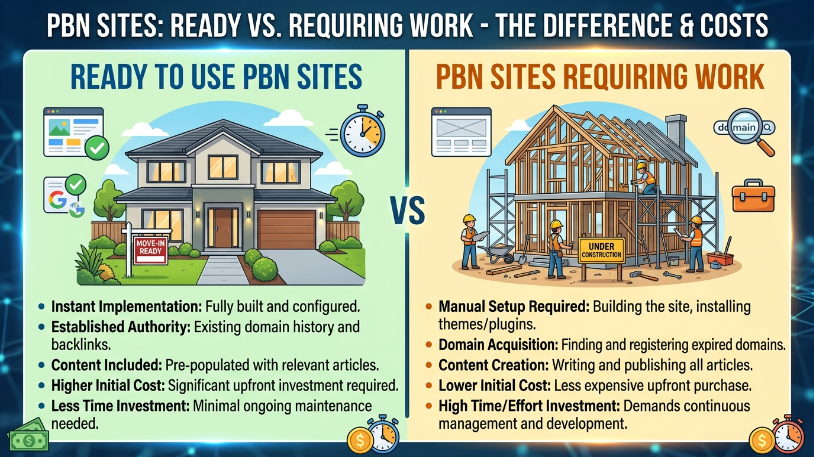
A PBN site that is truly ready to begin passing link authority immediately satisfies all of the following: indexed with multiple pages (5+ confirmed by site:domain.com), organic traffic from real keywords (even 20–50 monthly visits), coherent topical content across all articles, clean technical setup with no crawl errors, no prior problematic link placement history, and independent hosting on a unique IP.
What Genuinely Ready-to-Use Looks Like
A PBN site that is truly ready to begin passing link authority immediately satisfies all of the following:
Indexed with multiple pages — Google has crawled and indexed at least 5–10 pages on the site. Confirmed via site:domain.com returning multiple results.
Organic traffic from real keywords — At least some traffic arriving from organic search. Even 20–50 monthly visits confirms Google is ranking the site for queries.
Coherent topical content — All content on the site covers a consistent topic area. A site where articles randomly cover 6 unrelated niches is not topically coherent and will not provide strong relevance signals.
Clean technical setup — No 404 errors on indexed pages, no redirect chains, working internal linking, correct robots.txt and sitemap.xml configuration.
No prior link placement history creating problems — The site has not previously been used to link to penalised or blacklisted domains, and the outbound link profile is clean.
Independent hosting — The site is hosted on a unique IP, separate from other network sites.
What “Requiring Work” Actually Means in Practice
Sites sold as “ready” that fail any of the above criteria are not ready — they are projects. Here is what each failure type costs to fix:
| Issue | Fix Required | Estimated Cost / Time |
|---|---|---|
| Not indexed | Indexation service + GSC submission | £5–£20; 1–2 weeks |
| Thin or spun content | Content rewrite (500+ words each) | £15–£40/article |
| No organic traffic | Content strategy over 3–6 months | £100–£300; 3–6 months |
| Topically incoherent content | Partial or full content replacement | £150–£500+ |
| Shared hosting footprint | New hosting account setup | £5–£15/month + time |
A site requiring all of the above fixes may represent £500–£1,500 in additional investment beyond the purchase price. The “bargain” price of a requiring-work site often disappears entirely once real fix costs are factored in.
Content Strategy: What Preserves Indexation and What Gets Sites Deindexed
AI-spun or scraped content is the most common reason PBN sites lose Google indexation. Google Helpful Content system identifies text generated to fill pages rather than to inform readers. Duplicate content across network sites creates suppression of lower-authority copies. Sudden content volume spikes — zero for 6 months then 50 articles in a week — are flagged algorithmically. What preserves indexation: human-quality content at minimum 400–600 words per article, topical consistency across all site content, regular publishing cadence of 1–2 articles per month, internal linking structure, and supporting pages (About, Contact, Privacy Policy).
What Gets PBN Sites Deindexed
AI-spun or scraped content is the most common reason PBN sites lose their Google indexation. Google’s helpful content system has become increasingly effective at identifying text that was generated to fill pages rather than to inform or engage readers. A site where every article is clearly machine-generated without editorial oversight fails this evaluation.
Duplicate content across network sites — if the same article (or minimally rewritten versions of the same article) appears across multiple PBN sites in your network, Google’s duplicate content systems will suppress the lower-authority copies and may flag the pattern as coordinated.
Zero engagement signals — Sites with no internal linking, no logical navigation structure, and no content that a real user would voluntarily read provide no behavioural evidence of legitimate editorial purpose.
Sudden content volume spikes — A site that publishes zero content for 6 months and then posts 50 articles in one week has an unnatural publishing pattern that Google’s spam systems flag.
What Preserves PBN Site Indexation
Human-quality content at minimum 400–600 words per article — Articles that are readable, coherent, and informative in the topical area the domain covers. The bar is not literary excellence — it is whether a real reader would find the content useful.
Topical consistency — Every article on the site covers the same or closely adjacent topic. A site about small business finance should have articles about accounting, business loans, invoicing, and payroll — not random posts about travel, health, and gaming.
Regular publishing cadence — Publishing 1–2 new articles per month is enough to signal ongoing editorial activity. Sites that have been “set and forgotten” for years with no new content gradually lose crawl frequency.
Internal linking structure — Articles link to each other within the site on topically related anchor text. This mirrors natural editorial site structure and helps Google understand the site’s topical architecture.
Supporting pages — An About Us page, a Contact page, and a Privacy Policy page give the site the structure of a legitimate editorial operation.
The Thin Content Risk Specifically
A PBN site with articles under 200–300 words is particularly vulnerable. Post-Helpful Content update, Google’s systems evaluate whether pages have “sufficient depth and value.” Short articles that state obvious information without developing it are flagged as low-value.
If you buy a PBN site with thin content, rewrite all articles to 500+ words before placing any money site links. The cost of rewriting is significantly less than the cost of losing a money site’s rankings when its PBN links disappear due to deindexation.
Hosting Setup: The Five Rules for Footprint Avoidance
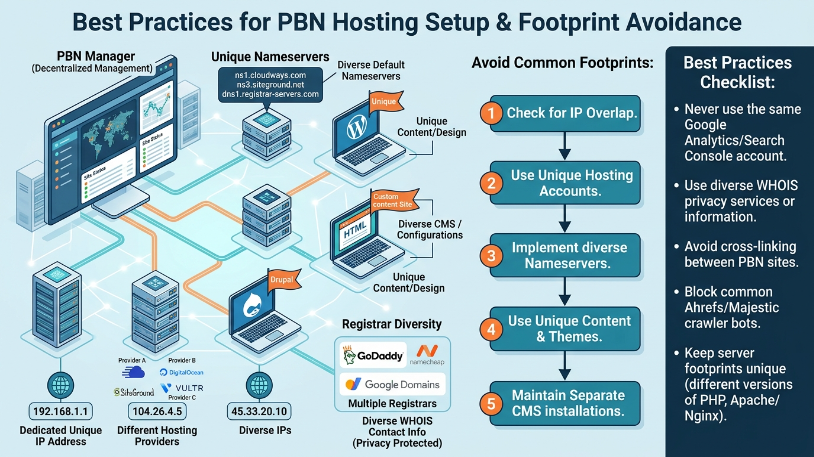
Rule 1: One site per hosting account — never host multiple PBN sites on the same account.
Rule 2: Separate /24 IP block per site — two sites on 185.62.147.X and 185.62.147.Y are on the same discoverable block.
The Rule 3: Different registrars across the network — use at least 4–5 different registrars.
Rule 4: Different nameservers per site — mix hosting provider nameservers, Cloudflare, and custom nameservers.
Rule 5: Different WordPress themes and admin configurations — every site uses a different theme.
The Five Hosting Rules for PBN Sites
Rule 1: One site per hosting account (or per isolated environment) Never host multiple PBN sites under the same hosting account. If the account is flagged, all sites on it are exposed simultaneously. Use separate hosting accounts — ideally at different providers — for each site or small group of sites.
Rule 2: Separate /24 IP block per site Each PBN site should be on a different /24 IP range. Two sites on IP addresses 185.62.147.X and 185.62.147.Y are on the same /24 block — this is a discoverable footprint. Use hosting providers with genuinely diverse IP allocations or spread sites across multiple providers.
The Rule 3: Different registrars across the network Use at least 4–5 different domain registrars: Namecheap, Porkbun, GoDaddy, Cloudflare Registrar, Name.com. All domains at one registrar are a single account that could expose the full network.
Rule 4: Different nameservers per site Default nameservers from a single DNS provider across every site create a consistent fingerprint. Mix hosting provider nameservers, Cloudflare, custom nameservers, and alternative DNS providers across the network.
Rule 5: Different WordPress themes and admin configurations Every site should use a different theme. Identical themes, the same plugin set, and the same wp-config settings across 20 sites create a machine-readable pattern. Vary themes, page structures, and configuration details across the network.
Hosting Providers That Support IP Diversity
For genuine IP diversity at manageable cost, combining the following hosting types is effective:
- Budget cPanel hosts (different accounts at different providers): Hostinger, SiteGround, NameCheap Hosting, DreamHost
- Cloud VPS providers (dedicated IPs, good geographic diversity): DigitalOcean, Vultr, Linode, OVH
- Regional hosting providers (different geographies, different IP blocks): UK-based, EU-based, and US-based providers provide natural IP range diversity
The goal is not to use exotic or expensive hosting — it is to use genuinely different providers so that no single hosting relationship is visible across more than 2–3 sites in the network.
Turnkey vs. Building From Scratch: Full Cost Comparison
| Quality Tier | Turnkey Buy Price | Build from Scratch (Hard Costs) | Build Advantage |
|---|---|---|---|
| Entry (DR10–20) | £100–£250 | £135–£335 | Similar — buy for speed |
| Mid (DR20–35) | £250–£500 | £325–£900 | Build cheaper by ~40% |
| Premium (DR35+, traffic) | £500–£1,200+ | £660–£1,880+ | Build cheaper, turnkey faster |
Risks when buying turnkey:
- Domain history may include prior problematic link placements not disclosed
- Content quality may not meet minimum standards without re-investment
- Hosting may already have footprint issues that require migration
- Metrics may be inflated or taken from an earlier snapshot
Always run a full pre-purchase audit (see Section 6) before buying any turnkey site.
Building From Scratch (DIY or Commissioned)
| Cost Component | Entry Build | Mid Build | Premium Build |
|---|---|---|---|
| Domain (auction) | £20–£80 | £80–£250 | £200–£600+ |
| Hosting (per year) | £60–£120 | £100–£200 | £150–£400 |
| WordPress setup | £0 (DIY) | £20–£80 | £50–£150 |
| Content (10 articles) | £50–£120 | £120–£350 | £250–£700 |
| Indexation | £5–£15 | £5–£20 | £10–£30 |
| Year 1 total | £135–£335 | £325–£900 | £660–£1,880+ |
DIY build advantages:
- Full control over domain selection, content quality, and hosting configuration
- No risk of inherited problems from previous operator
- Cheaper per site at scale once the workflow is established
DIY build disadvantages:
- Significant time investment (15–30 hours per site including domain sourcing)
- Learning curve cost for first-time builders
- Time to first usable link: typically 6–12 weeks from domain acquisition
The Break-Even Analysis
Turnkey premium sites at £600–£800 versus building from scratch at £400–£600 in hard costs: the premium for turnkey is approximately 20–40% over hard build costs. This premium buys time (immediate use rather than 6–12 weeks) and avoids the domain sourcing and setup labour.
For agencies and time-constrained practitioners, the turnkey premium is typically justified. For practitioners with domain sourcing skills and available time, DIY at scale provides meaningfully better unit economics.
Where to Find PBN Sites for Sale
Specialist PBN Marketplaces and Builders
Professional PBN builders who offer turnkey sites include:
- SEO.Domains — pre-vetted domain inventory, some with content
- SeekaHost — PBN-configured hosting with domain inventory
- Specialist black hat / grey hat SEO forums — BlackHatWorld, Digital Point, and similar communities have dedicated marketplace sections where practitioners sell individual sites and full networks
Content Site Marketplaces
Sites priced as content businesses with genuine traffic are sometimes acquirable at valuations that make them viable as PBN assets. The content and traffic justify the price; the link placement capability is a bonus.
- Flippa — broad marketplace, variable quality, requires strong due diligence
- Empire Flippers — higher quality threshold, more reliable vetting, higher minimum prices
- Motion Invest — specialises in smaller content sites with real organic traffic
Direct Acquisition From Practitioners
Within the SEO community — private Slack groups, Discord servers, PBN-focused forums, and SEO mastermind networks — practitioners frequently sell individual PBN sites or full networks when scaling down, pivoting, or exiting. These direct acquisitions often carry better context about the site’s history than marketplace listings, but require community access to find.
The 8-Point Pre-Purchase Evaluation Checklist
Run this evaluation on every site before committing to a purchase. It takes 15–30 minutes per site and identifies the majority of problems that turn apparent bargains into expensive projects.
Pre-Purchase Evaluation Checklist
Google Index Status Search site:domain.com in Google. How many pages are indexed? Zero = deindexed (major problem). 1–3 = barely indexed (likely problem). 5+ = acceptable starting point.
Organic Traffic Open the domain in Ahrefs or Semrush. Check the organic traffic trend over 24 months. Consistent traffic or growing = good signal. Traffic dropping to near-zero in recent months = concerning. Zero throughout = the site has not demonstrated Google trust.
Backlink Profile Quality Open Ahrefs Referring Domains with spam filter applied. Check for live referring domains. Review anchor text distribution — excess money keyword anchors in foreign languages = red flag. Check whether any inbound links are from obvious link farms.
Content Quality Spot-Check Visit the site and read 3 articles at random. Are they coherent, topically relevant, and at least 400 words? If articles are clearly AI-spun, under 200 words, or cover unrelated topics, factor rewriting costs into your offer.
Prior Link Placement History Open Ahrefs Outbound Links for the domain. What sites does this domain currently link to? Are any of those sites penalised, in grey-hat niches, or obviously part of link schemes? Prior placement to low-quality money sites creates association risk.
Hosting and Footprint Check Use ViewDNS.info to check the hosting IP. Search the IP address in Ahrefs — how many other sites share this IP? If dozens of obvious PBN sites share the same IP, the site’s footprint is already compromised.
Domain History Check the Wayback Machine. Confirm the original content was coherent and topically relevant. Flag any history in casino, pharma, adult, or spam niches.
Technical Setup Check for a working sitemap.xml, a robots.txt that doesn’t block crawling, correct HTTP/HTTPS setup without redirect chains, and basic on-page fundamentals (title tags on key pages).
Scoring and Decision Rule
Sites that pass all 8 checks: buy if price is appropriate for the metrics verified. Sites that fail 1–2 non-critical checks: negotiate price down to account for fix costs, then buy if economics work. Sites that fail any of checks 1, 5, or 6: pass unless the problems are unambiguously fixable and the price reflects the reality.
FAQ
What is the difference between buying a PBN site and buying PBN links?
Buying a PBN site gives you ownership — you control it permanently and use it for multiple placements over time at near-zero marginal cost. Buying PBN links means paying for a single placement on someone else’s network. Site ownership has higher upfront cost but lower long-term cost per placement at scale.
How long does it take for a newly acquired PBN site to start passing link authority?
A truly ready-to-use site: 3–14 days from placement to authority transfer. A site requiring content rebuilding or re-indexation: 4–12 weeks before it is ready for link placement.
How many links should I place from a single PBN site?
No more than 2–4 links from a single domain to any one money site, and no more than 10–15 total outbound money site links from a single PBN site across all campaigns.
What is a fair price for a PBN site with DR25 and 100 monthly organic visits?
Typically £300–£600 depending on niche relevance, content quality, and backlink profile cleanliness. Compare against build-from-scratch cost (domain + content + hosting) to establish your maximum purchase price.
Can I use a PBN site for my own business links and client links simultaneously?
Technically yes, but it creates cross-contamination risk. If a manual review surfaces the PBN site from one client’s profile, it could expose links to your own business site and all other clients simultaneously. Use dedicated site segments per client.
Conclusion
Buying PBN sites is an infrastructure investment that converts a one-time cost into an ongoing link placement capability. The conditions for compelling economics are clear: the site must be genuinely ready to pass authority, content must meet minimum quality standards, and hosting must avoid footprint patterns. The evaluation checklist in this guide covers all eight pre-purchase checks needed to distinguish a site that will deliver from one that requires expensive remediation. For curated buy PBN sites options on fully vetted domains with established content, verified metrics, and independent hosting setup, explore the available inventory and apply the evaluation framework above before any purchase.
About the Author
Louis Dobbler is a PBN link building strategist and off-page SEO specialist at BuyPBNBacklinks, with deep expertise in private blog network construction, domain acquisition, and authority link campaigns across iGaming, finance, and SaaS verticals.

Louis Dobbler is a PBN link building strategist and off page SEO specialist with deep expertise in private blog network construction, domain acquisition, and authority link campaigns. With years of experience working across competitive verticals including iGaming, crypto, finance, and CBD, Louis has helped hundreds of SEO agencies and affiliate marketers engineer rankings that hold through every Google core update.
At BuyPBNBacklinks, Louis oversees network quality, domain vetting, and campaign strategy ensuring every PBN backlink placed meets the highest standards for authority, footprint safety, and long term SEO performance.