The debate between buy niche edits and PBN links is one of the most common and most poorly answered questions in link building communities. This guide offers a head-to-head analysis based on what each link type actually delivers, for which site types, in which competitive contexts, and at what cost. It includes a detailed cost per link analysis, use case breakdowns for e-commerce, local SEO, and affiliate sites, and a decision framework table that buyers can use to make the right choice for their specific situation. This is a flagship comparison guide — treat it as a reference document.
Key Takeaways
- Niche edits are faster to take effect because they sit on aged, indexed pages — but they offer less control over context and anchor text.
- PBN links offer full control over article topic, anchor text, and surrounding context — but require fresh content to be indexed before taking effect.
- Cost per equivalent impact tends to favour niche edits for authority injection and PBN links for topical authority building.
- E-commerce category pages and local SEO typically respond better to PBN blog post links. Affiliate content typically responds better to aged-page niche edits.
- The decision is not binary — high-performing link profiles almost always combine both types.
Definitions: What Each Link Type Actually Is
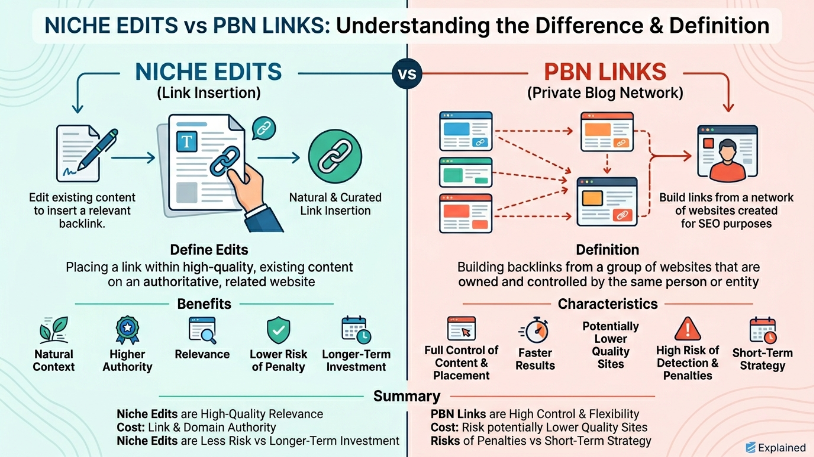
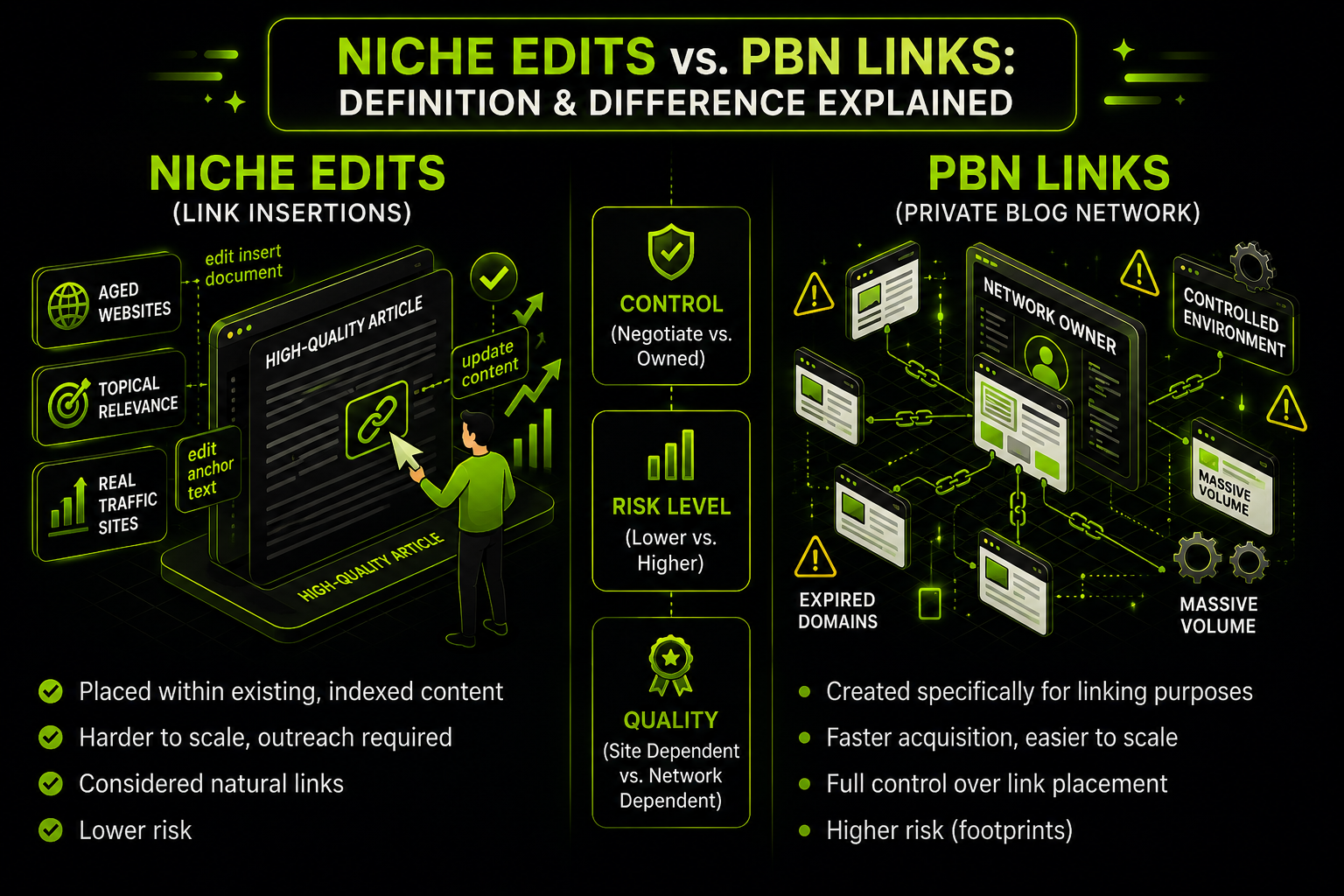
A niche edit is a link insertion into an existing, already-published article on a third-party website. The page already exists, is already indexed, and may already have backlinks. A PBN blog post link is placed inside a newly created article published on a PBN domain specifically for the placement. The key trade-off: niche edits are faster (already indexed) with higher potential page-level authority; PBN blog post links offer full topical and anchor text control but require fresh indexation.
Niche Edits: Definition
A niche edit is a link insertion into an existing, already-published article on a third-party website. The page already exists, is already indexed, and may already have backlinks pointing to it. Your link is added into the body of the article — either within existing text that is rewritten slightly to accommodate it, or at the end of an existing paragraph.
Niche edits can appear on:
- Real editorial sites (high risk of rejection, high value if obtained)
- PBN sites with aged published content (most common in the purchased niche edit market)
- Web 2.0 properties and content aggregators (lower value, high availability)
The key characteristic is that the page pre-exists your link placement.
PBN Blog Post Links: Definition
A PBN blog post link is placed inside a newly created article published on a PBN domain specifically for the placement. The article is written around a topic adjacent to your money site, and your link is embedded contextually within it.
The key characteristic is that the content is created fresh for the placement.
The Fundamental Trade-off
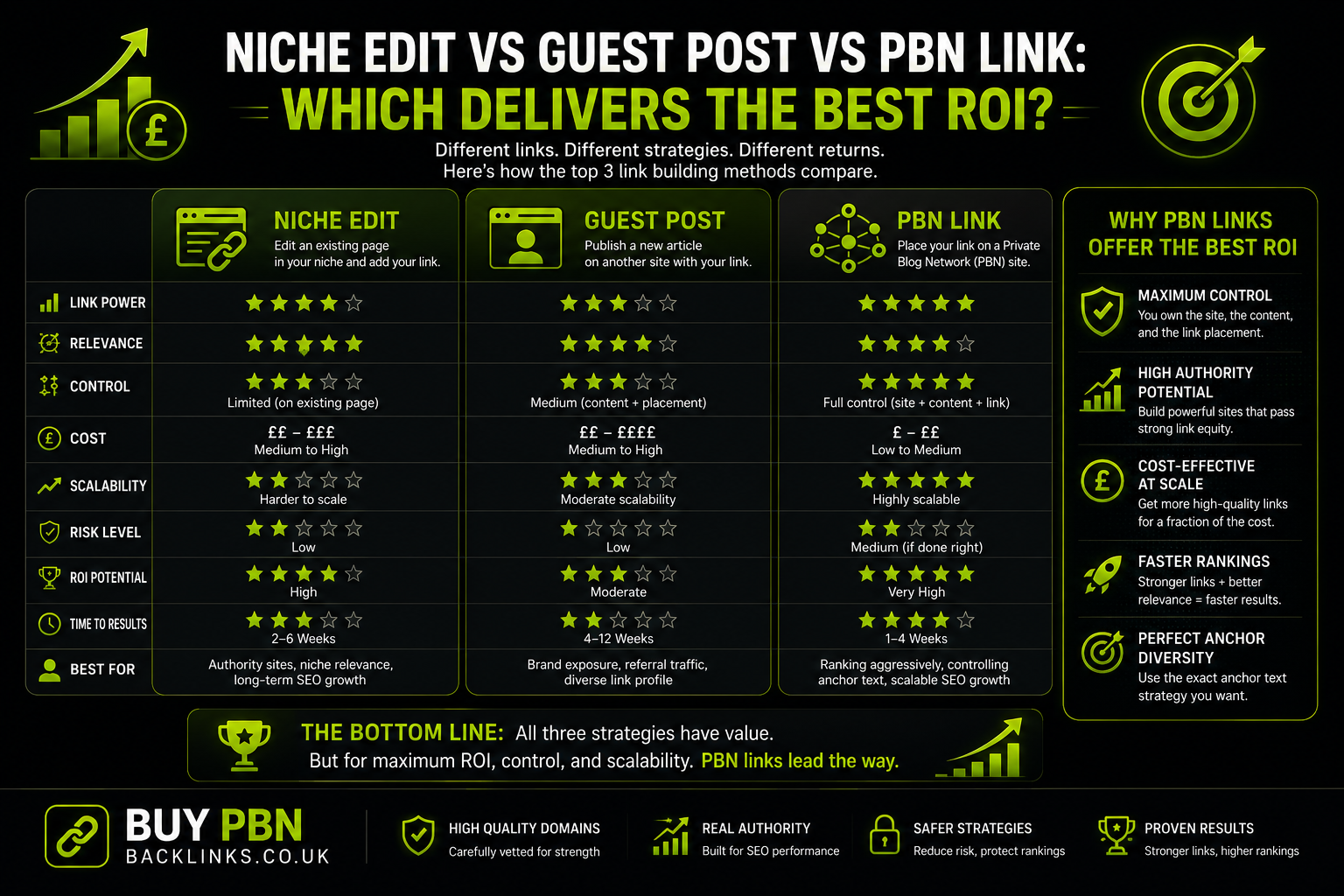
| Dimension | Niche Edit | PBN Blog Post Link |
|---|---|---|
| Page age | Aged (pre-existing) | New (created for placement) |
| Indexation at placement | Already indexed | Requires new indexation |
| Anchor text control | Limited (must fit existing text) | Full (article written around anchor) |
| Topical context control | Limited | Full |
| Speed to impact | Faster (already indexed) | Slower (requires indexation) |
| Page-level authority potential | Higher (aged page may have links) | Lower (new page, no accumulated links) |
Cost Per Link Analysis
| Tier | Niche Edit Price | PBN Blog Post Price | Premium for Niche Edit |
|---|---|---|---|
| Entry | £20–£60 | £15–£40 | ~35% |
| Mid | £60–£150 | £40–£100 | ~40% |
| Premium | £150–£500+ | £100–£250+ | ~50% |
The True Cost-Per-Impact Calculation
Comparing list prices alone is misleading. What matters is cost per unit of ranking improvement for a given competitive context.
For a DR30 placement:
- Niche edit on a DR30 PBN site with an aged page: ~£80–£120
- PBN blog post link on a DR30 site with moderate traffic: ~£45–£80
At equivalent DR, PBN blog post links are typically 30–50% cheaper than niche edits. However, niche edits on genuinely aged pages with their own backlink profile can deliver more concentrated page-level authority at the £100–£150 range than a PBN blog post at a similar price.
The real cost parity is at the premium tier: a £200+ niche edit on a high-authority genuine editorial site with 500+ monthly page visits typically outperforms a £200 PBN blog post link in pure authority terms, but the latter offers topical precision that the former cannot match.
Performance Comparison: Speed, Durability, and Impact
Speed to Ranking Impact
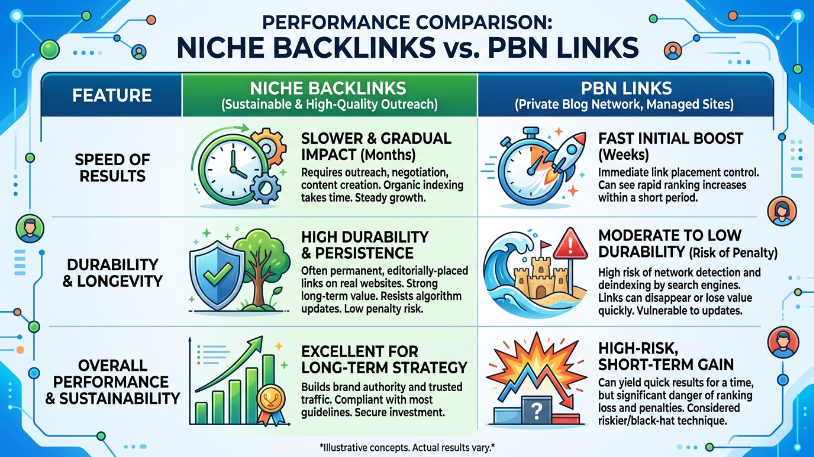
Niche edits take effect faster on average because the insertion happens on an already-indexed page. Google recrawls indexed pages on a regular schedule (for active sites, often weekly or faster). A niche edit placed on a frequently-crawled page can be processed and reflected in rankings within 1–2 weeks.
PBN blog post links require the new article to be indexed before the link begins passing authority. Indexation on maintained PBN sites typically takes 3–14 days. Add 1–2 weeks for Google to process the new link signal and most PBN blog post links begin impacting rankings 3–4 weeks after going live.
Speed advantage: Niche edits by approximately 2 weeks on average.
Authority Durability
Niche edits on real editorial sites with genuine traffic tend to be more durable — the hosting site has independent reasons to keep the content live. Niche edits on PBN sites are subject to the same maintenance and longevity risks as any PBN placement.
PBN blog post links durability depends entirely on the seller’s network maintenance standards. Well-maintained networks with annual domain renewals and active content management can sustain placements for years. Poorly maintained networks have high link attrition rates.
Durability advantage: Niche edits on genuine editorial sites; similar durability on PBN sites for both types.
Impact Depth
For pure authority transfer, aged niche edit pages with their own backlink history can deliver concentrated link equity that a new PBN article cannot immediately match. For topical authority building and keyword relevance signalling, PBN blog post links with precisely crafted surrounding content consistently outperform niche edits where the contextual fit depends on what was already written.
Use Cases: When Niche Edits Win
Topical Precision Is Required
When you need the linking content to cover a very specific topic — a niche within a niche, a specific product category, a precise geographic targeting — PBN blog post links allow you to specify the article topic, the surrounding semantic context, and the anchor text simultaneously. Niche edits are constrained by whatever was already written.
Anchor Text Strategy Is Critical
When your anchor text needs to be carefully managed — particularly in gambling, finance, and legal niches where anchor over-optimisation penalties are severe — PBN blog post links give you complete control. Niche edits require the anchor to fit naturally into existing text, which may not accommodate your preferred anchor precisely.
Volume Is Needed at Scale
For link-heavy campaigns targeting competitive terms in niches with weak guest post availability, PBN blog post links are more available at volume and lower cost than niche edits of equivalent quality. Building 100 quality placements is more achievable at mid-tier PBN link prices than at mid-tier niche edit prices.
Building Topical Authority Clusters
When the goal is not just adding individual links but building a coherent topical content cluster around your money site — multiple articles covering related topics all linking to your target page — PBN blog post links are the natural tool. Niche edits cannot construct a new topical cluster; they can only add links to what exists.
Industry-Specific Breakdown: eCommerce, Local, Affiliate
E-Commerce Category Pages
Winner: PBN blog post links
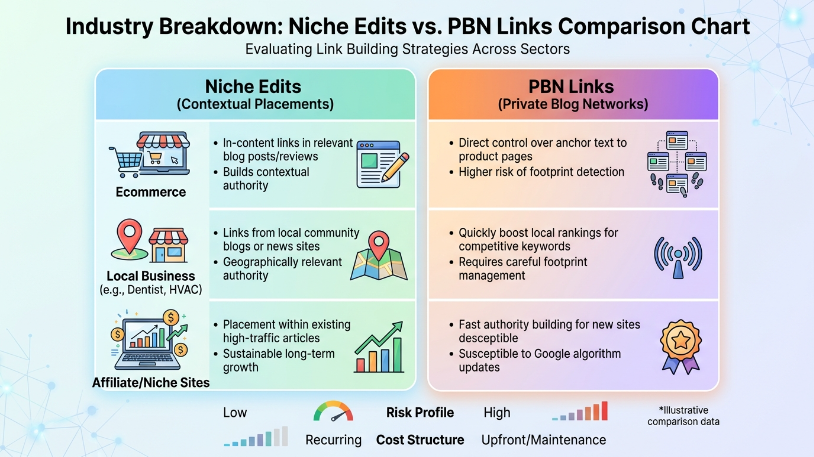
E-commerce category pages benefit most from topical authority signals that confirm the page covers a specific product category comprehensively. PBN articles written about the product type, use cases, and buying guides provide the semantic context that Google’s quality systems use to evaluate category page relevance. Niche edits on unrelated pages add authority without topical depth.
Recommended mix: 60% PBN blog post links (topical articles), 40% niche edits (authority injection from editorial sites where accessible)
Local SEO
Winner: PBN blog post links with geographic anchors
Local keyword rankings respond strongly to geographic relevance signals. PBN blog post links where the article includes local geographic context — city references, regional service area mentions — deliver more precise local authority signals than generic niche edits. The anchor text control also allows partial-match geographic anchors that niche edits struggle to accommodate naturally.
Recommended mix: 70% PBN blog post links (geographically contextual), 30% niche edits or citation-style placements
Affiliate Content Pages
Winner: Niche edits on aged content
Affiliate pages competing against established review and comparison content tend to perform best with page-level authority injections from aged editorial content. A niche edit on a 3-year-old comparison article that has accumulated its own backlinks delivers concentrated authority that a new PBN article cannot immediately replicate.
Recommended mix: 50% niche edits (aged page authority), 50% PBN blog post links (topical cluster building)
The Decision Framework Table
| Campaign Situation | Recommended Type | Reason |
|---|---|---|
| Speed is the priority | Niche edit | Faster indexation, immediate processing |
| Full anchor text control needed | PBN blog post | Article written around anchor |
| Building topical content cluster | PBN blog post | Fresh content for each topic |
| Pure authority injection needed | Niche edit (aged page) | Page history passes concentrated equity |
| High volume campaign (50+ links) | PBN blog post | Better availability and cost at volume |
| Gambling, finance, legal niches | PBN blog post | Anchor text control essential |
| Local SEO with geographic targeting | PBN blog post | Geographic context in article |
| E-commerce category pages | PBN blog post | Topical authority for product categories |
| Affiliate review/comparison pages | Niche edit | Aged page authority injection |
| Competitive national keywords | Combined | Both types in balanced profile |
FAQ
What is the main difference between a niche edit and a PBN link?
A niche edit inserts your link into an existing published article. A PBN blog post link places it inside a freshly created article. Niche edits are faster to take effect; PBN blog post links offer more control over topical context and anchor text.
Which is better for rankings: niche edits or PBN links?
Neither is universally better — both are effective in different situations. Most competitive campaigns use a combination of both.
Are niche edits safer than PBN links?
Both carry similar risk profiles on PBN sites. Niche edits on genuine editorial sites carry lower risk but are harder to obtain.
How much do niche edits cost compared to PBN links?
At equivalent domain metrics, niche edits typically cost 30–50% more. Entry-level: £20–£60 vs £15–£40. Mid-tier: £60–£150 vs £40–£100.
Can I use both niche edits and PBN links in the same campaign?
Yes — and for competitive targets you generally should. The combination looks more natural and delivers more complete ranking signals than either type alone.
Conclusion
The niche edits vs. PBN links debate has no clean winner — both deliver genuine ranking value in specific contexts. The decision framework table in this guide makes the choice faster and more systematic. For a complete view of how paid links fit into a broader SEO strategy, read our buy backlinks for SEO guide. You may also want to compare this with buy permanent backlinks for long-term ROI considerations. For access to both niche edit placements and PBN blog post links with transparent metrics, explore the buy niche edits and PBN links options available.
About the Author
Louis Dobbler is a PBN link building strategist and off-page SEO specialist at BuyPBNBacklinks, with deep expertise in private blog network construction, domain acquisition, and authority link campaigns.

Louis Dobbler is a PBN link building strategist and off page SEO specialist with deep expertise in private blog network construction, domain acquisition, and authority link campaigns. With years of experience working across competitive verticals including iGaming, crypto, finance, and CBD, Louis has helped hundreds of SEO agencies and affiliate marketers engineer rankings that hold through every Google core update.
At BuyPBNBacklinks, Louis oversees network quality, domain vetting, and campaign strategy ensuring every PBN backlink placed meets the highest standards for authority, footprint safety, and long term SEO performance.