The choice between renting PBN links on a monthly subscription and buying them as permanent placements is one of the most practically important financial decisions in a link building programme. This guide covers the cash flow economics for both agencies and in-house SEOs, explains what happens to rankings when rental links stop, identifies the specific use cases where each model wins, and provides a decision table that maps budget, campaign duration, and context to the optimal choice.
Key Takeaways
- Monthly rental links cost 3–5x more than permanent links over a 12-month period but allow flexibility to cancel when campaigns end.
- Rankings typically decline gradually over 2–6 months when rental links are removed, not immediately.
- Agencies billing clients monthly often prefer rental links because the cost structure matches client payment cycles.
- In-house SEOs with long-term organic goals almost always benefit more from permanent placements.
- The optimal model for most campaigns is a core of permanent links supplemented by temporary rentals during competitive peak periods.
The Fundamental Difference Between Renting and Buying
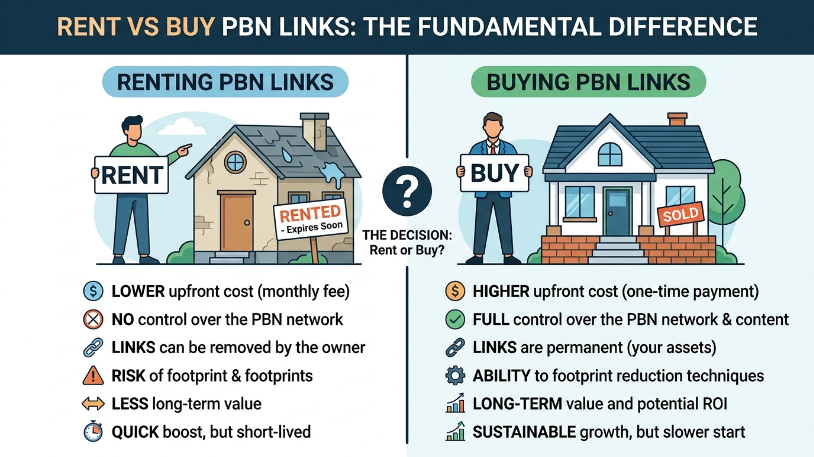
The distinction between renting and buying PBN links is simple in theory but has significant practical implications that are easy to underestimate.
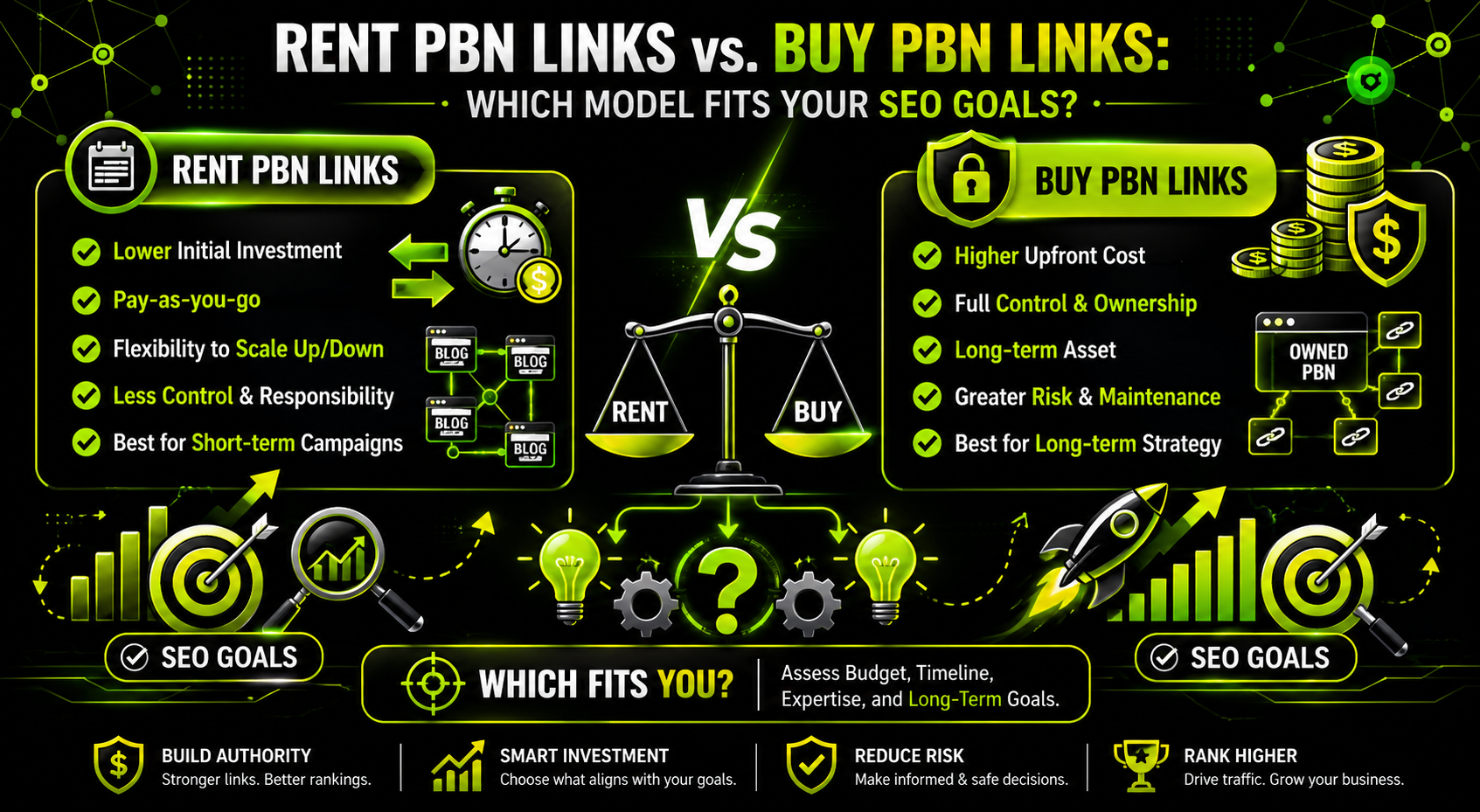
Rented links: You pay a monthly fee to maintain a live link on a specific domain. When you stop paying, the link is removed. Rankings supported by that link begin to decline. The seller retains ownership of the domain and the placement.
Permanent (purchased) links: You pay once for a link placed on a domain, with a commitment that it remains live indefinitely. You do not pay again regardless of how long the link remains live. If the seller maintains the domain, the link continues passing authority at zero ongoing cost.
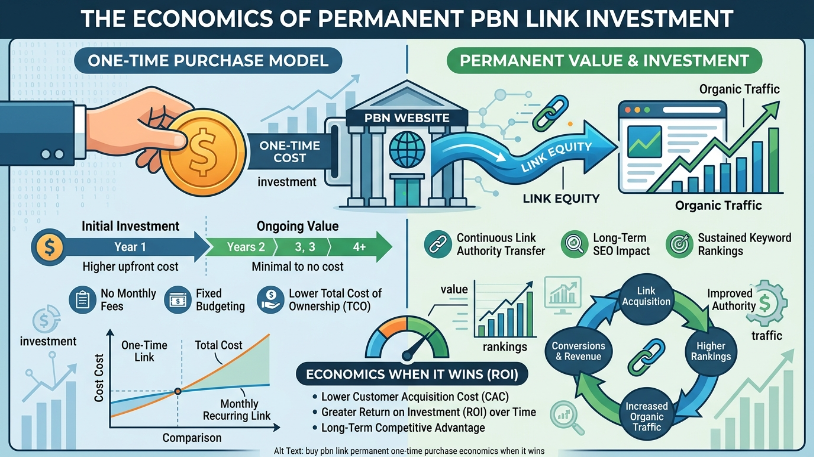
The economic implication: rented links are a subscription expense with ongoing cost proportional to ongoing value. Purchased links are a capital investment with front-loaded cost and long-duration value delivery.
Monthly Rental Economics: Agencies vs. In-House SEOs
The Agency Perspective
For agencies billing clients on monthly retainers, rental links have a structural advantage: the cost matches the revenue model. A client paying £1,500/month in retainer fees who receives £300/month in rental link costs creates a predictable, sustainable unit economics model. If the client terminates, the agency cancels the links. No sunk cost, no stranded assets.
The problem is the economic inefficiency. At £25/link/month, 12 months of a single rental link costs £300 typically 3–5x what a permanent placement on equivalent quality would cost. For a client retained for 24 months, the same link costs £600 potentially 8–10x the equivalent permanent placement cost.
Agencies that retain clients for 12+ months consistently find that permanent links become more economical once the relationship is established. A hybrid model rent initially, convert to permanent as client relationships stabilise often optimises for both flexibility and long-term cost efficiency.
The In-House SEO Perspective
In-house SEOs managing link building for a business with a stable long-term SEO programme have less reason to favour rental links. The business will continue operating indefinitely, the SEO goals are persistent, and there is no “cancel the client” event that requires rapid link removal.
For in-house teams, the permanent link model’s compounding economic advantage over 12–36 months is almost always the better choice. The only exception is during exploratory phases — testing whether a new keyword cluster responds to link signals — where rental links allow cheap experimentation before committing to permanent placements.
One-Time Purchase Economics: The Break-Even Table
The Break-Even and Beyond
For any permanent vs. rental comparison, the break-even point is straightforward:
Break-even months = permanent price ÷ monthly rental cost
Beyond that point, the permanent link is generating value at zero marginal cost while the rental link continues incurring monthly expenses.
| Permanent Price | Monthly Rental | Break-Even | Year 2 Saving per Link |
|---|---|---|---|
| £40 | £12/month | Month 3.3 | £104 |
| £70 | £20/month | Month 3.5 | £170 |
| £100 | £25/month | Month 4.0 | £200 |
| £150 | £30/month | Month 5.0 | £210 |
For a campaign with 20 links, the cumulative year-2 saving from permanent over rental at the £70/£20 comparison point is £3,400. Year three adds another £4,800. The permanent model’s economic advantage compounds significantly over time.
When Permanent Is Not the Right Choice
The permanent model is wrong when:
- The campaign has a defined short end date (under 4–5 months)
- Budget constraints prevent the higher upfront cost
- The target site or money site may be sold, pivoted, or abandoned before the break-even point
- The link is part of a test phase before committing to a target keyword
What Happens to Rankings When You Stop Renting
This is the question that most practitioners thinking about rental links underestimate. The impact of removing links is not immediate — but it is real and it scales with how significant those links were to the ranking position.
The Typical Decline Timeline
Months 1–2 after rental links removed: Little to no visible ranking change. Google does not immediately recalculate ranking positions as links disappear — the crawl cycle means changes take weeks or months to propagate.
Months 2–4: Gradual position decline begins for competitive keywords. The speed depends on how aggressively competitors are building links and how much of your ranking position was sustained by the rental links.
Months 4–6+: For keywords where rental links provided significant authority, significant ranking decline is typical. Pages may drop back toward their pre-link-building positions if no other authority has been accumulated.
What Factors Affect the Decline Rate
Competitive intensity: In low-competition niches where competitors are not actively building links, positions may hold for many months after rental removal before declining. In highly competitive niches, decline begins faster.
Remaining permanent links: If the site has accumulated a base of permanent links alongside the rentals, the permanent foundation continues supporting rankings after rentals are removed. The decline rate is reduced proportionally.
Content quality and on-page strength: Pages with strong content signals, active user engagement, and good technical SEO are more resilient to link loss than thin pages that were entirely ranking-dependent on link authority.
Use Cases Where Rental Wins
Short-Duration Campaigns With Defined End Dates
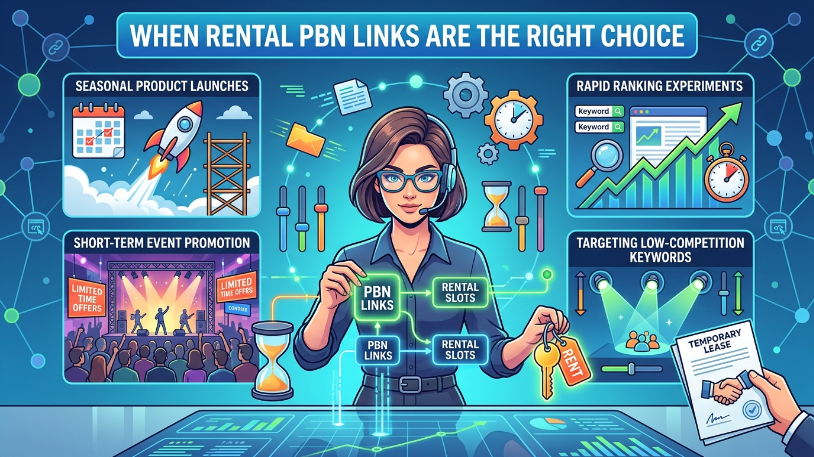
Seasonal campaigns, product launch periods, event-based content, and time-limited promotional pushes all have natural end dates. Rental links matched to the campaign duration cost less in total than permanent placements for a campaign that ends in 3–4 months.
Client Testing Phases
Before committing a client to a permanent link investment on a new keyword cluster, renting links for 60–90 days tests whether the page and keyword respond to link signals. A client who approves £300 in rental testing before authorising £2,000 in permanent placements is making a smarter risk allocation decision.
Agency Cash Flow Management
Agencies managing large portfolios of client campaigns sometimes use rental links specifically to match the monthly billing cycle without front-loading capital investment. The economic inefficiency is traded for cash flow predictability.
Competitive Surge Coverage
When a competitor suddenly surges in rankings due to a link building burst, temporary rental links can close the gap quickly while a longer-term permanent link strategy is built out. The rentals serve as a bridge rather than a foundation.
Use Cases Where Permanent Buying Wins
Stable Long-Term Campaigns
For in-house SEO programmes with 12–36+ month horizons, permanent links are almost always more economical. The compounding savings from months 4 onwards significantly outweigh the higher upfront cost at any scale.
Core Topical Authority Building
When the link building goal is not temporary ranking support but permanent topical authority — the kind that holds through algorithm updates and competitive changes — permanent placements on maintained, well-structured network sites are the appropriate tool. This authority does not benefit from temporary rental links.
High-Competition Keywords Requiring Stable Profiles
In highly competitive niches, ranking stability correlates with profile stability. A link profile that gains and loses links at rental renewal cycles is more volatile than one built on permanent placements. Stability is not just a cost preference — it is a quality signal that Google’s systems reward.
The Decision Table
| Campaign Situation | Recommended Model | Reason |
|---|---|---|
| Campaign under 4 months | Rent | Below break-even point |
| Campaign 4–8 months (stable) | Permanent | Past break-even by campaign end |
| Campaign over 8 months | Permanent | Significant cost saving |
| Agency, new client under 6 months | Rent | Flexibility to cancel if client leaves |
| Agency, retained client 12+ months | Permanent | Compounding savings justify upfront |
| In-house, stable business | Permanent | Long-term economics clearly favour it |
| Testing new keyword cluster | Rent | Low-cost signal test before commitment |
| Competitive surge response | Rent (bridge) | Speed and flexibility over long-term cost |
| Core topical authority build | Permanent | Stability and permanence are part of the signal |
FAQ
What happens to rankings if I stop paying for rental PBN links?
Rankings typically decline gradually over 2–6 months after rental links are removed, depending on competitive intensity. The decline is rarely immediate but is real for keywords where the rental links were providing significant authority.
Is it possible to mix rental and permanent PBN links?
Yes — and this is often optimal. A permanent core provides stable long-term authority. Rental supplements allow flexible volume adjustment during competitive surge periods without disrupting the foundation.
Are rented PBN links cheaper than permanent overall?
Per month yes, over 12+ months no. The break-even for most comparable placements is 3–5 months. Beyond that point permanent links are always cheaper on a cost-per-month basis.
Do sellers offer both rental and permanent PBN links?
Many do. Ask whether rental and permanent placements come from the same network inventory — the quality standard should be identical regardless of billing model.
How do I transition from rental to permanent links?
Order permanent replacements on equivalent domains before cancelling rentals. Allow the permanent placements to index before removing the rentals to prevent a ranking gap during transition.
Conclusion
The rent vs. buy decision is about matching the financial model to the campaign timeline, budget structure, and stability requirements. The decision table in this guide maps these situations to clear recommendations. For the option to rent or buy PBN links with full metrics transparency, both permanent and flexible subscription options, and complete delivery documentation, explore the available models.
About the Author
Louis Dobbler is a PBN link building strategist and off-page SEO specialist at BuyPBNBacklinks, with deep expertise in private blog network construction, domain acquisition, and authority link campaigns.

Louis Dobbler is a PBN link building strategist and off page SEO specialist with deep expertise in private blog network construction, domain acquisition, and authority link campaigns. With years of experience working across competitive verticals including iGaming, crypto, finance, and CBD, Louis has helped hundreds of SEO agencies and affiliate marketers engineer rankings that hold through every Google core update.
At BuyPBNBacklinks, Louis oversees network quality, domain vetting, and campaign strategy ensuring every PBN backlink placed meets the highest standards for authority, footprint safety, and long term SEO performance.