When buyers search for buy high DA PBN links, they are almost always using “DA” as shorthand for authority. The problem is that most sellers know this and exploit it — quoting DA numbers that either measure the wrong thing, use an outdated metric, or have been deliberately inflated. This guide clears up the confusion. If you are new to PBN link building, start with our complete PBN buyer’s guide before reading on. It explains the real difference between Moz DA and Ahrefs DR, explains which signals actually determine whether a PBN domain carries ranking authority with Google, and identifies the metric combinations that separate genuinely high-authority domains from high-looking ones. It also covers what realistic pricing looks like for domains with genuine authority, and gives buyers a five-point verification process they can run before every purchase.
Table of Contents
- DA vs. DR: Two Different Things, Constantly Confused
- What Google Actually Uses to Measure Authority
- What Makes a PBN Domain Genuinely High Authority
- Scam Metrics: What Sellers Show vs. What Matters
- What High DA PBN Links Should Realistically Cost
- How to Verify Before Buying
- FAQ
Key Takeaways
- DA (Moz) and DR (Ahrefs) are completely different metrics from different tools — “high DA” could mean either, or neither.
- Google uses its own internal trust signals that no third-party tool measures directly — organic traffic is the closest public proxy.
- A PBN domain that ranks for real queries in Google is genuinely authoritative regardless of what its DA or DR shows.
- Genuine high-authority PBN placements (DR30+, with real traffic) start at £60–£120. Below that, “high DA” is almost always a metric game.
- The five-step verification in this guide takes under ten minutes per domain and will catch the vast majority of inflated-metric sellers.
DA vs. DR: Two Different Things, Constantly Confused
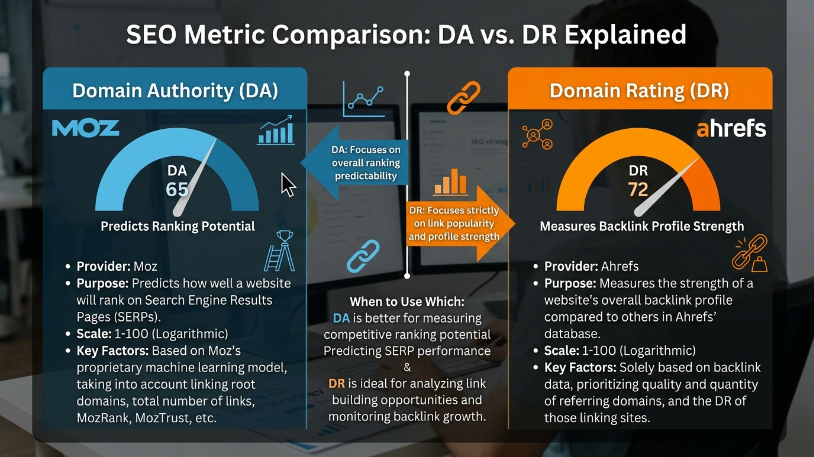
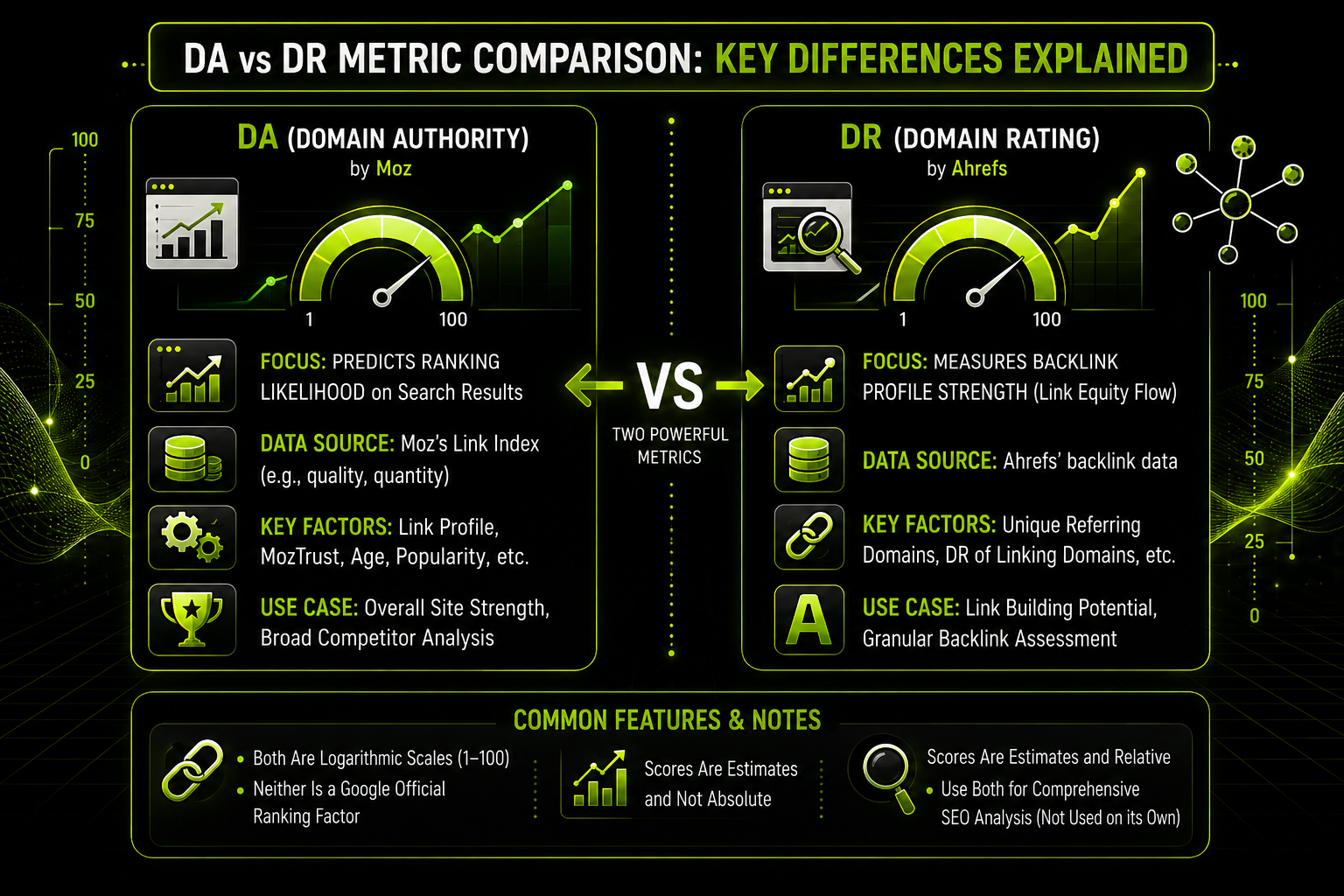
The phrase buy high DA PBN links is used across the industry as if DA were a universal standard. It is not. DA and DR are two separate metrics from two separate companies, measuring authority in different ways.
Domain Authority (DA) — Moz
Moz Domain Authority is a score from 0–100 that estimates how likely a domain is to rank in search results based on its link profile. Moz calculates it using their own link index, which is smaller and less frequently updated than Ahrefs. DA tends to be more stable but less current than DR. DA is also the metric most commonly cited on low-quality PBN seller pages because it is widely recognisable by non-technical buyers and easy to misrepresent.
Domain Rating (DR) — Ahrefs
Ahrefs Domain Rating measures the strength of a domain’s backlink profile relative to all other domains in Ahrefs’ index, on a logarithmic scale. DR is updated far more frequently than DA and reflects a more current picture of a domain’s link acquisitions. DR is more commonly cited by technically sophisticated sellers and SEO practitioners. It is also more commonly inflated through reciprocal PBN link exchanges.
The Practical Difference
| Metric | Tool | Updated | Gameable? | Best Use |
|---|---|---|---|---|
| DA | Moz | Monthly | Yes (slowly) | Initial floor check only |
| DR | Ahrefs | Frequently | Yes (quickly) | Better than DA, still not sufficient alone |
| TF | Majestic | Frequently | Harder | Most reliable authority proxy |
| Organic Traffic | Ahrefs/Semrush | Weekly | Hardest | Best Google-trust proxy available |
When a seller quotes DA without specifying the tool, ask which one. If they cannot say, that is your first red flag. For a complete buying guide, see our buy PBN links guide covering the full evaluation process.
What Google Actually Uses to Measure Authority

Google does not use DA, DR, or any Moz or Ahrefs metric. These are third-party estimates of what Google might consider. Google’s own signals are not publicly documented in any complete form, but years of algorithm research and testing have identified the signals that correlate most strongly with genuine ranking power. Google’s original PageRank algorithm still in use in evolved form measures a domain’s position within the global link graph. The most reliable external proxy for Google trust is whether a domain ranks for real organic queries. A domain that appears in Google search results for several topically coherent keywords has, by definition, passed Google’s quality assessments sufficiently to be ranked.
PageRank and Link Graph Position
Google’s original PageRank algorithm still in use in evolved form measures a domain’s position within the global link graph. A domain that is linked to by many other domains that are themselves well-linked earns more PageRank. This is what DA and DR are attempting to approximate.
The difference is that Google processes the entire web graph, including signals no external tool can see — the trust assigned to linking domains, the rate at which content is updated, user engagement signals, and historical quality assessments.
Organic Search Presence as a Proxy
The most reliable external proxy for Google trust is whether a domain ranks for real organic queries. A domain that appears in Google search results for several topically coherent keywords has, by definition, passed Google’s quality assessments sufficiently to be ranked. That is evidence of trust that no DA or DR number can replicate.
When evaluating a PBN domain for genuine authority, organic traffic confirmation in Ahrefs or Semrush is more valuable than any metric score.
What Makes a PBN Domain Genuinely High Authority
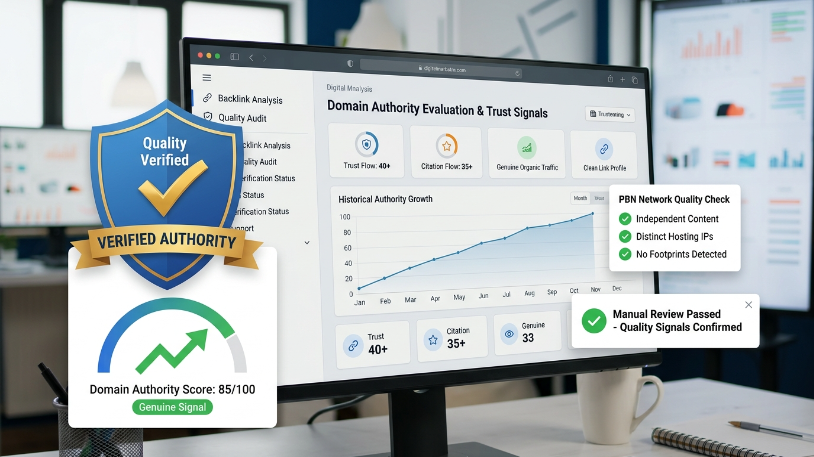
A PBN domain is genuinely high authority when it satisfies at least three of five conditions: real organic traffic of 50+ monthly visits, Trust Flow of 20+ with a TF:CF ratio above 0.4, DR 25+ with 20+ real referring domains, domain age of 4+ years with verified content history, and topical coherence over time. A domain scoring three or more of these conditions is genuinely high authority for PBN purposes. A domain scoring one or two but showing an impressive DA or DR is most likely a metric-inflated underperformer.
Condition 1: Real organic traffic (50+ monthly visits in Ahrefs/Semrush) The domain ranks for actual queries in Google’s index. This is the strongest single signal of genuine authority and the hardest to fake at meaningful scale.
Condition 2: Trust Flow of 20+ with a TF:CF ratio above 0.4 (Majestic) Domain’s backlink profile is topologically connected to trusted, established web properties — not just a high volume of low-quality links.
In Condition 3: DR 25+ with 20+ real referring domains (Ahrefs, spam-filtered) The domain has a genuine diversity of inbound links from unrelated sites, not just metric-boosting exchanges within the same PBN network.
Condition 4: Domain age of 4+ years with verified content history (Wayback Machine) The domain was a real, active website before it expired. Its authority history is genuine, not constructed after registration.
Condition 5: Topical coherence over time The domain has consistently covered a specific topic or niche throughout its history, meaning the authority it carries is niche-relevant — not just generic domain authority that applies to every possible target page equally.
A domain scoring three or more of these conditions is genuinely high authority for PBN purposes. A domain scoring one or two — but showing an impressive DA or DR — is most likely a metric-inflated underperformer.
Scam Metrics: What Sellers Show vs. What Matters
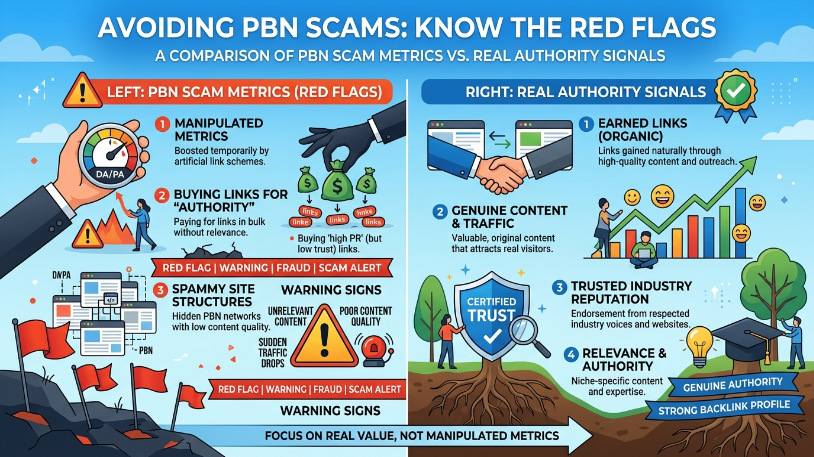
The most common ways sellers inflate or misrepresent authority metrics: DA screenshots without tool attribution or date, DR inflation via network cross-linking between PBN sites, “DA” used to mean a proprietary undefined number, and “High PR” claims referencing a metric Google stopped publishing in 2016. Any seller citing PR as a current metric is either uninformed or deliberately referencing a metric buyers cannot verify.
The DA Screenshot Without the Tool
Sellers sometimes present screenshots of DA numbers without specifying the tool or the date the screenshot was taken. DA changes. A screenshot from eight months ago showing DA45 may reflect a domain that has since been downgraded. Always check live in the tool before purchasing.
DR Inflation via Network Cross-Linking
Within a PBN, it is trivially easy for an operator to link their own sites to each other, artificially inflating DR across the entire network. A seller with 50 PBN sites all cross-linking creates a system where every site shows elevated DR with almost no real external authority. The tell is always zero organic traffic alongside impressive DR.
“DA” Used to Mean Something Else
Some sellers quote a proprietary or undefined “DA” that is neither Moz DA nor Ahrefs DR. This number is invented. Without a tool attribution, any authority metric is unverifiable. Always specify: “Which tool does this number come from?”
High PR Claims
“High PR” — references to Google PageRank — are functionally meaningless. Google stopped publicly updating PageRank scores in 2016. Any seller citing PR as a current metric is either uninformed or deliberately referencing a metric buyers cannot verify. Buy high PR links is a search term from an era when Google published PageRank; in 2026, it should be treated as equivalent to “high authority” with the verification requirements that implies.
What High DA PBN Links Should Realistically Cost
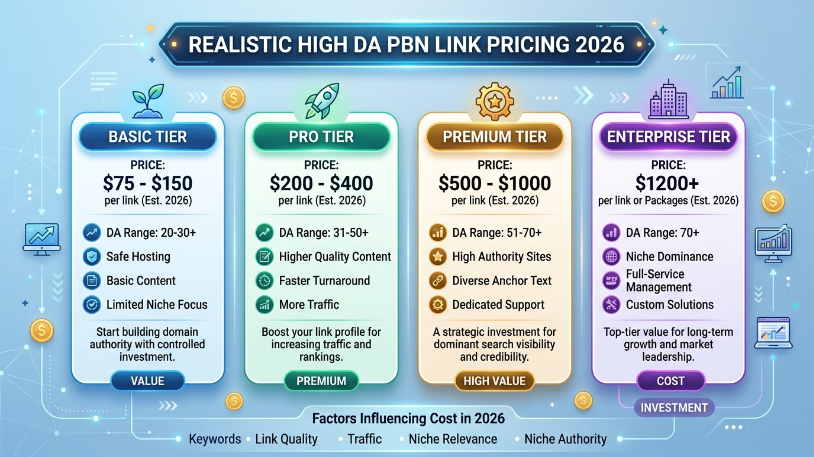
Entry-Level “High DA” Claims: £15–£40
Most sellers in this range are quoting DA20–DA30 or DR20–DR30 domains. If the price is here, the “high” qualifier is relative. You may be getting a legitimate entry-level domain — useful for Tier 2 campaigns — but you are not getting a domain with real organic traffic or a strong TF profile.
This is not necessarily a problem if your campaign goals match the placement type. The issue is when sellers present this range as premium high-authority when it is not.
Genuine Mid-Authority: £40–£100
DR25–DR45 domains with 50–300 monthly organic visits, 20+ real referring domains, and TF18–TF28. This is the realistic floor for placements that genuinely move competitive keyword rankings. Most legitimate “high DA PBN” services price in this range.
Demonstrably High Authority: £100–£250+
DR40–DR60+ domains with consistent organic traffic of 100–500+ monthly visits, strong TF profiles (25–40+), and long domain histories with genuine editorial link profiles. Placements in this range are appropriate for competitive national keywords, finance niches, and high-stakes campaigns where link authority genuinely matters.
Anything above this range enters the territory of specialist broker inventory or particularly strong domains, and is generally justified only for very high-competition campaigns.
| Tier | DR Range | Organic Traffic | Price Range | Best For |
|---|---|---|---|---|
| Entry-level claim | DR15–30 | Minimal or none | £15–£40 | Tier 2, low-competition only |
| Genuine mid-authority | DR25–45 | 50–300/mo | £40–£100 | Direct money site campaigns |
| Demonstrably high authority | DR40–60+ | 100–500+/mo | £100–£250+ | Competitive national keywords |
How to Verify Before Buying
Step 1 — Verify organic traffic in Ahrefs. Any genuine traffic confirms Google trust.
Step 2 — Check Trust Flow in Majestic. Look for TF15+ and TF:CF ratio above 0.4.
Step 3 — Run the Wayback Machine check. Confirm real topically coherent content history.
Step 4 — Apply spam filter to referring domains in Ahrefs. Fewer than 15 genuine referring domains on a claimed high-authority domain is a red flag.
Step 5 — Search site:domain.com in Google. Zero results means deindexed — disqualify immediately.
FAQ
What does DA mean in PBN link selling?
DA most commonly refers to Moz Domain Authority, a third-party metric from 0 to 100 estimating ranking potential based on link profile analysis. It is also sometimes used loosely to mean any domain authority metric including Ahrefs DR. Always ask sellers to specify which tool they are referencing and verify independently before purchasing.
Is DR or DA more reliable for evaluating PBN links?
Ahrefs DR is updated more frequently and harder to game than Moz DA. However, Majestic Trust Flow and organic traffic data are both more meaningful indicators of genuine Google-facing authority than either DA or DR alone.
What is a good DA for a PBN link?
The more useful measure is organic traffic alongside domain authority. A DA20 domain with 80 monthly organic visitors is almost always more valuable than a DA50 domain with zero traffic. Do not let a single metric decide the purchase.
Can I still buy high PR links in 2026?
Google stopped publicly updating PageRank in 2016. Any seller using PR as a current metric is referencing an outdated or unverifiable number. Evaluate using DR, TF, and organic traffic instead.
How do I know if a seller DA claims are genuine?
Check the domain yourself in the tool they cite — Moz for DA, Ahrefs for DR. Then cross-check with organic traffic data. Genuine authority metrics are accompanied by at least some real organic traffic confirming Google trust.
Conclusion
High DA is one of the most misused phrases in the PBN market. DA, DR, and PR are all third-party estimates that can be gamed, inflated, or misattributed. The five-step verification process in this guide — organic traffic, Trust Flow, Wayback Machine, referring domain quality, and Google index check — identifies genuine authority regardless of what metrics a seller highlights. For genuinely high DA PBN links built on verified domains with transparent metrics, explore the available options and apply these checks before every purchase. For a broader strategy view, see our buy backlinks for SEO guide and our PBN domains with backlinks guide.
About the Author
Louis Dobbler is a PBN link building strategist and off-page SEO specialist at BuyPBNBacklinks, with deep expertise in private blog network construction, domain acquisition, and authority link campaigns across iGaming, finance, and SaaS verticals.

Louis Dobbler is a PBN link building strategist and off page SEO specialist with deep expertise in private blog network construction, domain acquisition, and authority link campaigns. With years of experience working across competitive verticals including iGaming, crypto, finance, and CBD, Louis has helped hundreds of SEO agencies and affiliate marketers engineer rankings that hold through every Google core update.
At BuyPBNBacklinks, Louis oversees network quality, domain vetting, and campaign strategy ensuring every PBN backlink placed meets the highest standards for authority, footprint safety, and long term SEO performance.