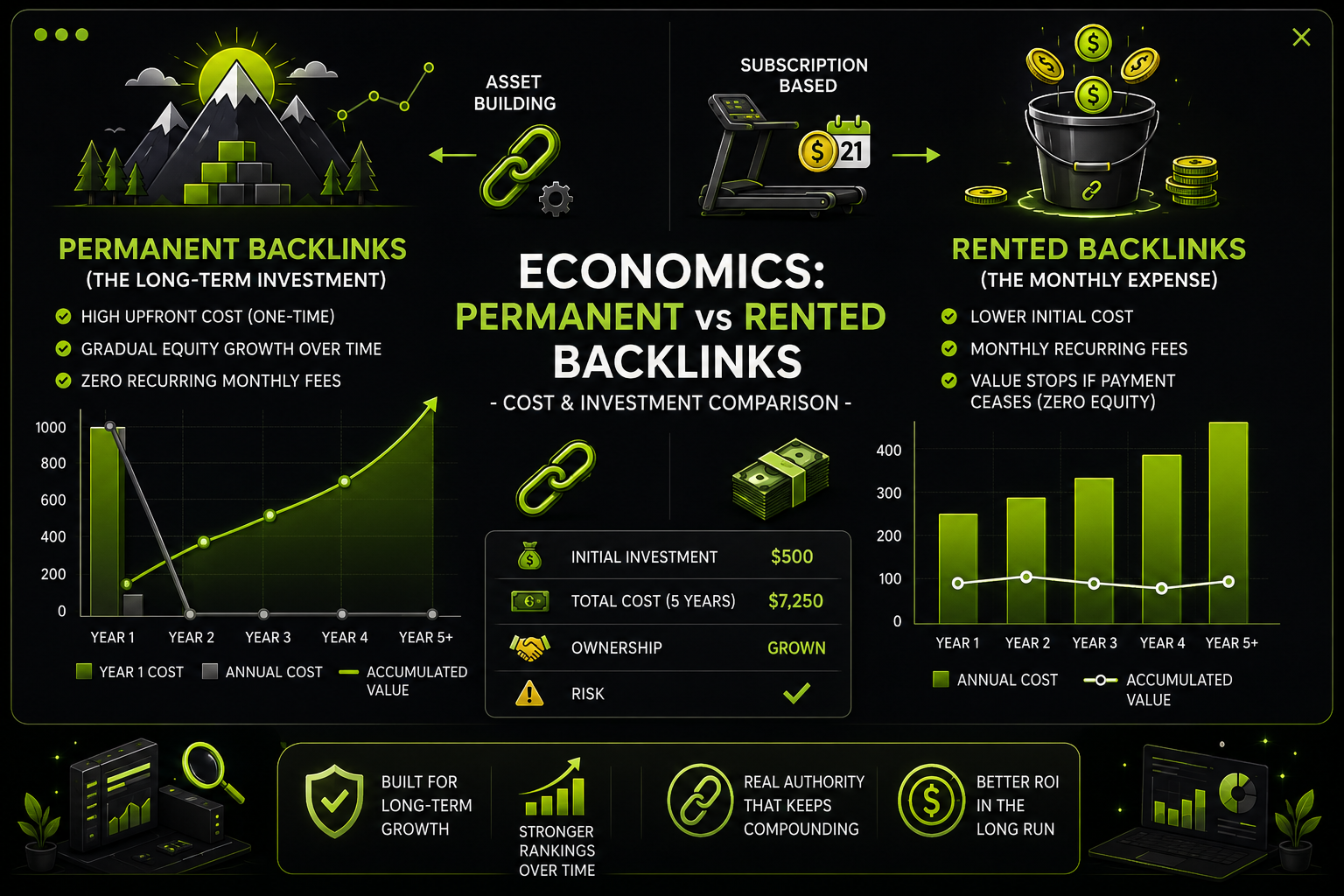
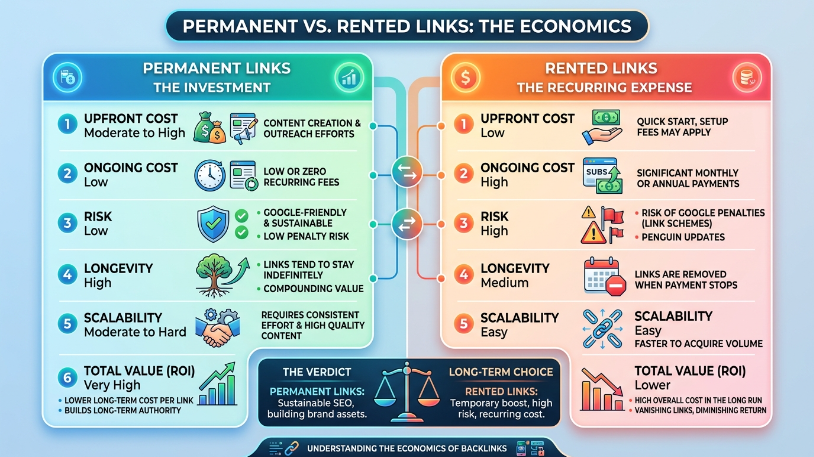
When link buyers compare permanent placements to rented links, the conversation usually starts with price. Buy permanent backlinks costs more upfront. Rented links cost less per month. What the comparison misses is the fundamental economics of link ROI over a 12–24 month campaign horizon. A permanent placement — pay once, link stays live indefinitely — delivers consistently better cost-per-ranking-improvement over time than links that expire when payments stop. This guide makes the economic case with actual numbers, explains how to verify permanence before buying, and gives you specific contract language to request from sellers.
Key Takeaways
- A permanent £80 link is cheaper than a £20/month rental after just 4 months — and continues delivering value at zero ongoing cost.
- “Permanent” must be verified through seller terms, domain registration history, and explicit replacement policies — it is a promise, not a technical guarantee.
- Request explicit contract language covering link lifetime, content preservation, and replacement obligations before any purchase.
- Rented links make sense for short campaigns, budget-constrained testing phases, and campaigns with defined end dates. For a full comparison of both models, see our rent PBN links vs buy PBN links decision guide.
Permanent vs. Rented Links: The Economics
| Permanent Price | Monthly Rental | Break-Even Month |
|---|---|---|
| £50 | £15/month | Month 3.3 |
| £80 | £20/month | Month 4.0 |
| £120 | £25/month | Month 4.8 |
| £200 | £30/month | Month 6.7 |
Beyond the break-even point, every month of continued ranking benefit from a permanent link is effectively free. A permanent link delivering ranking improvements for two years has a true cost-per-month of £3.33 for an £80 placement — a fraction of the rental cost for equivalent ongoing benefit.
Reason 1: Rankings Take Time to Build and Stabilise
A PBN link placed today typically begins showing ranking impact 3–6 weeks later and reaches its full contribution to the link profile over 2–4 months. Rented links that are cancelled during this build-up phase or shortly after it deliver partial benefit at disproportionate cost. Permanent links allow the full benefit to compound over the natural ranking development timeline without the risk of the link disappearing at the wrong moment.
Reason 2: Consistent Link Profiles Earn More Trust Over Time
Google’s algorithms evaluate link profiles not just for current authority but for consistency and stability over time. A link profile that gains and loses links at irregular intervals — as subscription renewals, budget cycles, and service terminations cause rented links to appear and disappear — is more volatile than one built on permanent placements. Stable, long-term link profiles are consistently associated with rank stability through algorithm updates.
Reason 3: Compound Value of Topical Authority
When PBN links are part of a topical authority strategy — multiple articles on related topics all linking to a target page — the compounding of that topical signal is disrupted when links are removed. Permanent placements preserve the topical cluster intact regardless of payment cycles or service provider changes.
How to Verify Permanence Before Buying
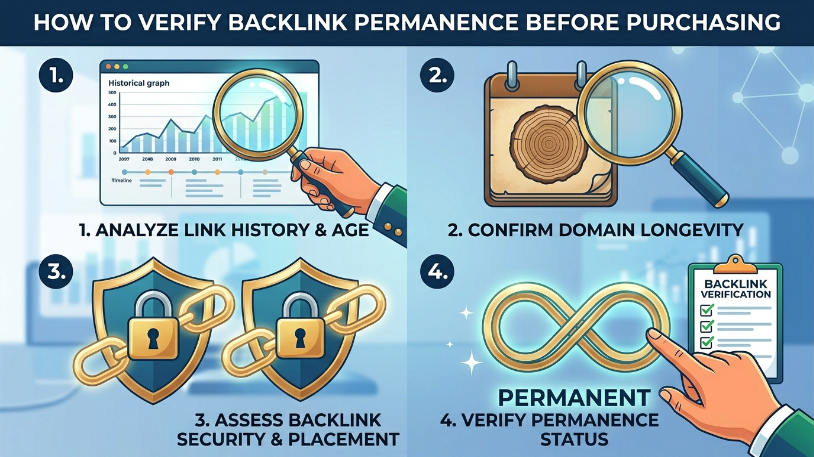
Check 1: WHOIS domain registration expiry — a domain registered through 2028+ indicates deliberate long-term planning. Check 2: Wayback Machine publishing consistency — 2+ years of regular content signals a seller invested in long-term network maintenance. Check 3: request an explicit written guarantee covering minimum lifetime, replacement policy, and what happens if the domain expires. Check 4: review seller domain renewal track record by checking whether sample domains provided previously are still live and maintained.
Check 1: Domain Registration Duration
Look up the domain’s WHOIS record (via who.is or similar). Check when the domain registration expires. A domain registered until 2026 from a “permanent” link service raises a question about what happens at renewal. A domain registered through 2028 or 2030 indicates more deliberate long-term planning by the operator.
Check 2: Active Content Publishing History
Check the Wayback Machine for the domain. A site that has been publishing content consistently for 2+ years is far more likely to remain operational than one rebuilt six months ago. Sellers invested in long-term network maintenance have incentives to keep domains alive — their business model depends on it.
Check 3: Request an Explicit Written Guarantee
Before purchasing any placement labelled “permanent,” ask the seller for their written policy on link permanence. Specifically ask:
- What is the guaranteed minimum lifetime of the placement?
- What happens if the domain expires or the site closes?
- Do they offer replacement links if the original placement goes down?
- Is the placement indexed in their records and can they provide access to verify it remains live?
A legitimate buy permanent backlinks seller will have clear, written answers to all four questions.
Check 4: Review the Seller’s Domain Renewal Track Record
For sellers you are considering for the first time, check whether their sample domains have been maintained consistently. If you can access a list of domains they have provided in the past, check expiry status and site availability. Consistent domain renewal history is the strongest operational signal of genuine permanence commitment.
Check 5: Verify Live URLs Quarterly
Once a placement is live, add a quarterly check to your link monitoring routine. Search site:articleurl in Google or use a link monitoring tool to verify the page remains indexed and your link remains in the content. Document any deindexation events and report them to the seller per their replacement policy.
Contract Language to Request From Sellers
Request these commitments in writing via email before any significant permanent link purchase: placement lifetime (minimum 24 months or domain lifetime), content preservation (article will not be modified or link removed without notification), deindexation replacement (replacement within 30 days at no additional cost), and metrics verification (domain metrics verifiable for 90 days post-delivery).
Recommended Terms to Request in Writing
Placement Lifetime: “This placement will remain live on [domain.com] for a minimum of [24 months / the lifetime of the domain / indefinitely] from the date of delivery.”
Content Preservation: “The article containing the placement will not be substantially modified or have the client link removed for any reason without prior notification to the client.”
Deindexation Replacement: “In the event the article page is deindexed by Google or the domain expires, a replacement placement of equivalent or superior metrics will be provided within [30 days] at no additional cost.”
Metrics Verification: “Domain metrics (DR, TF, organic traffic) cited at time of sale will be available for verification by the client for [90 days] post-delivery.”
Access and Reporting: “The client will receive the live article URL, anchor text confirmation, and indexed status verification within [7 days] of delivery.”
These are reasonable requests that any legitimate permanent link seller should be able to confirm. A seller who refuses to provide written confirmation of these points should be treated as offering a best-efforts placement rather than a genuine permanent one.
When Rented Links Actually Make Sense
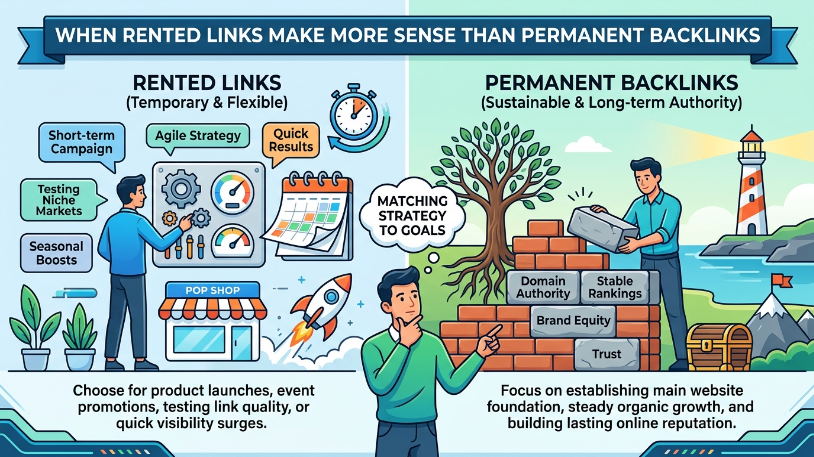
Despite the strong economic case for permanent links, there are specific situations where a rental model is more appropriate.
Short-Duration Campaigns
If a campaign has a defined end date — a product launch, a seasonal event, a 90-day promotional push — renting links for the campaign duration and cancelling afterwards may be more economical than purchasing permanent placements you do not need beyond the campaign window.
Budget-Constrained Testing Phases
When testing whether a page responds to link signals before committing to a permanent link investment, a small number of rented placements for 1–2 months provides the data you need at lower upfront cost. Confirm the page responds, then switch to permanent placements for the sustained campaign.
Cash Flow Constraints for Agencies
For agencies managing multiple client campaigns simultaneously, rental links spread cost over monthly periods rather than concentrating it upfront. The economics favour permanent links in aggregate, but monthly billing may better match client payment cycles and agency cash flow.
What to Look for in Buy Blog Links Opportunities
“Blog links” as a category encompasses both PBN blog post links and editorial guest posts on real blogs. Within this category, the characteristics that most reliably predict permanent, high-performing placements are:
Active publishing cadence: A blog that publishes new content monthly or more frequently is a healthier, more permanent host environment than one that was last updated in 2022.
Real organic traffic to the domain: Traffic confirms Google’s active interest in the site. Sites with traffic are less likely to be abandoned or allowed to expire.
Content coherent with your target niche: A link to a finance site placed within a clearly finance-focused article on a finance-focused blog is both more topically valuable and more likely to be maintained long-term than a generic placement.
Operator with a visible commercial stake in the network: Sellers who are publicly building a content publishing business have more incentive to maintain their domains than those selling anonymously with no visible operational stake.
FAQ
How long does a permanent PBN backlink actually last?
This depends on the seller and their domain management practices. On a well-maintained domain, indefinitely. On a poorly managed network, it may disappear when the domain expires in 6–12 months. Verify permanence before buying.
Are permanent backlinks more expensive than rented ones?
Upfront yes, but cheaper over 12+ months. The break-even point for most comparable placements is 3–6 months. Beyond that point, permanent links are always cheaper on a cost-per-month basis.
What should I do if a permanent link goes down?
Contact the seller immediately and reference the replacement policy confirmed before purchase. Document the deindexation date and escalate via your payment method if the seller is unresponsive.
Can I verify permanence before buying?
Yes — through domain registration duration checks, content publishing history, written replacement commitment, and the seller track record. These checks significantly reduce risk.
Is buying blog links the same as buying permanent backlinks?
Not necessarily. Always specify whether you want a permanent one-time placement or a subscription arrangement and confirm the seller specific permanence policy.
Conclusion
The case for permanent backlinks is fundamentally economic: past the break-even point, every month of continued ranking benefit is free. For a complete overview of how this fits into a broader paid link strategy, see our buy backlinks for SEO guide. The verification framework transforms “permanent” from marketing language into a contractually supported expectation. For permanent PBN backlinks on well-maintained domains with explicit replacement policies and full delivery documentation, explore the available options.
About the Author
Louis Dobbler is a PBN link building strategist and off-page SEO specialist at BuyPBNBacklinks, with deep expertise in private blog network construction, domain acquisition, and authority link campaigns.

Louis Dobbler is a PBN link building strategist and off page SEO specialist with deep expertise in private blog network construction, domain acquisition, and authority link campaigns. With years of experience working across competitive verticals including iGaming, crypto, finance, and CBD, Louis has helped hundreds of SEO agencies and affiliate marketers engineer rankings that hold through every Google core update.
At BuyPBNBacklinks, Louis oversees network quality, domain vetting, and campaign strategy ensuring every PBN backlink placed meets the highest standards for authority, footprint safety, and long term SEO performance.