Affiliate SEO is a link building arms race. The sites ranking in top positions for commercial keywords like “best project management software,” “top VPN for 2026,” or “cheapest car insurance comparison” are not there because their content is marginally better than the next result — they are there because their link profiles are stronger. For affiliate marketers competing in commercial SERPs where every top-three position is contested by well-funded sites, understanding exactly how to use PBN links for affiliate sites is not optional knowledge — it is a core operational skill. This guide covers the specific affiliate strategy differences that make PBN link building more effective for review and comparison content, which pages to prioritise, how to structure anchor text for commercial affiliate keywords, and how to build the topical authority clusters that support sustainable affiliate rankings.
Why PBN Links Are the Primary Link Building Tool for Most Affiliate Sites
Affiliate sites face a structural link building challenge that makes PBN links not just useful but often the primary viable strategy: the content is commercial by design, which makes editorial outreach structurally difficult.
Editorial sites with real audiences are generally reluctant to link to affiliate review pages because those pages are clearly monetised and the editors know their readers can identify sponsored or affiliate-motivated recommendations. Guest post services that work well for informational content frequently decline affiliate review pages. The result is that affiliate sites with budgets for outreach typically find acceptance rates well below what non-commercial content achieves.
PBN links solve this structural problem directly. The seller controls the content and the placement — your affiliate review page gets a quality contextual link regardless of whether it is monetised, regardless of the commercial intent of the page it links to, and with full anchor text control that matches your commercial keyword strategy. For most affiliate niches, PBN links form the backbone of any effective link building programme.
Affiliate Site Architecture and Link Priority
Before building a single link, understanding your affiliate site architecture determines which pages to target and in what order. Affiliate sites typically follow one of three content structures, and each requires a slightly different link building approach.
Structure 1 — Review-Led Sites
The majority of pages are individual product or service reviews. A hub comparison page (“best X of 2026”) links to individual review pages. Revenue comes from clicks on affiliate CTAs within individual reviews.
Link priority: Hub comparison page first — this is typically the highest-value commercial keyword and the page most directly tied to revenue. Individual review pages second, prioritising the reviews for the highest-commission products. Use internal links from newly ranked hub pages to distribute authority to individual reviews once the hub is competitive.
Structure 2 — Comparison-Led Sites
The primary content is head-to-head comparisons: “X vs Y,” category roundups, and ranked lists. Revenue comes from clicks on comparison tables and affiliate links within rankings.
Link priority: Primary category comparison page first, then secondary comparison pages for the most commercially valuable sub-niches. These pages benefit most from topical authority cluster building — multiple PBN articles covering related comparison topics all pointing to the primary comparison page.
Structure 3 — Informational-Plus-Commercial Sites
A mix of informational guides (how to choose X, what is Y) and commercial review pages. Informational content drives traffic and topical authority; commercial pages convert.
Link priority: Commercial review and comparison pages first for direct revenue impact. Informational hub pages second, specifically the ones that internally link to multiple commercial pages — ranking these amplifies the entire commercial cluster through internal link equity distribution.
The Affiliate Topical Authority Cluster Strategy
The most effective long-term PBN strategy for affiliate sites is not building isolated links to individual review pages — it is constructing a topical authority cluster that signals to Google that your site is a comprehensive, authoritative source on the entire topic category.
How a Topical Cluster Works for Affiliates
A software review affiliate targeting “best project management software” builds a cluster like this:
- Hub page: Best Project Management Software 2026 (primary commercial keyword — primary link target)
- Supporting reviews: Individual reviews of top tools (secondary link targets)
- Informational guides: How to choose project management software, project management for small teams, Agile vs Waterfall comparison (topical authority builders)
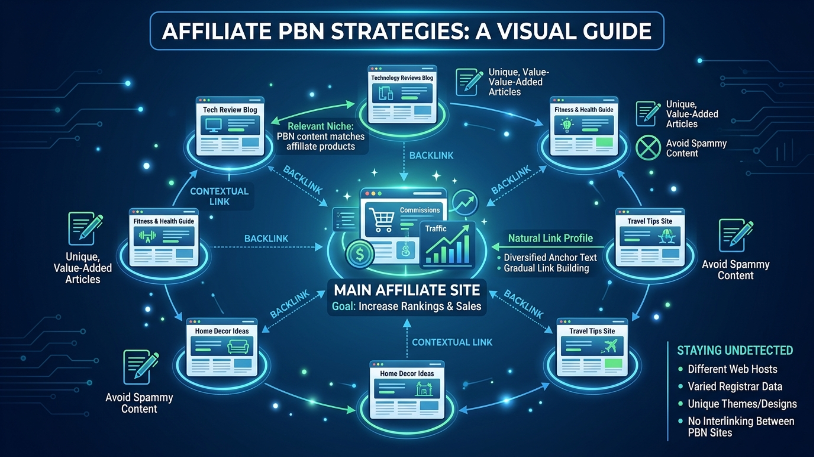
PBN links point to all layers of this cluster — not just the hub. Articles on PBN network domains covering software topics link to the hub page with commercial anchors and to the informational guides with topical anchors. The resulting topical signal tells Google that your site deserves to rank for project management software topics comprehensively, not just for one isolated keyword.
This cluster approach is significantly more effective than building all links to one page. Ten links distributed across a five-page topical cluster typically outperform ten links concentrated on one page for cluster-level keyword rankings, because topical authority is a cluster-level signal rather than a page-level one.
Anchor Text Strategy for Affiliate PBN Links
Affiliate anchor text strategy requires balancing commercial keyword relevance against over-optimisation risk. Affiliate niches are commercially motivated — Google knows this and applies additional scrutiny to commercial anchor patterns in affiliate-heavy SERPs.
Affiliate Anchor Text Distribution
| Anchor Type | Target % | Affiliate Examples |
|---|---|---|
| Branded | 25–35% | Site name, site name + review, site domain |
| Topical / review context | 20–25% | honest VPN review, software comparison guide, best tools roundup |
| Partial match commercial | 15–20% | best project management tools, top VPN services compared |
| Generic | 15–20% | read more, see full review, click here, visit site |
| Naked URL | 5–10% | https://youraffiliatsite.com/best-vpn |
| Exact match commercial | 5–10% | best VPN 2026, cheapest car insurance UK |
The key difference from standard campaigns: topical and review-context anchors (honest review, comparison guide, software roundup) are naturally higher in affiliate profiles because review site editors use these phrases when referencing affiliate-style content. This allows the topical anchor category to carry more of the keyword relevance load without triggering over-optimisation signals that pure exact-match commercial anchors would.
PBN Links vs Other Link Types for Affiliate Sites
| Link Type | Affiliate Effectiveness | Availability | Cost | Notes |
|---|---|---|---|---|
| Quality PBN links | High | High | £35–£150 | Primary volume layer — full anchor control |
| Niche edits on review sites | Very High | Medium | £50–£200 | Best for authority injection on aged review content |
| Editorial guest posts | High | Low for commercial content | £100–£500 | Difficult to place affiliate-style content on quality sites |
| Resource page links | Medium | Low | £0 (time cost) | Useful for informational pages, not commercial |
| HARO and PR links | Low–Medium | Variable | £0 (time cost) | Works for brand mentions, not commercial review links |
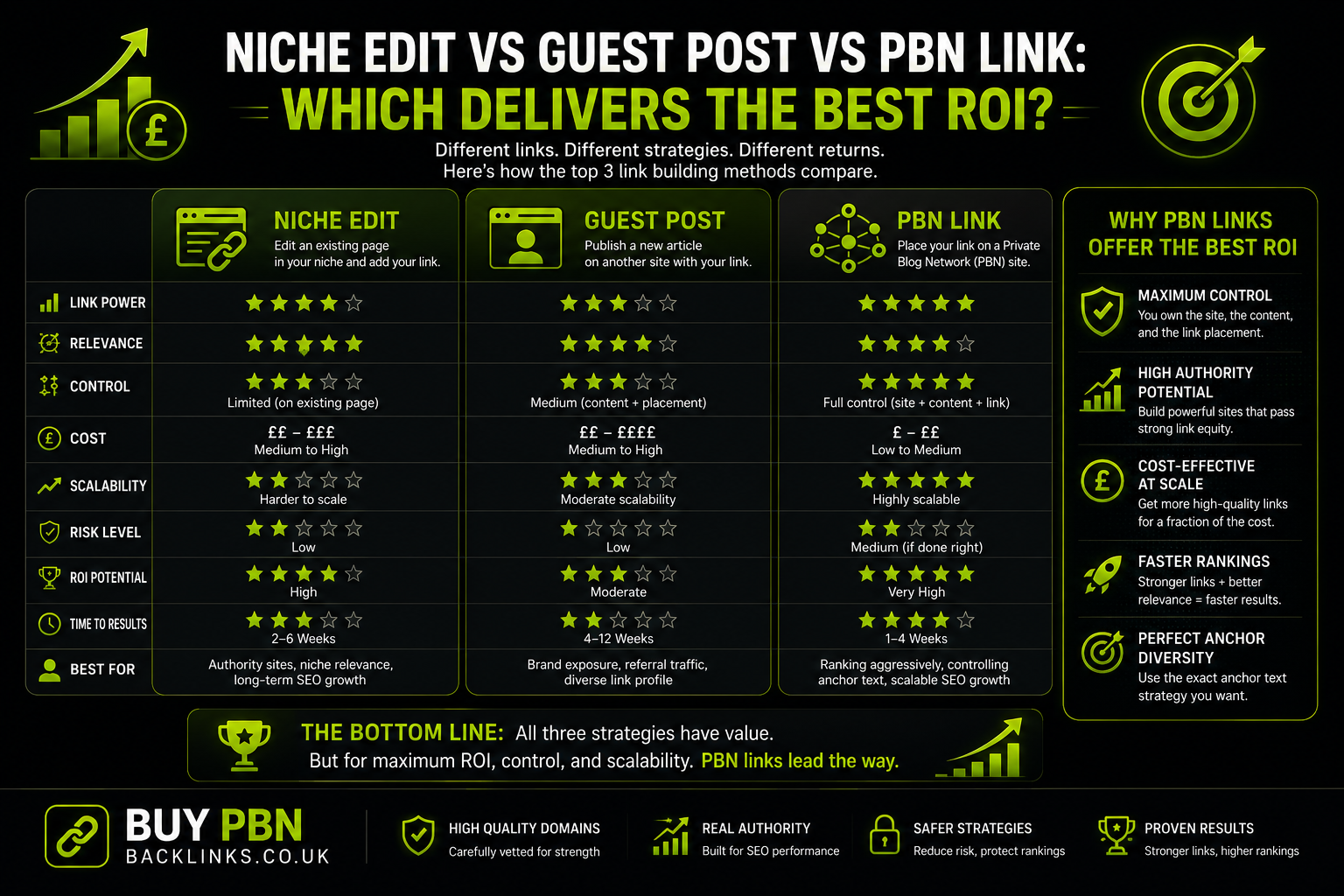
The combination that works best for most affiliate sites: PBN links as the primary volume and anchor control layer, supplemented by niche edits on aged review content for authority injection, and occasional editorial guest posts on industry publications for profile credibility. For a detailed comparison of these link types see our niche edit vs guest post vs PBN comparison.
Niche-Specific Affiliate PBN Strategies
Software and SaaS Affiliate
Software affiliate is one of the most competitive affiliate categories. Established review sites like G2, Capterra, and Trustpilot dominate generic software searches, while niche-specific comparison sites compete for category terms. PBN link building for software affiliates should focus on category comparison keywords (“best CRM for small business,” “project management software comparison”) rather than brand-specific review keywords where the software vendor itself typically dominates.
Domain targeting tip: For software affiliate, PBN domains with technology or business content histories pass more topically relevant authority than general interest domains. Use our PBN domain sourcing guide to find domains with technology or B2B content histories.
Finance Affiliate (Insurance, Loans, Credit Cards)
Finance affiliate is YMYL territory — Google applies higher scrutiny to link profiles for financial product comparison sites. This means quality standards are higher and volume without quality is more likely to trigger algorithmic review. For finance affiliate sites, prioritise DR 30 plus domains with genuine traffic and Trust Flow above 20. Budget £80 to £180 per placement and never exceed 8 percent exact-match anchor concentration on financial keywords.
The finance affiliate niche is also one where niche edits on aged financial content pages deliver disproportionate authority — an aged personal finance article from 2019 with its own backlinks is a highly valuable Tier 1 placement for a finance comparison affiliate.
Consumer Electronics and Product Reviews
Consumer electronics affiliate is highly seasonal — ranking improvements need to be in place before peak shopping periods (Black Friday, Christmas, back to school). This makes link velocity planning critical: build links three to four months before the seasonal peak to allow full indexation and ranking impact to materialise. For e-commerce adjacent affiliate content see our buy backlinks for SEO guide which covers seasonal campaign planning.
VPN and Privacy Affiliate
VPN affiliate is one of the most link-saturated niches online. Top-ranking VPN comparison sites have thousands of referring domains from years of aggressive link building. New entrants need a sustained 12 to 18 month link building programme at mid-tier volume to compete. PBN links provide the volume and anchor control that makes this competitive entry feasible at realistic budgets. Focus on sub-niche VPN keywords (“best VPN for streaming,” “cheapest VPN UK 2026”) rather than broad head terms until sufficient domain authority is established.
Building for E-Commerce Affiliate and Product Categories
E-commerce affiliate sites — those comparing physical products and driving traffic to Amazon, ASOS, or direct retail — benefit from PBN links in a slightly different way than pure digital product affiliates. Product category pages (“best running shoes under £100,” “top robot vacuums 2026”) respond strongly to topically relevant PBN links written about the product category, because the surrounding article provides specific product category context that generic link placements cannot.
For e-commerce affiliate PBN link building:
- Brief PBN articles to cover the specific product category — not just a general interest article with your link dropped in
- Use partial-match product category anchors (“best running shoes review,” “robot vacuum comparison”) rather than branded anchors as the primary anchor type
- Target your comparison hub pages and best-of roundups rather than individual product review pages
- Build links to seasonal content (Black Friday best deals, Christmas gift guides) 60 to 90 days before the seasonal window
Affiliate Site Link Building Timeline
| Month | Focus | Links | Anchor Mix |
|---|---|---|---|
| 1–2 | On-page audit, cluster architecture, baseline tracking | 0–3 citations | Branded only |
| 3–4 | Primary money page link building begins | 4–6 PBN links | Branded 50%, generic 30%, topical 20% |
| 5–6 | Topical cluster building around primary hub | 6–10 PBN links | Topical 30%, partial-match 25%, branded 30%, generic 15% |
| 7–8 | Secondary money page + niche edit injection | 8–12 mixed | Introduce selective exact-match below 8% |
| 9–12 | Scale based on ranking data, gap analysis vs competitors | 10–20 mixed | Full distribution per anchor framework above |
Tracking Affiliate PBN Campaign Performance
Affiliate sites have two trackable success metrics that standard campaigns lack: keyword rankings and affiliate revenue. Both should be tracked from campaign start.
Keyword rank tracking: Track primary commercial keywords weekly. Most affiliate sites have five to fifteen primary commercial keywords that directly drive revenue — these are your primary success metrics. Also track the informational cluster keywords to monitor topical authority development.
Revenue correlation: Record affiliate revenue weekly. When ranking movements occur, correlate them with revenue changes. This produces a dollar-per-ranking-position metric that directly justifies link building investment and helps prioritise which keywords to target next based on revenue per position improvement.
Traffic share analysis: Use Google Search Console to monitor impression and click share for your primary keywords. Position three typically earns five to eight percent click-through rate; position one earns twenty-five to forty percent. The revenue difference between position five and position one on a high-volume affiliate keyword often justifies significant link building investment.
FAQ
Do PBN links work for affiliate sites?
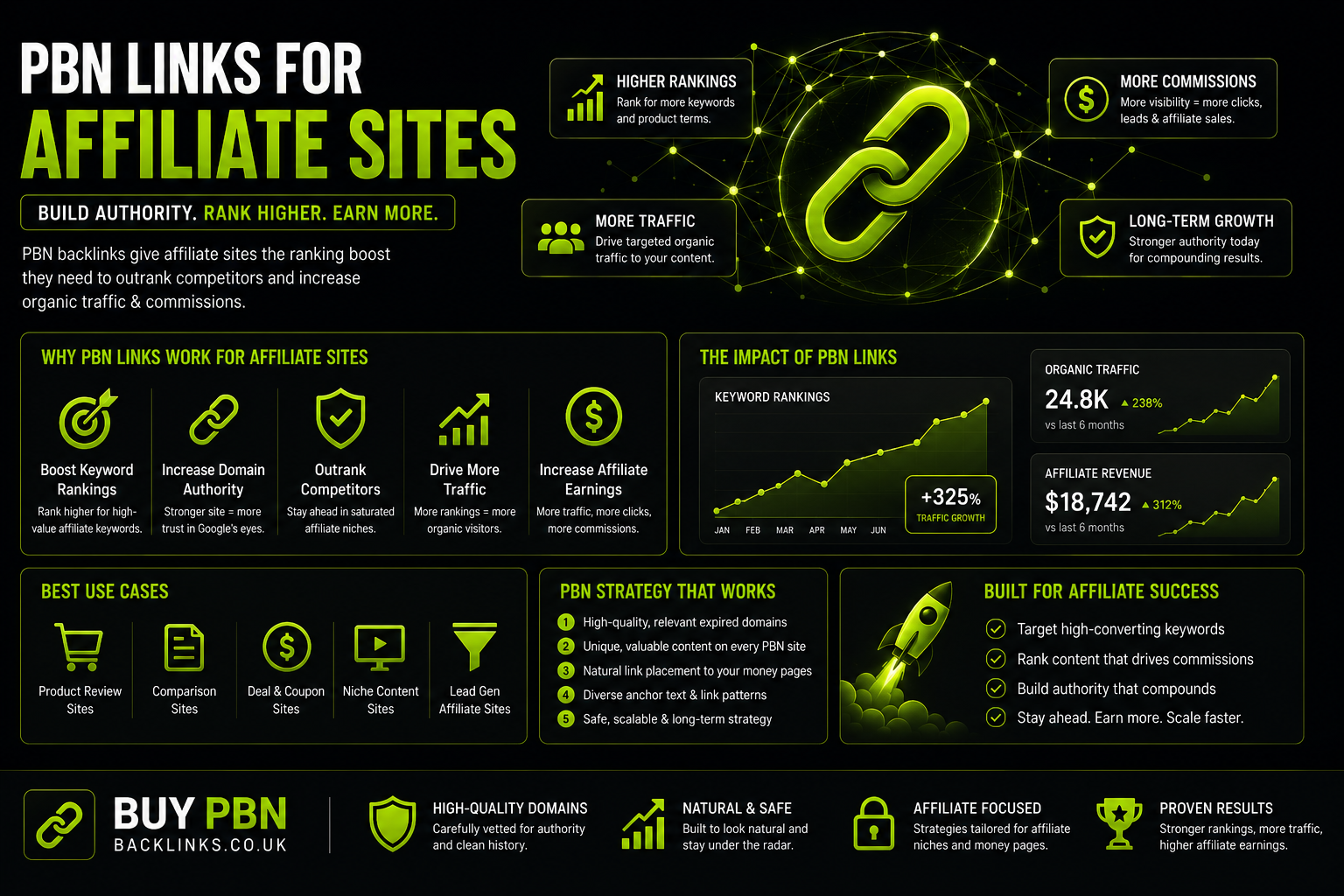
Yes. PBN links are particularly effective for affiliate sites because editorial outreach acceptance rates for commercial review content are structurally low. PBN links provide the full anchor control, topical relevance, and volume that affiliate commercial SERPs require at costs that make campaigns economically viable.
Which affiliate pages should I build PBN links to first?
Primary money pages — your highest-value commercial review and comparison pages — first. These deliver direct revenue impact from ranking improvements. Informational hub pages second, prioritising those that internally link to multiple commercial pages to amplify authority distribution across the cluster.
What anchor text should I use for affiliate PBN links?
Branded (25–35%), topical and review-context (20–25%), generic (15–20%), partial-match commercial (15–20%), naked URL (5–10%), and exact-match commercial (5–10%). Review-context anchors like “honest VPN review” or “software comparison guide” carry commercial relevance without the over-optimisation risk of pure exact-match commercial anchors.
How many PBN links does an affiliate site need to rank?
For KD under 25 affiliate keywords: ten to twenty quality links across a topical cluster within three to five months. High-competition affiliate niches: fifty or more links across an extended topical authority campaign. Always benchmark against top-three competitor referring domain counts before setting volume targets.
Should I build PBN links to review pages or informational pages first?
Review pages first — they directly generate affiliate commissions. Informational pages second, specifically those that internally link to multiple commercial pages. Building informational page authority amplifies the entire commercial cluster through internal link equity distribution.
Can Google penalise affiliate sites for using PBN links?
The same risk management principles apply as for any paid link campaign: quality domains with genuine organic traffic, natural anchor distribution, controlled velocity, and human-written topical content. Affiliate niches face slightly more scrutiny due to commercial motivation, but quality PBN campaigns managed with proper risk controls are not penalised at materially higher rates than other site types.
Conclusion
PBN links are the primary link building tool for most affiliate sites because they solve the structural access problem that makes outreach ineffective for commercial review content. The strategy in this guide — topical cluster targeting, commercial anchor distribution balanced with review-context and branded anchors, money page prioritisation, and niche-specific quality standards — gives affiliate marketers a repeatable link building framework that compounds in effectiveness over a twelve-month campaign horizon.
The affiliate sites that rank consistently and stably in competitive commercial SERPs are not waiting for editorial links that may never arrive — they are building deliberate, quality-controlled PBN campaigns that construct the topical authority and link equity their commercial keywords require. Apply the cluster strategy and anchor framework in this guide from your first placement and you will build a link profile that supports both current commercial rankings and long-term topical authority.
For quality PBN links for affiliate sites — with full anchor text control, topically relevant domain matching, indexed delivery confirmation, and detailed placement reports — explore the available options and apply the affiliate cluster strategy from this guide before every campaign build.
About the Author
Louis Dobbler is a PBN link building strategist and off-page SEO specialist at BuyPBNBacklinks, with deep expertise in private blog network construction, domain acquisition, and authority link campaigns across iGaming, finance, and SaaS verticals.

Louis Dobbler is a PBN link building strategist and off page SEO specialist with deep expertise in private blog network construction, domain acquisition, and authority link campaigns. With years of experience working across competitive verticals including iGaming, crypto, finance, and CBD, Louis has helped hundreds of SEO agencies and affiliate marketers engineer rankings that hold through every Google core update.
At BuyPBNBacklinks, Louis oversees network quality, domain vetting, and campaign strategy ensuring every PBN backlink placed meets the highest standards for authority, footprint safety, and long term SEO performance.