The three most common paid link types niche edits, guest posts, and PBN links are frequently discussed as if one is obviously superior to the others. In reality, each has specific strengths, specific weaknesses, and specific contexts where it outperforms the alternatives. This guide does not pick a winner in the abstract. Instead it gives you a precise, criteria-based framework for deciding which type to use, when, for which campaign context, and at which budget level. If you have been using only one link type across all your campaigns, this guide will almost certainly improve your results and your cost per ranking improvement.
Definitions: What Each Link Type Actually Is
Niche Edit
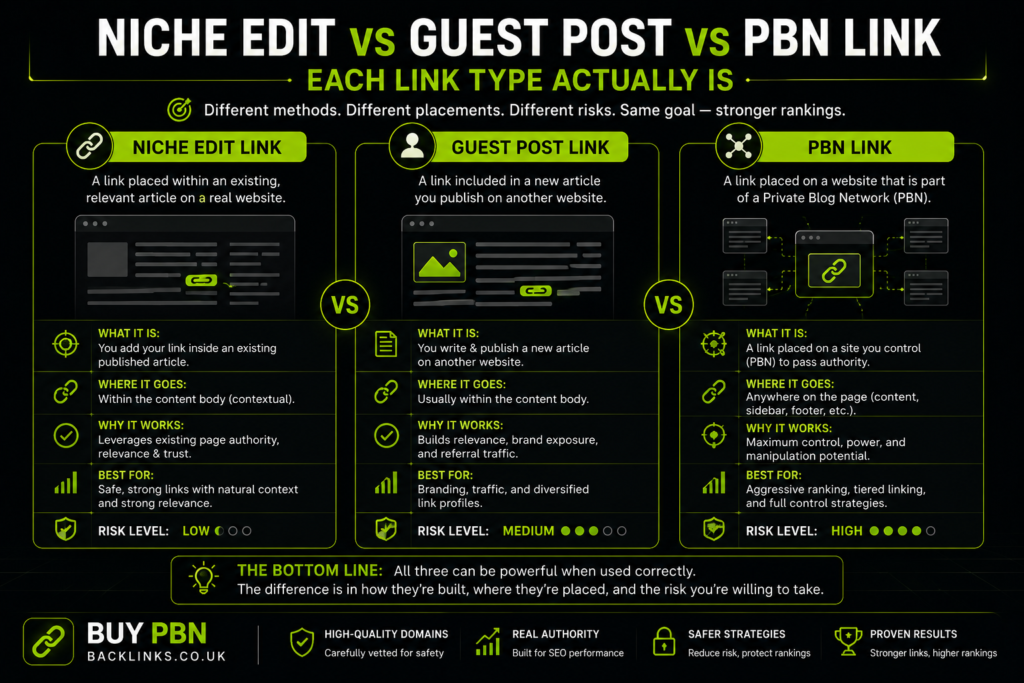
A niche edit — also called a link insertion — places your link inside an existing, already-published article on a third-party website. The article was written and published before you arrived. Your link is inserted contextually into the existing text, either by rewriting a sentence to accommodate it or by adding a short passage. The page is already indexed and may already have its own backlinks, giving your link immediate access to accumulated page-level authority.
Guest Post
A guest post is a newly written article you or a writer produces and publishes on a third-party website. The article is created specifically for the placement and your link appears within it. You have more influence over the surrounding content than in a niche edit, but the article starts with zero backlinks of its own and must go through the full indexation cycle before your link begins passing authority.
PBN Link
A PBN link is placed inside a newly written article published on a domain within a private blog network — a collection of sites operated specifically to provide link placements. You control the anchor text, article topic, and timing precisely. The host domain has accumulated authority from its own backlink history. For a full explanation see our guide on what is a PBN link.
The Three-Way Comparison Table
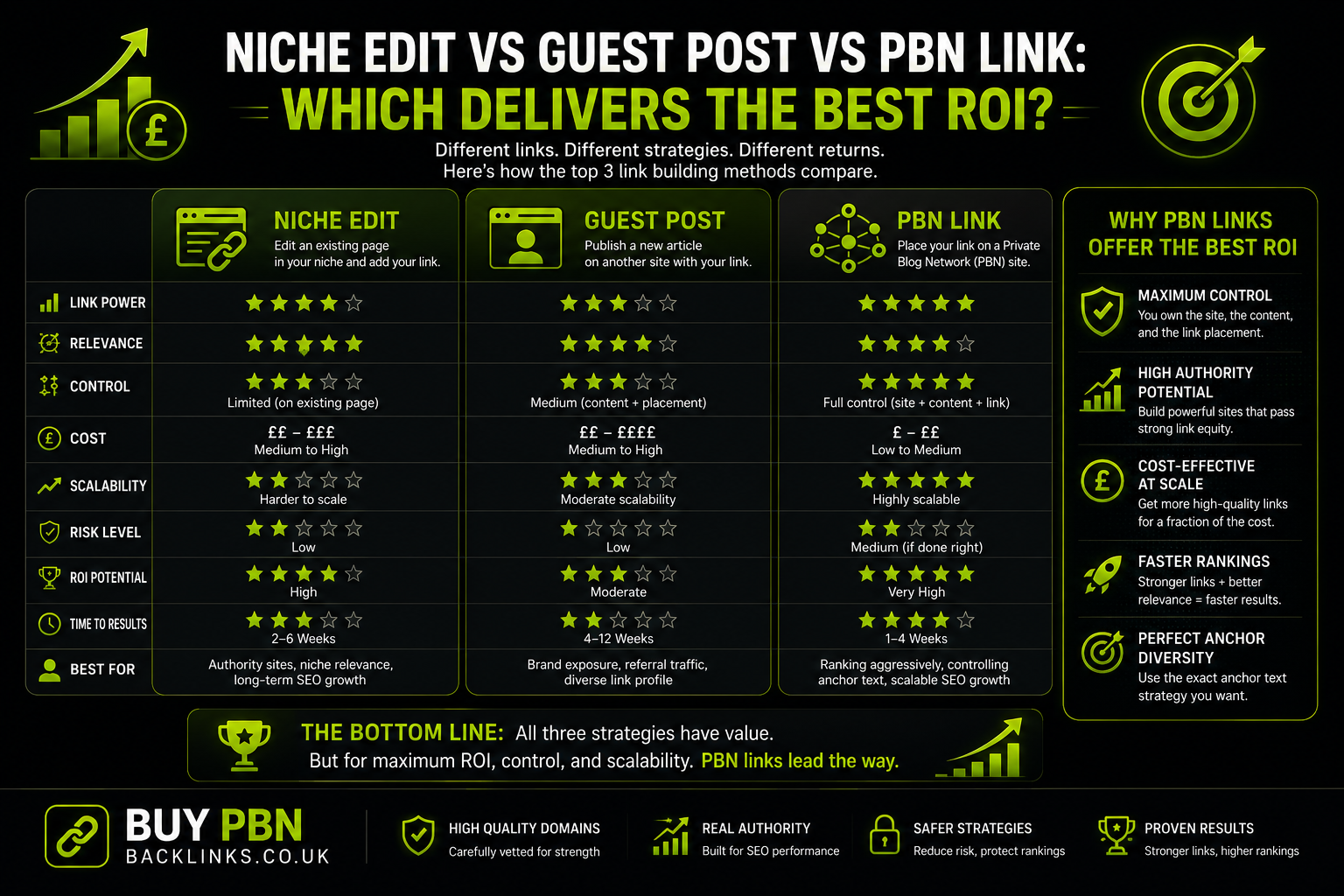
| Dimension | Niche Edit | Guest Post | PBN Link |
|---|---|---|---|
| Anchor text control | Limited — must fit existing text | Good — written around your anchor | Full — article built around anchor |
| Topical context control | Limited — existing content dictates | Good — you write or brief the article | Full — topic specified in brief |
| Speed to ranking impact | Fastest — already indexed | Slower — new article must index | Medium — new article must index |
| Page-level authority | High potential — aged page may have own backlinks | Low initially — new page starts fresh | Medium — domain authority, new page |
| Scalability | Medium — depends on available inventory | Low-Medium — editor approval required | High — available on demand |
| Cost at equivalent DR | Medium — £30–£300 | Highest — £80–£600+ | Lowest — £20–£250 |
| Niche availability | Medium — depends on existing content | Low — many niches refused | High — most niches available |
| Algorithmic risk | Low–Medium | Lowest on genuine editorial sites | Medium — managed by quality |
| Permanence | Variable — depends on site stability | Variable — depends on site stability | Controllable — seller replacement policy |
Cost Per Link Comparison at Equivalent Metrics
| Quality Tier | Niche Edit | Guest Post | PBN Link |
|---|---|---|---|
| Entry (DR 15–25) | £30–£70 | £60–£150 | £15–£45 |
| Mid (DR 25–40) | £70–£180 | £120–£350 | £45–£120 |
| Premium (DR 40–60+) | £180–£400+ | £300–£700+ | £120–£300 |
At every quality tier, PBN links are consistently the most cost-effective option. Guest posts are the most expensive — partly because they require original content creation, partly because editorial sites price in their audience value and acceptance selectivity. Niche edits sit in the middle, reflecting the aged page authority premium over new PBN content combined with lower cost than full guest post production.
Speed to Ranking Impact
Niche Edits — Fastest
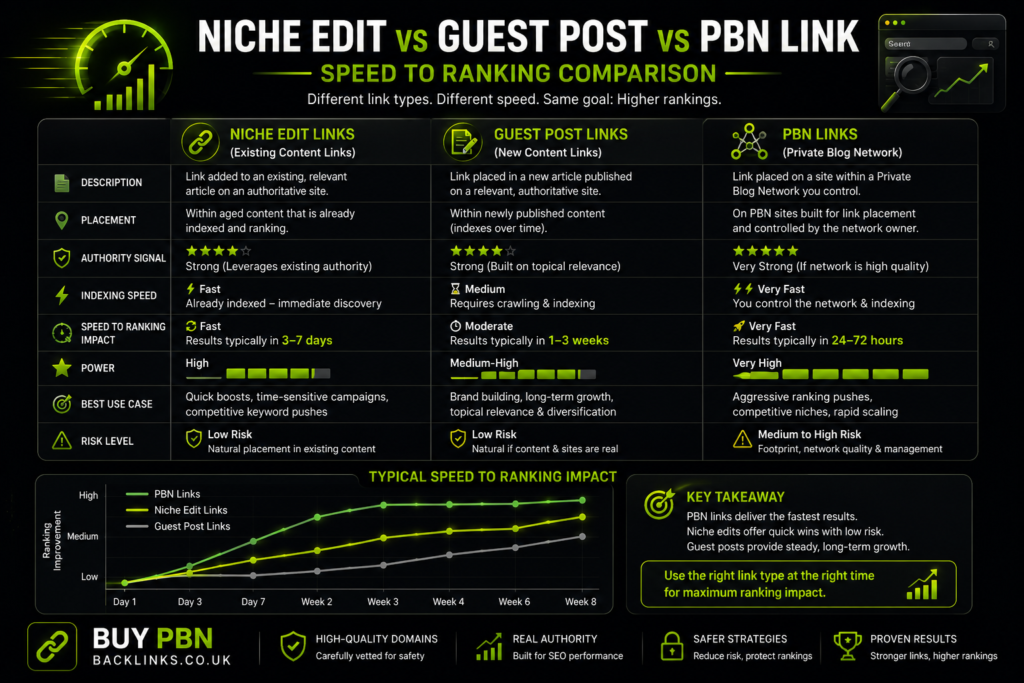
A niche edit placed on an already-indexed page takes effect as soon as Google next crawls that page — typically within 1–2 weeks for active sites with regular crawl schedules. The page is already in Google index, already evaluated for quality, and already accumulating any page-level authority it has. Your link is processed in the next crawl cycle without the indexation waiting period of new content.
PBN Links — Medium Speed
A PBN blog post link requires the new article to be indexed before the link begins passing authority. On well-maintained PBN domains with regular content publishing and active crawl schedules, new articles typically index within 3–10 days. Add 1–2 weeks for Google to process the new link signal and most quality PBN placements begin affecting rankings 3–4 weeks after going live.
Guest Posts — Slowest
Guest posts face the longest timeline: editorial approval and revisions (1–4 weeks), publication, then indexation (1–2 weeks), then ranking signal processing (1–2 weeks). End-to-end, a guest post campaign can take 6–10 weeks from outreach to first ranking impact. For campaigns with deadlines, this timeline is a significant constraint.
When Each Link Type Wins
Niche Edits Win When:
Speed is the priority. Time-sensitive campaigns — product launches, seasonal peaks, competitive responses — benefit from niche edits fastest-to-impact timeline. If you need rankings to move in the next four weeks, niche edits give you the best chance.
Aged page authority is needed. For pages competing against well-established editorial content in high-authority SERPs, a niche edit on an aged page with its own backlink profile delivers concentrated page-level authority that a new PBN article cannot immediately match at the same price point.
Affiliate and review pages. Review and comparison pages in competitive niches tend to respond well to authority injection from aged editorial content — niche edits on established review articles in the same category carry strong topical relevance alongside the authority signal.
Guest Posts Win When:
Genuine editorial credibility is the goal. A guest post on a real, high-traffic editorial site with a genuine audience carries trust signals that no PBN placement can replicate. For YMYL niches — finance, health, legal — where Google evaluates E-E-A-T signals carefully, genuine editorial placements contribute to the site credibility profile in ways that go beyond raw link equity.
Long-form content surrounding your link matters. In niches where Google evaluates the quality and depth of the content surrounding your link, a well-written guest post with 1,000+ words of relevant expert content provides a stronger contextual signal than a shorter PBN article.
Budget is not constrained and outreach relationships are available. When you have access to editorial sites in your niche and the budget to justify the premium, guest posts in high-authority publications contribute disproportionately to the top layer of your link profile. A small number of genuine editorial links alongside quality PBN mid-tier links is a stronger profile combination than either type alone.
PBN Links Win When:
Full anchor text control is required. In niches where anchor text strategy is critical — gambling, finance, legal, competitive affiliate — PBN links give you the precision that niche edits and guest posts cannot reliably match. You specify the exact anchor and it is placed in a sentence built around it, not forced into existing text.
Volume is needed at scale. Building 50+ quality links through niche edits or guest posts in a competitive niche within a reasonable timeframe is practically very difficult. PBN links at mid-tier quality can deliver that volume within weeks at costs that make the campaign economically viable.
Restricted niches with low editorial acceptance. For iGaming, CBD, cryptocurrency, adult, and other verticals where editorial outreach has structural rejection rates above 90%, PBN links fill the gap that guest posts simply cannot reach. For a detailed iGaming-specific analysis see our guide on buy casino backlinks.
New sites need foundational authority quickly. As covered in our link building for new websites guide, PBN links provide the fastest controllable authority foundation for sites without the editorial credibility to earn guest posts from quality publishers.
E-commerce category and local SEO pages. These page types benefit most from topical authority signals — PBN articles written specifically about a product category or local service area provide precise topical context that generic guest posts on unrelated sites cannot match.
ROI Analysis by Niche Type
| Niche | Best Primary Type | Best Secondary Type | Avoid |
|---|---|---|---|
| Local SEO (tradespeople, services) | PBN links (geographic anchors) | Citations and directories | Expensive guest posts (poor ROI at local scale) |
| E-commerce category pages | PBN links (product topical content) | Niche edits on review pages | Generic guest posts with no product relevance |
| Affiliate review and comparison | Niche edits (aged review authority) | PBN links (topical cluster) | Low-DR guest posts on unrelated blogs |
| SaaS and B2B technology | Guest posts (editorial credibility) | PBN links (mid-layer volume) | Cheap bulk links of any type |
| iGaming and gambling | PBN links (only viable option at scale) | Niche edits on gambling content | Standard guest post outreach (90%+ rejection) |
| Finance and legal (YMYL) | Guest posts + PBN combined | Niche edits on finance content | Low-quality anything — E-E-A-T penalties severe |
| CBD and restricted niches | PBN links (editorial outreach fails structurally) | Niche edits on health content | Guest post outreach (near-universal refusal) |
| New websites (months 1–6) | PBN links (controllable foundation) | Citations for trust signals | Expensive guest posts before site has credibility |
The Decision Framework: Choosing the Right Link Type
| Situation | Recommended Type | Reason |
|---|---|---|
| Speed is critical (under 4 weeks) | Niche edit | Already indexed, fastest to impact |
| Full anchor text control essential | PBN link | Article built around your anchor |
| Budget is tight, volume needed | PBN link | Lowest cost per placement at any tier |
| Aged page authority injection | Niche edit | Page history and accumulated equity |
| Editorial credibility for YMYL | Guest post | Genuine E-E-A-T signal from real editorial |
| Restricted niche (gambling, CBD) | PBN link | Only viable option at meaningful scale |
| Building topical content cluster | PBN link | New articles on specified topics |
| Competitive national keyword | All three combined | Diversified profile with all authority signals |
| Local SEO campaign | PBN link with geo anchors | Geographic context in article content |
| Affiliate review page | Niche edit first, PBN to support | Aged authority injection + topical depth |
| New site, months 1–4 | PBN link | Fastest controllable authority for new domains |
| Tier 2 amplification | PBN link or Web 2.0 | Cost-effective amplification of Tier 1 pages |
The Optimal Link Profile: Using All Three Together
For most competitive campaigns, the answer is not one link type — it is the right combination of all three, structured by layer and purpose.
Foundation layer (50–65% of budget): Quality PBN links at DR 25–45. These build topical authority depth, provide anchor text precision, and deliver the volume that outreach-only campaigns cannot match. This is where most paid link building investment sits.
Authority injection layer (20–30% of budget): Niche edits on aged, relevant pages. These contribute concentrated page-level authority from accumulated content equity. Particularly valuable for pushing rankings from page two to page one on keywords where competitor pages have strong aged backlink profiles.
Editorial credibility layer (10–20% of budget): Guest posts on genuine editorial sites where accessible. Even one or two editorial links from high-authority, editorially credible sources contribute disproportionately to the profile trustworthiness that Google quality systems evaluate — particularly for YMYL niches and competitive branded searches.
The combination is more effective than any single type at scale, looks more natural to algorithmic review, and delivers both the authority depth and the editorial credibility signals that top-ranking pages in competitive SERPs consistently show. For guidance on how PBN links and niche edits compare specifically see our detailed niche edits vs PBN links ROI guide.
FAQ
What is the difference between a niche edit and a guest post?
A niche edit inserts a link into an existing published article. A guest post is a newly written article created for publication. Niche edits are faster (already indexed), while guest posts offer more content control. Both differ from PBN links where you control the full article, anchor, and placement context.
Are niche edits better than guest posts for SEO?
For speed and authority injection from aged pages — yes. For editorial credibility and long-form content context — guest posts have the edge. For most commercial campaigns, PBN links outperform both on cost and control. The best campaigns use all three types strategically.
Why are PBN links better than guest posts for most campaigns?
Full anchor text control, full topical context control, faster acquisition, lower cost, and availability across restricted niches. The trade-off is higher algorithmic risk than genuine editorial guest posts — which is manageable through quality domain selection and natural anchor distribution.
How much does a niche edit cost compared to a guest post?
At equivalent domain metrics: PBN links are cheapest, niche edits mid-range, guest posts most expensive. Entry-level: PBN £15–£45, niche edit £30–£70, guest post £60–£150. Mid-tier: PBN £45–£120, niche edit £70–£180, guest post £120–£350.
Which link type is safest for SEO?
Guest posts on genuine editorial sites carry the lowest risk. Niche edits and PBN links carry similar risk profiles when placed on quality domains with natural anchors. The quality of the hosting domain and naturalness of the placement context matter more than the placement format itself.
Can I use all three link types in the same campaign?
Yes — and for competitive targets you should. PBN links for topical depth and anchor control, niche edits for authority injection, guest posts for editorial credibility. The combination creates a naturally diverse profile more resistant to algorithmic review than any single type at scale.
Conclusion
The niche edit vs guest post vs PBN link debate has no single winner because each type solves a different problem. Niche edits solve the authority injection and speed problem. Guest posts solve the editorial credibility problem. PBN links solve the control, scale, and niche availability problem. Knowing which problem your campaign faces determines which type belongs in your strategy — and in what proportion.
For most campaigns, that proportion is: PBN links as the scalable foundation, niche edits for authority concentration, and guest posts for editorial trust where accessible and budget-justified. Apply the decision framework table above to each campaign individually and you will consistently outperform campaigns that default to a single link type regardless of context.
For quality PBN links and niche edit placements with transparent metrics, indexed delivery confirmation, and full placement reports — explore the available options and apply this framework before every campaign build.
About the Author
Louis Dobbler is a PBN link building strategist and off-page SEO specialist at BuyPBNBacklinks, with deep expertise in private blog network construction, domain acquisition, and authority link campaigns across iGaming, finance, and SaaS verticals.

Louis Dobbler is a PBN link building strategist and off page SEO specialist with deep expertise in private blog network construction, domain acquisition, and authority link campaigns. With years of experience working across competitive verticals including iGaming, crypto, finance, and CBD, Louis has helped hundreds of SEO agencies and affiliate marketers engineer rankings that hold through every Google core update.
At BuyPBNBacklinks, Louis oversees network quality, domain vetting, and campaign strategy ensuring every PBN backlink placed meets the highest standards for authority, footprint safety, and long term SEO performance.