One of the most common questions from first-time PBN link buyers is also one of the hardest to answer without context: how many do I actually need? Generic answers like “it depends” are unhelpful. So is a single number that ignores competition level, site age, and keyword type. This guide gives you specific, data-driven link count targets by keyword difficulty bracket, explains exactly how to calculate your personal link gap against competitors, provides safe monthly velocity guidelines by site age, and shows you how to build toward your target in a way that produces stable, algorithmic-safe ranking results rather than temporary spikes.
The Core Principle: You Need Enough to Beat the Competition — Not More

The number of PBN links you need is not an absolute figure — it is a relative one. You need enough authority to rank above the page currently in position one for your target keyword. That means the right question is not “how many PBN links do I need” but “how many more quality referring domains does the top-ranking page have than I do, and how do I close that gap at an appropriate velocity?”
This relative framing matters because it prevents two common mistakes. The first is under-building — starting a campaign with five links for a keyword where the top result has 200 referring domains and wondering why nothing moved. The second is over-building — spending budget on fifty links for a keyword where the top result has eight referring domains and three quality links would have been sufficient.
The tables and framework below give you both the absolute starting benchmarks and the relative gap calculation method for your specific situation.
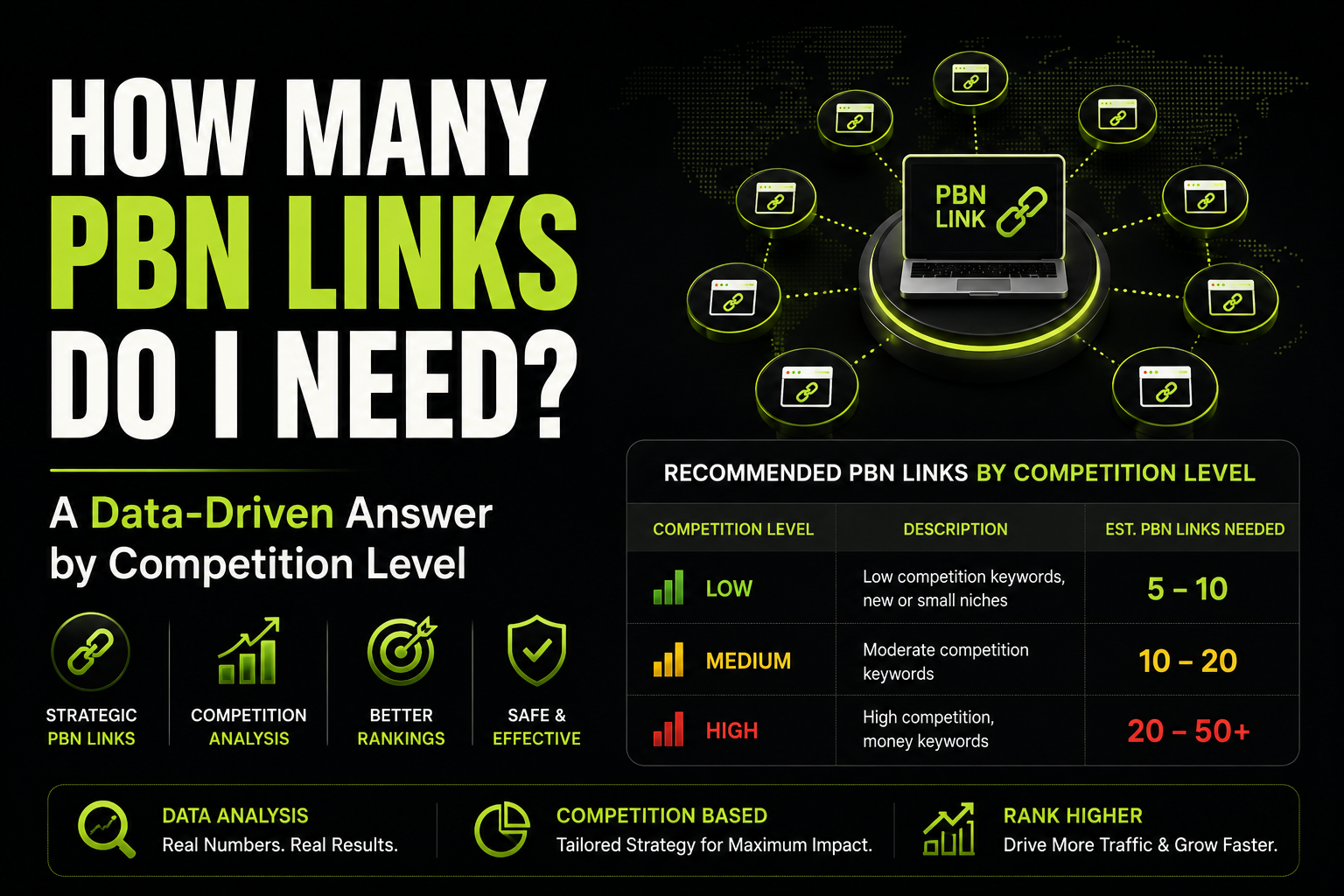
PBN Link Requirements by Keyword Difficulty
| KD Range | Competition Level | Est. Top-3 Avg RDs | Links Needed (from zero) | Campaign Timeline | Monthly Rate |
|---|---|---|---|---|---|
| KD 0–10 | Very Low | 5–25 RDs | 5–15 quality links | 2–4 months | 3–5/month |
| KD 10–20 | Low | 20–60 RDs | 15–30 quality links | 3–6 months | 5–8/month |
| KD 20–35 | Medium | 50–150 RDs | 30–60 links (mixed types) | 5–9 months | 8–12/month |
| KD 35–50 | High | 100–300 RDs | 60–120 links (PBN + editorial) | 9–15 months | 10–15/month |
| KD 50+ | Very High | 200–500+ RDs | 120+ as foundation layer | 12–24 months | 15–25/month |
Important caveat: These figures assume PBN links at mid-tier quality (DR 25–40, some organic traffic). Entry-tier links (DR 15–25, minimal traffic) are less efficient — multiply the link counts by 1.5 to 2 for equivalent impact. Premium links (DR 40+, consistent traffic) are more efficient — you may achieve the same impact with 20 to 30 percent fewer placements.
The Competitor Gap Calculator: Your Personal Link Target
The table above gives you absolute starting benchmarks. For a precise personal target, run this five-step competitor gap analysis before starting any campaign.
Step 1 — Identify Your True Competitors
Search your target keyword in Google and identify the top three organic results (excluding paid ads, featured snippets, and Google properties like YouTube or Maps). These are the sites you need to outrank — not theoretical competitors, the actual pages ranking above you right now.
Step 2 — Check Each Competitor Referring Domain Count
Open each of the three URLs in Ahrefs Site Explorer → Backlinks → Referring Domains. Record the referring domain count for each. Use the “Live and Lost” filter to focus on currently active backlinks rather than all-time totals. A competitor with 200 total referring domains but only 60 currently live is weaker than it appears from total count alone.
Step 3 — Calculate the Average and Your Gap
Average the three referring domain counts. This is your competition benchmark. Subtract your own current referring domain count from this average. The result is your raw authority gap.
Example: Top three competitors have 45, 62, and 38 live referring domains. Average = 48. Your site currently has 12 referring domains. Your gap = 36 referring domains.
Step 4 — Apply the Quality Multiplier
Not all referring domains are equal. A competitor with 45 referring domains that are primarily DR 40+ editorial sites with real traffic has a stronger profile than a competitor with 45 referring domains that are primarily DR 15 PBN links. Compare the average DR of your competitor referring domains to the average DR you plan to build.
If your planned PBN link quality is lower than competitor quality: multiply your gap by 1.5. If your planned quality matches competitors: use the gap as-is. If your planned quality is higher than competitor average: multiply your gap by 0.75.
Step 5 — Set Your Campaign Target and Monthly Rate
Divide your adjusted gap by the number of months you want to take to close it. This gives you your monthly link acquisition target. Cross-reference against the safe velocity guidelines in the next section to confirm the rate is appropriate for your site age.
Continuing the example: Adjusted gap = 36 (quality matched). Closing in 6 months = 6 links per month. Check against velocity guidelines for a site that is 12 months old: safe range is 8 to 20 links per month. Six links per month is well within safe velocity. Campaign confirmed.
Safe Monthly Velocity Guidelines
Link velocity — the rate of new backlink acquisition — is one of the most important risk management variables in PBN link building. Acquiring links too fast creates an unnatural velocity signature that triggers algorithmic review regardless of individual link quality.
| Site Age | Min Monthly Links | Max Monthly Links | Notes |
|---|---|---|---|
| 0–2 months | 0 | 2–3 (citations only) | No PBN links until site has indexed content |
| 3–5 months | 2 | 5 | First PBN placements — space across the full month |
| 6–11 months | 3 | 10 | Gradual ramp — never order all links in one week |
| 12–17 months | 5 | 18 | Established baseline — consistent monthly cadence |
| 18–35 months | 8 | 25 | Scale based on competition — match competitor acquisition rate |
| 36+ months | 10 | 35+ | Authority site — higher velocity less suspicious |
The Consistency Rule
The single most important velocity principle: the same number every month is always better than variable bursts. A site that acquires eight links every month for twelve months has a fundamentally different — and safer — acquisition pattern than one that acquires 96 links in three burst campaigns spaced across the year, even if the annual total is identical.
Google does not just count links — it evaluates acquisition patterns. Consistent monthly patterns resemble organic reference accumulation. Burst patterns resemble coordinated link campaigns. The former earns trust; the latter attracts review.
How Link Quality Changes the Count
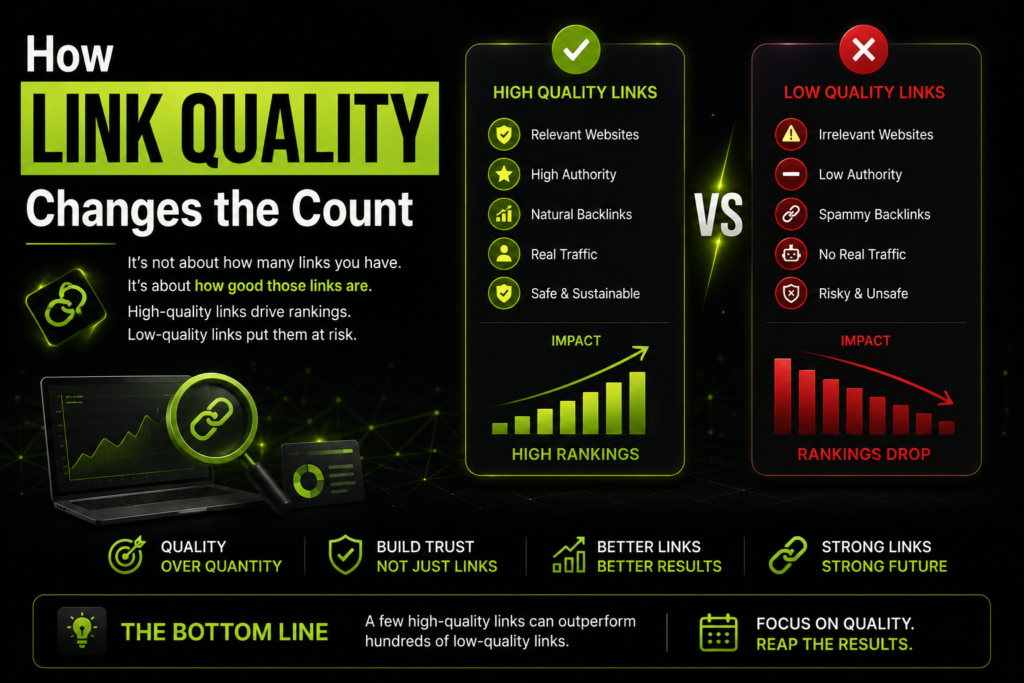
The link count targets above assume mid-tier quality. Quality significantly affects how many links you actually need to achieve a given authority level.
| Link Quality Tier | DR Range | Organic Traffic | Efficiency vs Mid-Tier | Price Range |
|---|---|---|---|---|
| Entry | DR 15–22 | 10–40/mo | 0.5× — need 2× as many | £20–£45 |
| Mid-tier | DR 22–38 | 50–200/mo | 1× — baseline | £45–£120 |
| High-tier | DR 38–52 | 150–500/mo | 1.5× — need 30% fewer | £120–£250 |
| Premium | DR 52+ | 400+/mo | 2× — need 50% fewer | £250+ |
Budget optimisation insight: Ten mid-tier links at £70 each (£700 total) typically delivers better ranking results than twenty entry-tier links at £35 each (£700 total) for most campaigns. The higher individual authority per link more than compensates for the lower volume. For understanding exactly what makes a link high quality see our 7-point backlink quality checklist.
Link Count by Campaign Type
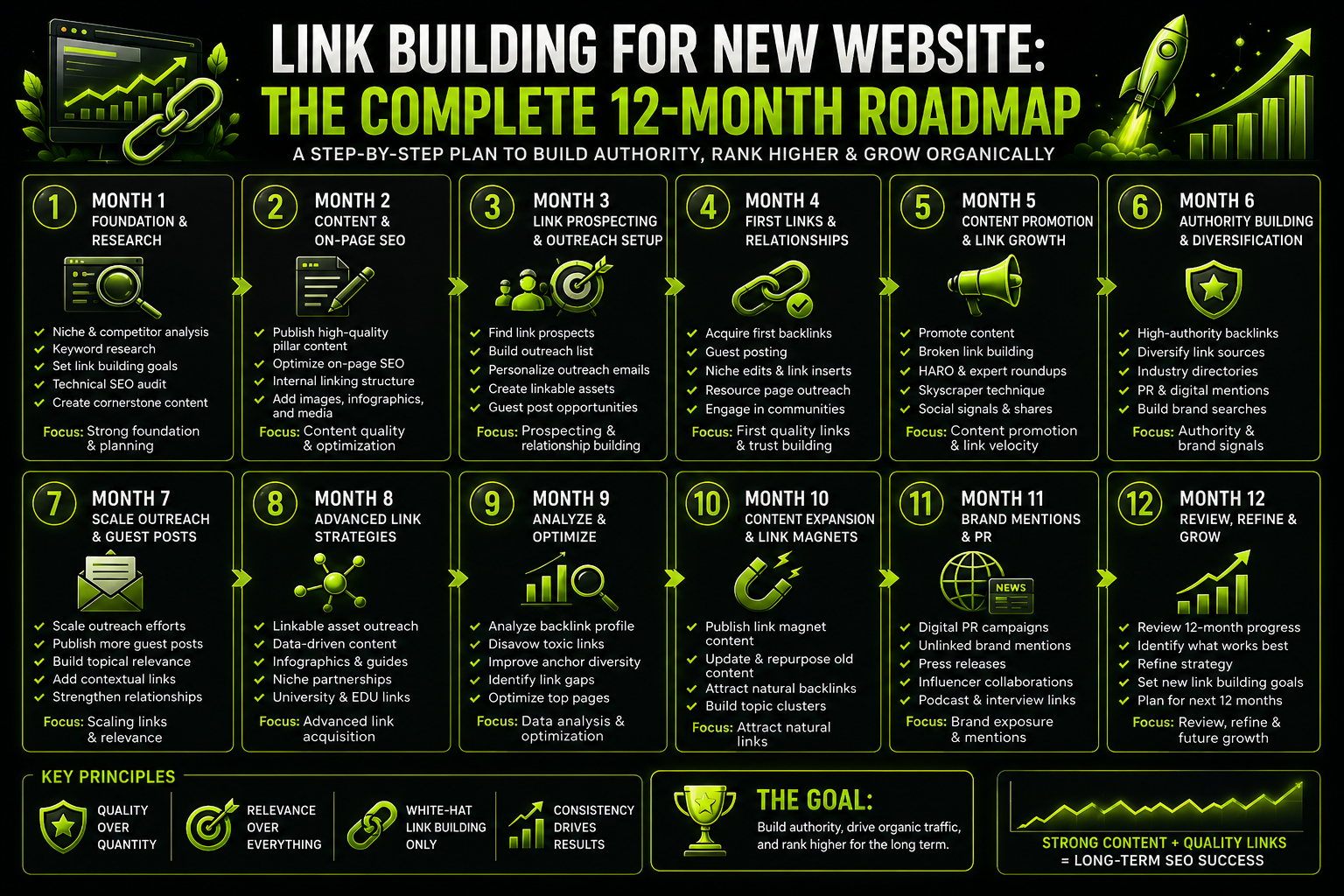
New Website — First 12 Months
Month 1–2: zero PBN links (on-page and citation foundation only). Month 3–4: three to five PBN links targeting primary money page. Month 5–6: five to eight links building topical cluster. Month 7–8: eight to twelve links targeting pages showing early movement. Month 9–12: ten to fifteen links per month scaling to competitive context. Year one total: 40 to 70 quality PBN links across a structured topical build.
For the complete new site roadmap see our link building for new website guide.
Local SEO Campaign
For single-location low-competition local keywords (KD under 15): five to twelve quality PBN links targeting the primary location service page. For competitive city-wide keywords (KD 15–25): fifteen to thirty links across the location page and homepage. For multi-location businesses: treat each location page as a separate campaign with its own five to fifteen link target. Monthly rate: three to eight links per month depending on competition level.
Affiliate Review Site
Low-competition affiliate keywords (KD under 20): ten to twenty links across a topical cluster. Mid-competition affiliate keywords (KD 20–35): thirty to sixty links over a sustained campaign with topical cluster architecture. High-competition affiliate niches: sixty to one hundred and twenty links as a foundation layer with editorial placements at the top.
E-Commerce Category Pages
Category pages in low-competition product niches: eight to twenty links with product category topical context. Competitive national retail categories: thirty to eighty links combined with strong on-page content and internal link architecture from supporting informational pages. For e-commerce link strategy see our PBN links for affiliate and e-commerce sites guide.
How to Know When You Have Enough Links
The question “how many links do I need” transitions into “have I built enough” at two observable checkpoints:
Checkpoint 1 — Your referring domain count matches or exceeds the top-three competitor average. Once you reach parity with competitors on referring domain count at equivalent quality, additional links produce diminishing marginal returns. At this point, focus shifts from volume building to profile quality improvement — higher-DR domains, more editorial variety, and Tier 2 amplification on your strongest existing links.
Checkpoint 2 — Your target keywords are in positions one to three and holding through algorithm updates. If you are ranking stably at the top for your primary targets, the campaign has succeeded. Maintenance mode — three to five quality links per month to defend rankings against competitive pressure — replaces the build phase.
If you reach referring domain parity with competitors but are still not ranking at the expected position, the issue is not link count — it is likely link quality differential, on-page optimisation gaps, or topical authority depth. Investigate these before adding more link volume.
The Link Velocity Planning Tool: Your Monthly Schedule
Use this framework to convert your campaign target into a monthly schedule:
| Campaign Phase | Target Links | Monthly Rate | Anchor Focus |
|---|---|---|---|
| Phase 1 — Foundation (months 1–3) | 30% of total target | Conservative per velocity table | Branded and generic only |
| Phase 2 — Build (months 4–7) | 50% of total target | Steady pace per velocity table | Introduce topical and partial-match |
| Phase 3 — Consolidate (months 8–12) | 20% of total target | Maintain pace, adjust based on ranking data | Selective exact-match below 10% |
This three-phase structure ensures velocity builds gradually and naturally, anchor text diversity develops appropriately, and rankings are evaluated at meaningful intervals before significant additional investment is committed. For the complete anchor text distribution framework see our buy backlinks for SEO strategy guide.
Common Counting Mistakes to Avoid
Counting total referring domains instead of live ones. Ahrefs shows total historical referring domains by default. Switch to “Live” to see only currently active backlinks. A competitor with 200 total but 60 live referring domains is much more beatable than the headline number suggests.
Treating all referring domains as equal. A competitor with 50 referring domains at average DR 45 with genuine traffic is stronger than a competitor with 50 referring domains at average DR 18 with zero traffic. Quality-adjust your gap calculation before setting targets.
Not accounting for the topical relevance of competitor links. A competitor whose 40 referring domains are all from niche-relevant sites in your industry has stronger topical authority than a competitor whose 40 domains are generic lifestyle blogs. Topical link relevance is a quality dimension that raw count does not capture.
Forgetting about on-page optimisation as a variable. If a competitor is ranking with fewer referring domains than you have, the difference is usually on-page quality — better content, stronger E-E-A-T signals, superior user engagement metrics. Audit the on-page gap alongside the link gap before attributing ranking deficits entirely to link count.
FAQ
How many PBN links do I need to rank on page one?
For KD under 15: five to fifteen quality links. For KD 15 to 30: fifteen to forty links in a topical cluster. For KD 30 to 50: fifty-plus links as part of a comprehensive campaign. Always benchmark against top-three competitor referring domain counts rather than using generic targets.
Is it better to build more PBN links or higher quality ones?
Higher quality almost always wins at equivalent budget. Three links from DR 35 domains with genuine traffic outperform fifteen links from DR 15 zero-traffic domains in most competitive contexts. Only once quality is matched should volume become the primary focus.
How many PBN links per month is safe?
New sites (months 3–5): three to five per month. Sites six to eleven months old: three to ten per month. Sites twelve to seventeen months: five to eighteen per month. Established sites over eighteen months: eight to twenty-five per month. Consistency every month is more important than the specific number.
How do I calculate exactly how many links I need?
Check the live referring domain count for the top three ranking pages for your target keyword in Ahrefs. Calculate the average. Subtract your current referring domain count. Adjust for quality differential. This is your authority gap — plan your monthly velocity to close it over six to twelve months.
Do more PBN links always mean better rankings?
No. Beyond the threshold required to match competitor authority, additional links produce diminishing returns. Quality always matters more than count, and links need time to be processed — fifty links added simultaneously produce less impact than the same fifty added gradually over six months.
Should I build all my PBN links at once or spread them out?
Always spread them out. Consistent monthly velocity produces more stable and durable rankings than bulk acquisition. A site acquiring eight links every month for six months consistently outperforms a site that acquires forty-eight links in one week, even at identical individual link quality.
Conclusion
The answer to “how many PBN links do I need” is always: enough to close the authority gap between you and the top-ranking competitor for your target keyword, built at a velocity appropriate for your site age, using link quality matched to the competition level. The competitor gap calculator in this guide converts that principle into a specific monthly number for any campaign.
Start with the five-step gap analysis before every new campaign. Set a monthly rate within the safe velocity table for your site age. Phase your anchor text development from branded-heavy in months one to three to a full distribution profile by month eight. Track rankings against your baseline every two weeks. Adjust based on what moves and what does not — the data will tell you when you have enough and when you need to add more.
For quality PBN links at mid-tier and premium quality tiers — with verified organic traffic, independent hosting infrastructure, and indexed delivery confirmation — explore the available options and apply the link count and velocity framework from this guide before placing your first order.
About the Author
Louis Dobbler is a PBN link building strategist and off-page SEO specialist at BuyPBNBacklinks, with deep expertise in private blog network construction, domain acquisition, and authority link campaigns across iGaming, finance, and SaaS verticals.

Louis Dobbler is a PBN link building strategist and off page SEO specialist with deep expertise in private blog network construction, domain acquisition, and authority link campaigns. With years of experience working across competitive verticals including iGaming, crypto, finance, and CBD, Louis has helped hundreds of SEO agencies and affiliate marketers engineer rankings that hold through every Google core update.
At BuyPBNBacklinks, Louis oversees network quality, domain vetting, and campaign strategy ensuring every PBN backlink placed meets the highest standards for authority, footprint safety, and long term SEO performance.