Key Takeaways
- All seven criteria must be evaluated independently — a link scoring 6/7 may still be a poor purchase depending on which criterion it fails.
- Organic traffic is the most important criterion and the hardest to fake — weight it most heavily when forced to choose.
- Red flags in a seller sales language reliably predict link quality — specific patterns consistently indicate operational shortcuts.
- Quality standards vary by industry — the checklist thresholds adapt to your specific niche.
Every link seller describes their inventory as “buy high quality backlinks.” The phrase has become so overused that it carries essentially no information. It is the SEO equivalent of a hotel describing itself as “comfortable” — technically possible to verify, but verifiable only by the guest after they have already paid.
The only useful definition of a high-quality backlink is an operational one: a link that, in your specific campaign context, contributes positively to your target page’s rankings and does not introduce penalty risk. Both halves of this definition matter. A link from a DR70 site is not high quality if it is in a niche completely unrelated to your target page. A link from a relevant DR25 site is not high quality if the domain is going to disappear in three months.
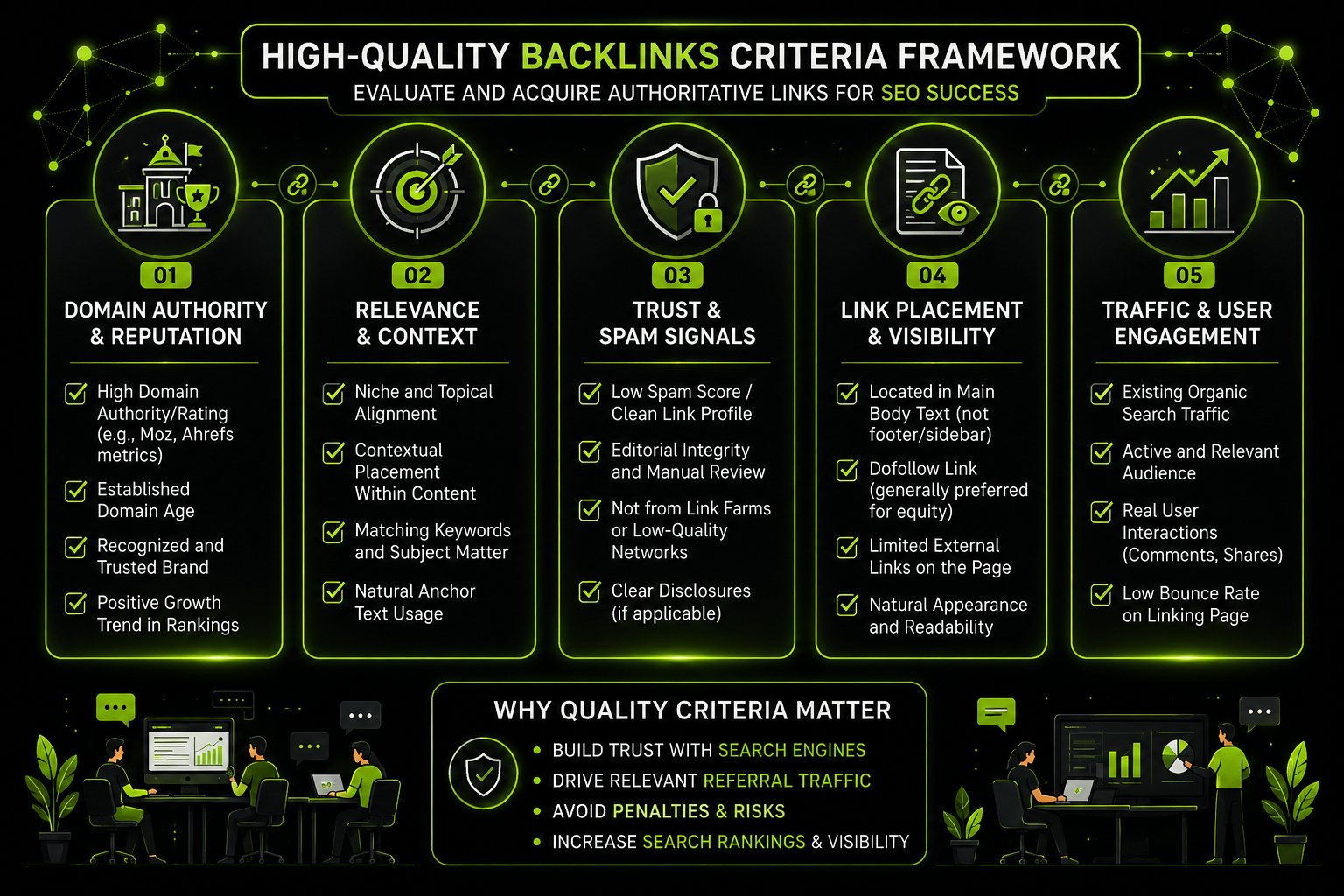
The seven criteria below operationalise “buy high quality backlinks” into checkable conditions rather than aspirational descriptions.
Why “High Quality” Is Meaningless Without Criteria
There is no shortage of guides on what makes a backlink “buy high quality backlinks.” Most describe the ideal in abstract terms without giving buyers a practical framework for evaluating real-world link offers before spending money. This guide does something different: it presents seven non-negotiable quality criteria, each framed as a yes/no check that any buyer can apply to any link offer in under fifteen minutes, and explains what the correct answer is and why it matters. Together these form a checklist that works across all link types — PBN placements, guest posts, niche edits, directory links — and all price points.
The 7-Point Quality Checklist
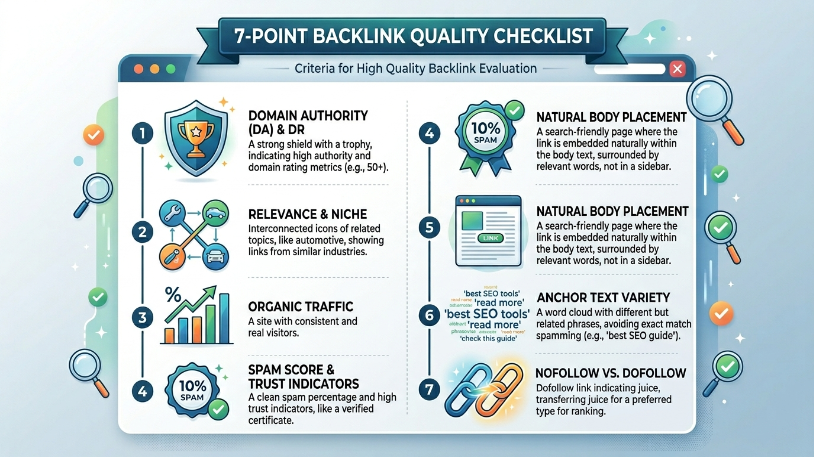
Criterion 1: The Linking Domain Has Genuine Organic Traffic
Check: Open the domain in Ahrefs or Semrush. Does it have at least 20–50 monthly organic visits?
Why it matters: Organic traffic is the most reliable external proxy for Google’s trust in a domain. A domain with zero traffic has not demonstrated to Google that it produces content worth ranking. A link from such a domain passes less credible authority than one from a domain Google actively ranks.
Acceptable answer: Yes — some genuine organic traffic exists. Disqualifying answer: Zero traffic, or traffic that is entirely paid/direct with no organic component.
Criterion 2: The Linking Domain Has a Genuine History
Check: Search the domain at web.archive.org. Was there real, topically coherent content on this domain before today?
Why it matters: A high-quality link comes from a site with genuine editorial history — not a domain that was registered last month and filled with AI-generated content to host link placements. Authentic domain history confirms the authority being passed is accumulated from real use rather than constructed artificially.
Acceptable answer: Multiple years of genuine, readable, topically coherent content visible in the Wayback Machine. Disqualifying answer: No archive history, parking page history, or obvious PBN construction history with multiple unrelated niches.
Criterion 3: The Link Is Contextually Placed in Topically Relevant Content
Check: Can you read the article containing the link? Does the topic of the article relate to the topic of the target page? Does the anchor text fit naturally into the surrounding sentence?
Why it matters: Contextual relevance is one of the signals Google uses to evaluate the quality of a link’s endorsement. A link embedded naturally in a relevant article passes more targeted authority than one inserted awkwardly into unrelated content or placed in a footer or sidebar.
Acceptable answer: Yes — article topic is related, anchor text fits naturally in the paragraph. Disqualifying answer: Link is in a footer, sidebar, or link list. Article topic has no relation to the target page. Anchor text is clearly force-fitted into unnatural surrounding text.
Criterion 4: The Linking Domain Has a Clean Spam History
Check: Check Moz Spam Score for the domain. Run the domain through Ahrefs with spam filter applied to the referring domains. Does anything appear suspicious?
Why it matters: A domain that previously participated in link schemes — or that currently has a high proportion of spammy inbound links — is more likely to be devalued or deindexed by Google. A link from a compromised domain can, in extreme cases, associate your site with spam-pattern signals.
Acceptable answer: Moz Spam Score below 30%, no obvious spam patterns in referring domain anchor text. Disqualifying answer: Spam Score above 60%, anchor text dominated by casino/pharma/adult keywords in foreign languages, or bulk links from known link farms.
Criterion 5: The Placement Will Remain Live (Permanence Check)
Check: Is the seller offering a permanent placement? Have you confirmed their replacement policy in writing? Is the domain registered long enough that it will not expire before your link has delivered value?
Why it matters: A link that disappears in three months delivers fractional value compared to one that remains live for years. The permanence of the placement is a direct multiplier on the cost-per-impact calculation.
Acceptable answer: Permanent placement with explicit replacement policy confirmed in writing. Disqualifying answer: Month-to-month rental with no long-term guarantee, or seller unable to confirm what happens if the domain expires.
Criterion 6: The Link Will Be Indexed
Check: Is the article on a site that is actively indexed by Google? Can the seller confirm their indexation process?
Why it matters: An unindexed link passes no value. Regardless of the domain’s authority metrics, a link that Google has never processed contributes nothing to rankings.
Acceptable answer: Seller confirms an indexation process; site has indexed pages confirmed via site:domain.com. Disqualifying answer: Seller cannot explain how they ensure indexation; domain shows zero indexed pages; delivery comes with no indexation confirmation.
Criterion 7: The Metrics Are Independently Verifiable
Check: Has the seller provided the actual domain URL? Can you verify DR, TF, and organic traffic independently in Ahrefs, Majestic, and Semrush before paying?
Why it matters: Any metric claim that cannot be verified is meaningless. Sellers who quote metrics without providing the URL for verification either do not have the inventory they are describing or are hiding something. Verifiable metrics are not just a quality signal — they are the minimum standard for any legitimate link transaction.
Acceptable answer: Seller provides domain URL; metrics verify within acceptable range in third-party tools. Disqualifying answer: Seller quotes metrics without providing the URL; metrics cannot be independently verified; seller declines to share the placement domain before payment.
Red Flags in Sales Language
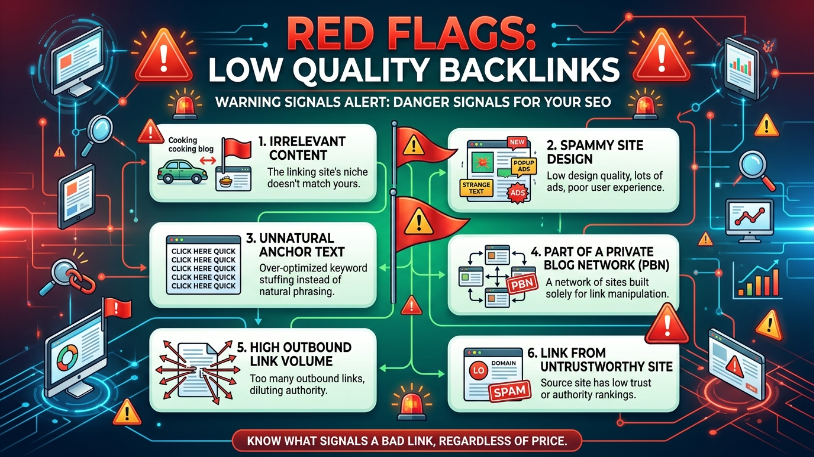
Beyond the seven-point checklist, certain patterns in seller communications and sales pages reliably predict low-quality placements regardless of how they are priced.
“100% Google-safe” or “Google-approved” — No third-party link is Google-approved. Any seller using this language either does not understand Google’s guidelines or is deliberately misleading buyers.
“Permanent” without any replacement policy — Permanent without recourse is marketing language. A genuine permanent placement comes with a defined replacement or refund process.
Bulk packages with no individual domain information — “10 links for £X” with no ability to review the specific domains before purchase is a strong predictor of low-quality network inventory.
Metrics quoted without tool attribution — “DA40+ guaranteed” without specifying whether this is Moz DA, Ahrefs DR, or something else is unverifiable by design.
“Niche-relevant” claimed for all topics — Networks that accept any niche without restriction or premium are not building topically coherent sites. Genuine relevance requires specialisation.
Delivery timelines under 24 hours — Quality link placements involve human content creation and editorial process. Sub-day delivery is a reliable indicator of automation.
What High Quality Looks Like Across Different Industries
The seven criteria above apply universally, but the threshold for what constitutes “passing” each criterion varies by industry.
Local SEO (Tradespeople, Local Services)
In local SEO, topical relevance at the geographic level matters as much as niche relevance. A DR20 domain that covers local business topics in your target city or region can be more valuable than a DR35 domain with no geographic connection. Organic traffic threshold can be set lower (20–50 visits) given the inherently limited search volume in local niches.
E-Commerce (Retail, D2C Brands)
Product category relevance is the key differentiator. A link from a site covering your product type — cooking equipment, outdoor gear, baby products — is worth significantly more than a link from a generic lifestyle blog. DR thresholds should be moderate (DR20+) but topical precision should be weighted heavily.
Finance and Legal
The bar is higher in YMYL (Your Money, Your Life) niches because Google applies more scrutiny to these verticals. Organic traffic threshold should be set at 100+ monthly visits. Trust Flow requirements are higher (TF20+). Spam history is more critical to verify thoroughly than in lower-stakes niches.
iGaming and Casino
As covered in Blog 10, topical relevance is structurally constrained in this vertical. The available pool of genuinely relevant linking domains is smaller. Threshold adjustments: prioritise topical relevance (gambling/gaming domain history) above organic traffic volume, accept lower DR thresholds if topical alignment is strong.
SaaS and B2B Technology
Domain authority and referring domain quality matter more here than in many other niches because SaaS SERPs are frequently dominated by high-authority sites. DR25+ minimum with real traffic is typically required for placements to register in SaaS keyword competitions.
How to Use This Checklist When Vetting Sellers
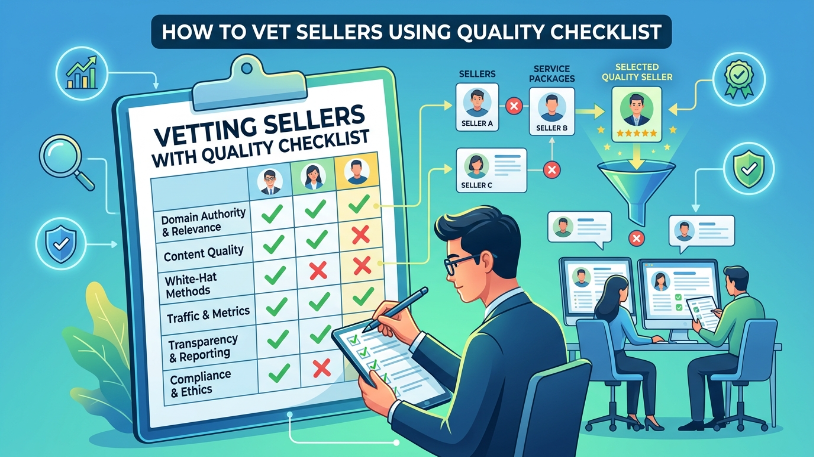
Before Your First Order
Run the checklist on three to five sample domains from the seller’s inventory. Ask for the actual URLs of domains you would be placed on — not “sample sites” or generic portfolio links. Any seller who declines to provide verifiable domain information before first payment is not worth proceeding with.
For Recurring Orders
Even for sellers you have used successfully before, run at least Criterion 1 (organic traffic) and Criterion 7 (metrics verification) on each new domain before paying for the specific placement. Network quality can change over time as domains are added, expire, or degrade.
For Bulk Orders
For orders above 10 links, request a domain list before confirming the order. Spot-check a random 30% of the domains against all seven criteria. If more than 20% fail any single criterion, renegotiate the order or decline.
Scorecard Format
Maintain a seller scorecard that records checklist performance across orders. A seller whose placements consistently score 7/7 on the checklist is a keeper. A seller who scores below 5/7 on average should be reconsidered, regardless of how competitive their pricing appears.
FAQ
What is the most important criterion when buying high quality backlinks?
Organic traffic — the hardest to fake, most directly correlated with Google trust, and most predictive of ranking impact.
How do I verify a backlink quality before paying?
Ask for the actual domain URL, then check in Ahrefs (organic traffic, DR, referring domains), Majestic (TF, CF), Moz (Spam Score), and the Wayback Machine. The full checklist takes 10–15 minutes per domain.
Do these quality criteria apply to all backlink types?
Yes — the seven criteria apply equally to PBN links, guest posts, niche edits, and directory links. Thresholds may vary by type but the criteria are universal.
Is a high DR always a sign of high quality?
No. DR can be inflated through link exchanges. A DR35 domain with zero traffic may be less valuable than a DR15 domain with consistent organic traffic and a clean backlink profile.
What should I do if a purchased backlink fails the checklist after delivery?
Contact the seller immediately, reference the specific failing criteria, and request a replacement. A quality seller will accommodate this. If unresponsive, escalate via your payment method within the dispute window.
Conclusion
The seven criteria in this checklist address specific mechanisms by which a link either delivers genuine ranking authority or fails to do so. Running all seven before each purchase transforms link buying into a quality-controlled process. For a complementary vetting framework for sellers specifically, see our best PBN services guide and our 10 questions to ask a PBN backlinks service. For placements that consistently meet all seven criteria with full domain-level transparency and verified metrics before purchase, explore the high quality PBN backlinks options available.
About the Author
Louis Dobbler is a PBN link building strategist and off-page SEO specialist at BuyPBNBacklinks, with deep expertise in private blog network construction, domain acquisition, and authority link campaigns.

Louis Dobbler is a PBN link building strategist and off page SEO specialist with deep expertise in private blog network construction, domain acquisition, and authority link campaigns. With years of experience working across competitive verticals including iGaming, crypto, finance, and CBD, Louis has helped hundreds of SEO agencies and affiliate marketers engineer rankings that hold through every Google core update.
At BuyPBNBacklinks, Louis oversees network quality, domain vetting, and campaign strategy ensuring every PBN backlink placed meets the highest standards for authority, footprint safety, and long term SEO performance.