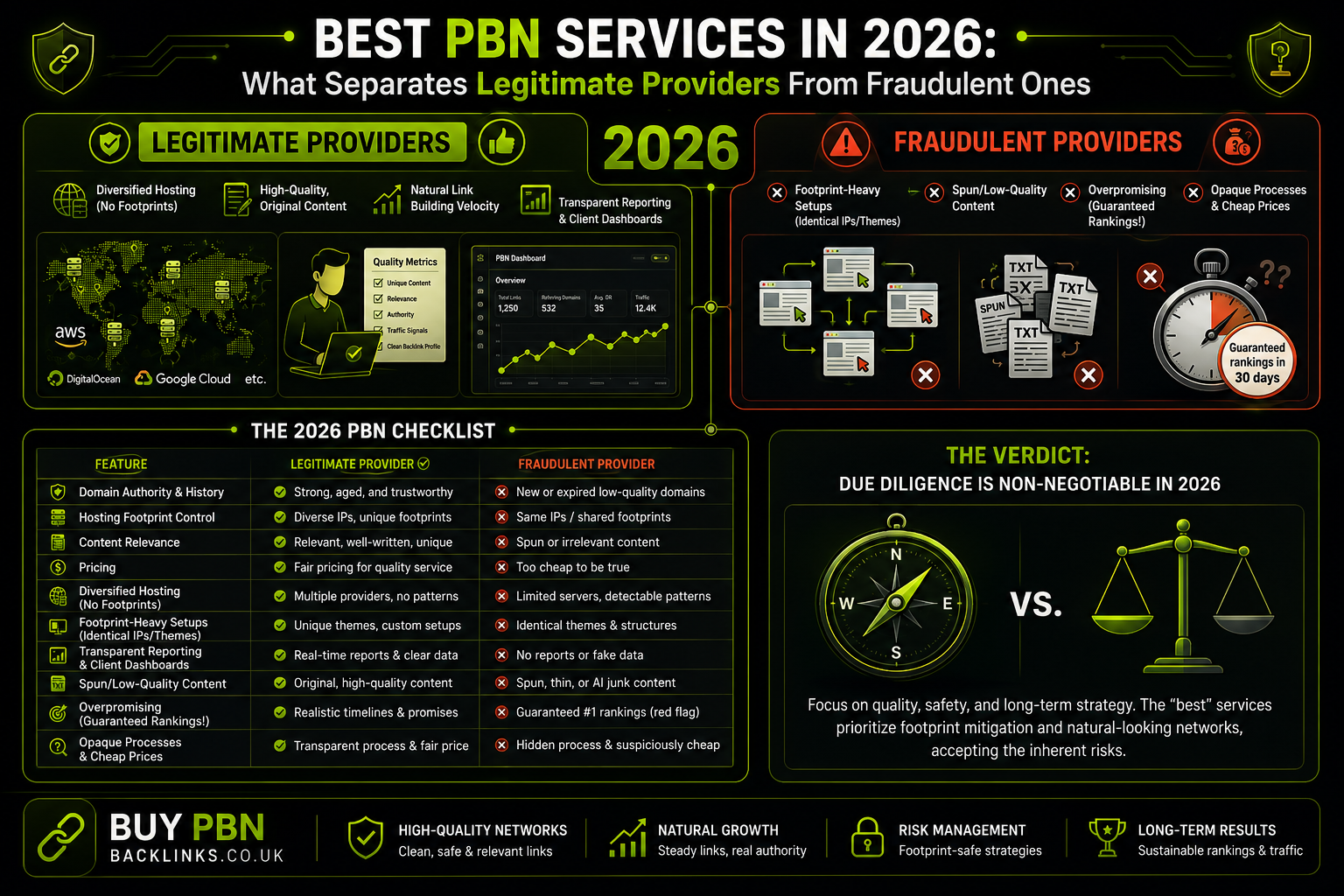
Identifying the best PBN services in 2026 is not a brand comparison exercise — it is a criteria application exercise. This guide defines what the best PBN services look like in terms of verifiable, objective criteria. It covers which metrics to benchmark when comparing providers, how to structure a 30-day provider trial that genuinely validates quality claims, how to identify red flags embedded in sales copy and fake case studies, and how to interpret delivery reports to assess whether what was promised was actually delivered.
Key Takeaways
- The best PBN services are defined by verifiable criteria — not brand recognition.
- A 30-day provider trial with structured evaluation criteria separates genuine quality from sales page performance.
- Fake case studies in PBN marketing have specific, identifiable patterns.
- Delivery reports from quality providers contain specific, verifiable data — vague or templated reports signal mass-production operations.
- Price is the weakest indicator of quality in this market.
What “Best” Actually Means for PBN Services
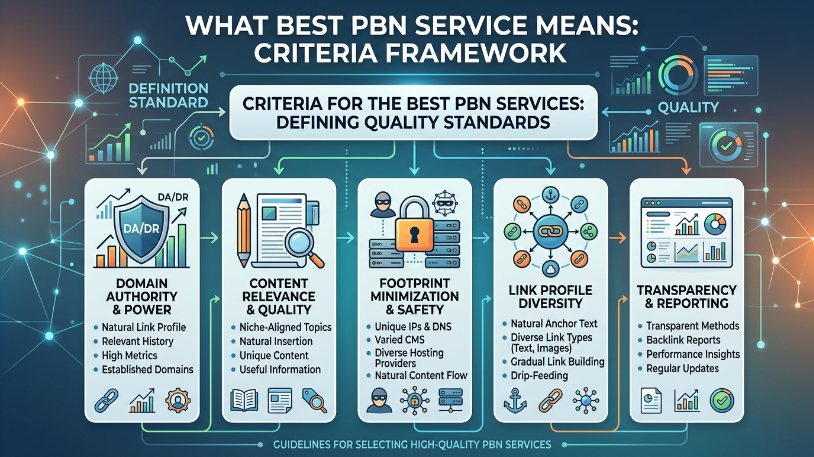
The word “best” in link building contexts is usually defined by whoever is writing about it — typically in a way that favours their own product or the products that pay for placement in their comparison. This guide avoids that bias by defining “best” operationally: a PBN service is among the best if it consistently delivers placements that meet objective quality criteria and satisfies the buyer’s campaign goals at the price point paid.
This definition has three important implications:
“Best” is relative to your campaign goals. The best service for an aggressive iGaming campaign is not the same as the best service for a local plumber’s website. Topical relevance, domain authority requirements, and volume needs vary enormously.
“Best” is relative to the price tier. A service charging £25 per link cannot be expected to deliver the same quality as one charging £100 per link. The question is whether each service delivers appropriate quality for its price — not whether a £25 service equals a £100 one.
“Best” is verifiable. Every criterion in this guide is something you can check independently. No criterion requires trusting a brand’s self-reported quality claims.
Criteria Framework for Benchmarking Providers
The Seven Benchmarks for Evaluating Any Provider
Evaluate every provider against these seven benchmarks before and after any initial order.
Benchmark 1: Domain Quality Verification Rate
What it measures: The percentage of domains delivered that pass a standard verification check (organic traffic, TF, Wayback history, spam score).
How to measure: Run the 7-point quality checklist from Blog 13 on a sample of delivered placements. A best-in-class provider should have a 90%+ pass rate across the full checklist.
Minimum acceptable: 70% pass rate (3 of 7 criteria easily met, none critically failed)
Benchmark 2: Indexation Rate
What it measures: The percentage of placed articles that are indexed in Google within 21 days of delivery.
How to measure: Search site:articleurl in Google for each placement 21 days after delivery. Calculate the indexed count as a percentage of total placements.
Minimum acceptable: 80% indexation within 21 days; any unindexed placement should trigger seller notification per their replacement policy.
Benchmark 3: Metric Accuracy
What it measures: Whether the domain metrics quoted at sale match the independently verified metrics at delivery.
How to measure: For each delivered domain, check DR, TF, and organic traffic in Ahrefs and Majestic. Compare to quoted metrics. Calculate average deviation.
Minimum acceptable: Metrics within 15% of quoted values. Consistent over-representation of 30%+ is a disqualifying pattern.
Benchmark 4: Content Quality Score
What it measures: The quality and topical relevance of the article surrounding your placement.
How to measure: Read each delivered article. Evaluate on a 1–5 scale: 1 = clearly AI-spun or irrelevant; 3 = readable and broadly relevant; 5 = well-written and precisely topically matched. Calculate average score.
Minimum acceptable: Average score of 3.0 or above. Score of 2.0 or below indicates systematic content quality issues.
Benchmark 5: Turnaround Consistency
What it measures: Whether the provider delivers within their quoted turnaround timeframe.
How to measure: Record the date of order and the date of delivery URL receipt for each placement. Calculate on-time delivery rate.
Minimum acceptable: 80% of placements delivered within quoted timeframe; no placement exceeding quoted timeframe by more than 5 business days without proactive communication.
Benchmark 6: Delivery Report Completeness
What it measures: Whether delivery documentation contains all specified components.
How to measure: Check each delivery report against the required components: live URL, anchor confirmation, article text, screenshot, domain metrics, indexed status confirmation.
Minimum acceptable: All 5 components present in 90%+ of delivery reports.
Benchmark 7: Replacement Response Rate
What it measures: Whether the provider responds to and resolves deindexation reports within their stated replacement timeframe.
How to measure: Track any deindexation events and the time from notification to replacement delivery.
Minimum acceptable: Replacement delivered within 30 days of written notification; provider responsive to initial notification within 2 business days.
How to Run a 30-Day Provider Trial
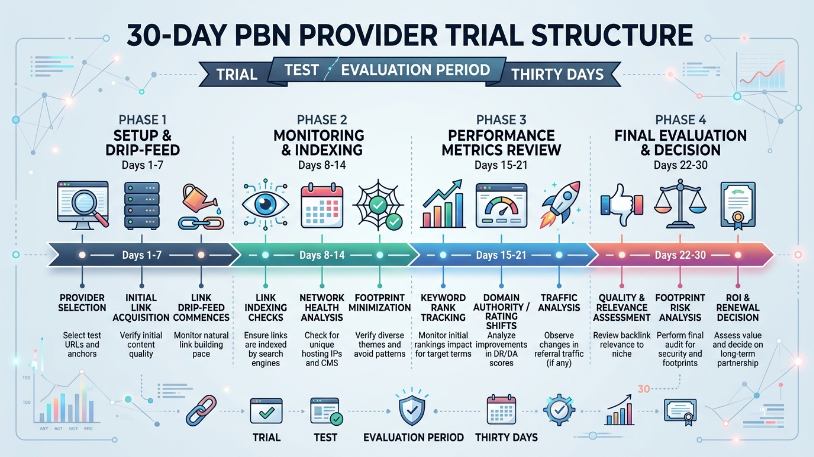
A 30-day trial evaluates not just whether a provider delivers what it promises, but whether that delivery translates to observable ranking signals.
Week 1: Order and Baseline
- Record baseline rankings for 3–5 target keywords on the test money page
- Place a test order of 3–5 links from the new provider
- Use a mix of anchor types (branded, partial-match, topical)
- Record all order details including quoted domain metrics
Week 2: Delivery Evaluation
- Verify delivery documentation completeness for each placement
- Cross-check delivered domain metrics against Ahrefs and Majestic
- Check content quality and topical relevance of each article
- Confirm indexation status or set a reminder to check at day 14
Week 3: Indexation Check and Early Signals
- Recheck indexation for all placements
- Note any unindexed placements and notify the provider
- Check ranking positions for the first time since baseline
Week 4: Performance Assessment
- Final ranking check and comparison to baseline
- Document any movement (positive, negative, or none)
- Evaluate against all seven benchmarks
- Score the provider using the comparison matrix
What Success Looks Like at 30 Days
Early movement in rankings (1–5 positions) within 30 days on a responsive page in a low-competition niche. Partial movement (some keywords moving, not all) for more competitive terms. No movement does not mean failure at 30 days — ranking impact typically takes 4–8 weeks. The 30-day evaluation is primarily about delivery quality, not ranking outcomes.
Red Flags in Sales Copy and Fake Case Studies
Before/after screenshots without competitive context or timeline. Anonymous unverifiable case studies with no traceable detail. “Safe” or “white hat” language applied to PBN links — PBN links are by definition not white hat. Domain metric screenshots that cannot be reproduced in current tool checks. Testimonials from non-attributable sources.
PBN services invest significantly in marketing that creates the appearance of credibility. These patterns are common in fraudulent or low-quality providers’ sales materials.
Red Flag 1: Before/After Screenshots Without Context
Ranking improvement screenshots showing a dramatic jump from position 30 to position 3 are meaningless without: the target keyword (was it competitive?), the timeline (did it take 2 weeks or 18 months?), and the full link profile context (were other activities happening simultaneously?). Screenshots without these data points tell you nothing about what caused the movement.
Red Flag 2: Anonymous or Unverifiable Case Studies
“Client A in the finance niche saw 340% traffic growth” — with no verifiable detail — cannot be evaluated. Quality providers who have real case studies can usually share at least anonymised data with sufficient detail to assess credibility: the keyword category, the DR of links used, the timeframe, and the baseline position.
Red Flag 3: “Safe” or “White Hat” Language for PBN Links
PBN links are not white hat. They violate Google’s guidelines by definition. A provider describing PBN links as “safe,” “white hat,” or “Google-approved” either does not understand what PBN links are, or is deliberately using confusing language to appeal to buyers who would be deterred by honest risk disclosure. Both are concerning.
Red Flag 4: Domain Metric Screenshots That Cannot Be Reproduced
If a provider sends you Ahrefs screenshots of their domains but the metrics you see when you check independently are materially different, either the screenshots are old, fabricated, or the domains shown are not the ones you would actually receive. Always verify independently — screenshots are evidence of what a domain looked like at one point in time, not what it looks like now.
Red Flag 5: Testimonials From Unverifiable Sources
Testimonials from “John S., SEO Manager” or similar non-attributable sources are unverifiable and trivially easy to fabricate. This is not to say all testimonials are fake — it is to say that testimonials without verifiable attribution are not meaningful social proof.
How to Interpret Delivery Reports
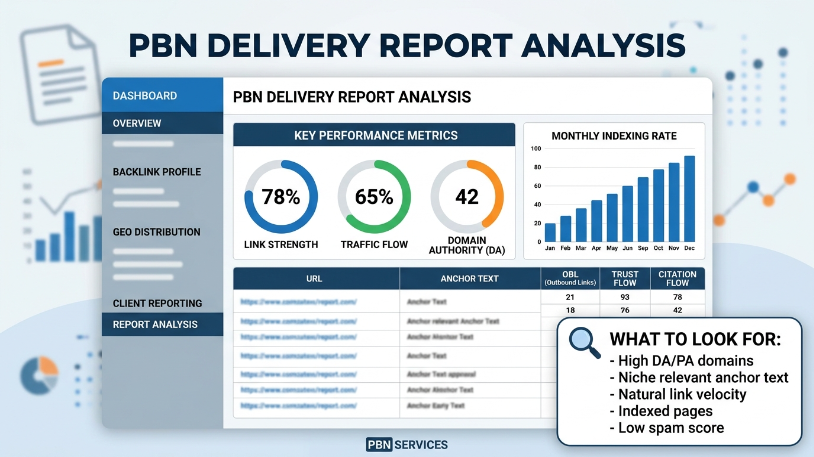
Delivery reports from the best PBN services are specific, verifiable, and actionable. Here is what to look for and what each element tells you.
What a Complete Delivery Report Contains
Live article URL — The full, clickable URL of the article containing your link. You should be able to open it in a browser immediately and find your link.
Anchor text confirmation — The exact anchor text used, matching your specified preference or explaining any deviation.
Full article text — A copy of the article content, either within the report or as an attachment. This allows you to verify content quality, topical relevance, and the context of your link placement.
Screenshot of link in context — A screenshot showing the surrounding paragraph of your link, with the link visible. This provides a timestamped record of the placement.
Domain metrics at delivery — DR, TF, organic traffic, and spam score at the time of delivery. This documents what you actually received.
Indexed status — Either a Search Console URL Inspection screenshot or a site:articleurl Google search result confirming the page is indexed.
What Templated Reports Look Like
Low-quality services often provide a spreadsheet with domain name and a URL — nothing else. There is no article text, no metrics confirmation, no screenshot, and no indexed status. This is a minimum-viable delivery report that tells you almost nothing about the quality of what was placed.
When you receive a templated report, ask specifically for the missing components. If the seller cannot or will not provide them, treat the placement as unverified until you have checked each element yourself.
The Provider Comparison Matrix
Score each of the seven benchmarks 0–5 with weighting: domain quality (20%), indexation rate (20%), metric accuracy (15%), content quality (15%), turnaround consistency (10%), delivery report completeness (10%), replacement response (10%). Weighted total out of 5: 4.5–5.0 = excellent primary provider; 3.5–4.4 = good supplementary provider; 2.5–3.4 = acceptable with monitoring; below 2.5 = do not use.
FAQ
Is there a definitive list of the best PBN services?
No list is reliably current — service quality changes over time. The criteria framework in this guide lets you evaluate any provider at any time against consistent standards, which is more durable than a static ranked list.
How much does a high-quality PBN service cost?
Mid-tier quality: £40–£100 per link. Premium with verified organic traffic and specialist niche targeting: £100–£250+. Services below £20 should be evaluated very carefully against the quality benchmarks.
How long does it take to evaluate a new PBN provider?
A complete 30-day trial evaluates delivery quality. Full ranking impact evaluation requires 8 weeks. Delivery quality benchmarks 1–6 can be completed within 3 weeks of the test order.
Can I trust Trustpilot or forum reviews of PBN services?
With caution. Weight specific detail-rich reviews more heavily than brief generic endorsements. The criteria framework in this guide is more reliable than any reputation signal.
What makes a PBN service worth paying a premium for?
Verifiable domain quality with organic traffic and genuine TF, human-written topically relevant content, active indexation processes, complete delivery documentation, and a tested replacement policy.
Conclusion
The best PBN services in 2026 are identified by what they do, not by what they say about themselves. The seven benchmarks and 30-day trial structure in this guide give buyers a systematic way to evaluate any provider against objective standards. For a best PBN backlinks service that can be evaluated against all seven benchmarks with full transparency, apply this framework to every provider you consider.
About the Author
Louis Dobbler is a PBN link building strategist and off-page SEO specialist at BuyPBNBacklinks, with deep expertise in private blog network construction, domain acquisition, and authority link campaigns.

Louis Dobbler is a PBN link building strategist and off page SEO specialist with deep expertise in private blog network construction, domain acquisition, and authority link campaigns. With years of experience working across competitive verticals including iGaming, crypto, finance, and CBD, Louis has helped hundreds of SEO agencies and affiliate marketers engineer rankings that hold through every Google core update.
At BuyPBNBacklinks, Louis oversees network quality, domain vetting, and campaign strategy ensuring every PBN backlink placed meets the highest standards for authority, footprint safety, and long term SEO performance.