The term buy PBN blog post backlinks refers to a specific and often misunderstood placement type within private blog networks — a contextual link embedded inside a full article published on a PBN domain, as opposed to a sitewide link, a homepage mention, or a niche edit inserted into pre-existing content. In 2026, this distinction matters more than ever. Google quality systems have become increasingly sophisticated at evaluating the context in which a link appears, not just the authority of the linking domain. This guide explains exactly how blog post PBN links work, how they compare to homepage links and niche edits, which anchor text strategies work best, and where they fit most effectively in real-world SEO campaigns.
Table of Contents
- What Makes a Blog Post PBN Link Different?
- Blog Post Links vs. Homepage PBN Links
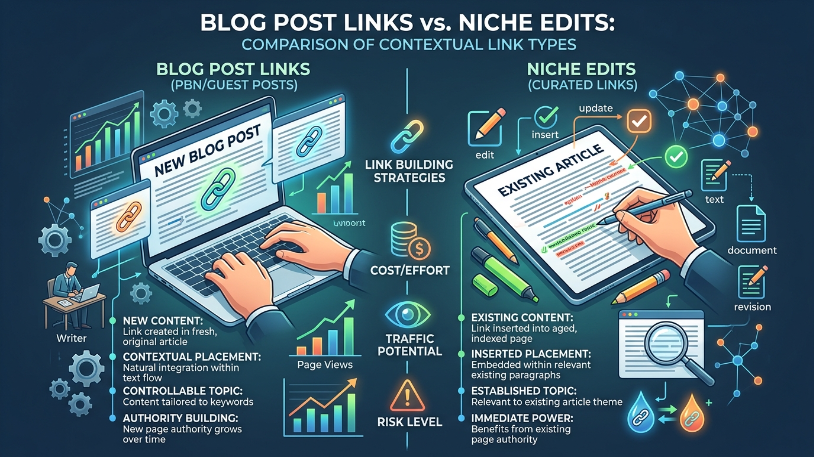
- Blog Post Links vs. Niche Edits
- The Value of Contextual Placement
- Best Anchor Text Types for Blog Post Links
- Real-World Use Case Scenarios
- FAQ
Key Takeaways
- Blog post PBN links are contextual placements inside purpose-written articles — fundamentally different from homepage or sitewide links.
- They carry more targeted topical relevance signals than homepage links, which pass general domain authority without contextual alignment.
- Compared to niche edits, blog post links offer greater control over anchor text and surrounding context.
- Partial-match and topical anchors outperform exact-match on blog post placements — they blend naturally with editorial content.
- The most effective use cases are supporting content pages, boosting inner pages in competitive niches, and Tier 2 authority amplification.
What Makes a Blog Post PBN Link Different?

There are at least four distinct placement types within a typical PBN inventory. A homepage link appears on the front page of a PBN domain. A sitewide link appears in the footer or navigation of every page. A blog post link has a fresh article written specifically for the PBN site with your link embedded contextually within that article. A niche edit inserts your link into an already-published aged article. The blog post link offers the highest level of topical control of any PBN placement type.
Why the Placement Type Matters to Google
Google algorithm evaluates links not just by the authority of the linking domain, but by the context in which the link appears. A link embedded in a 600-word article about commercial insurance, written specifically for a site with a history of covering business finance topics, sends a very different signal from the same link dropped into a homepage widget with no surrounding text. Blog post PBN links are designed to maximise that contextual signal.
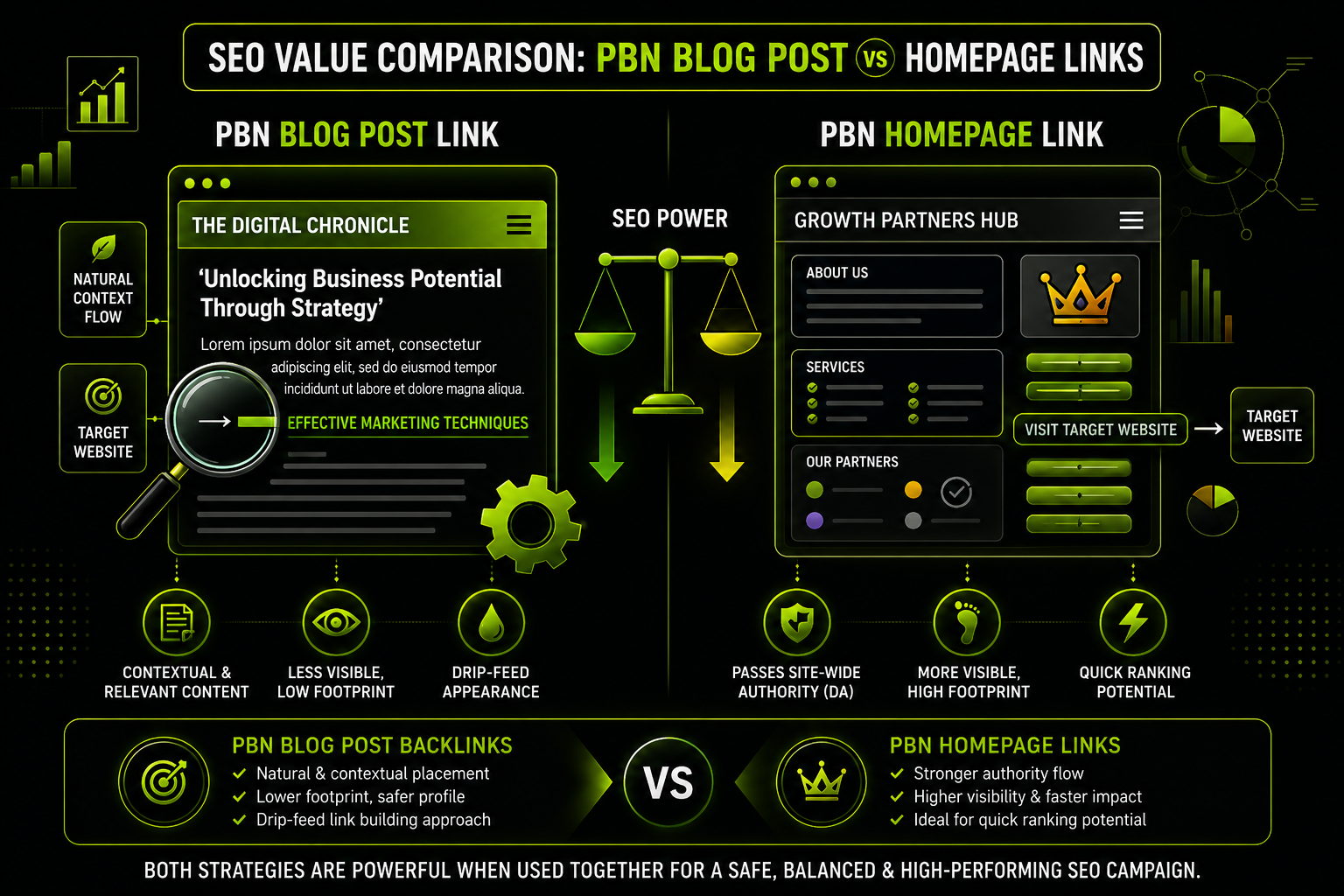
Blog Post Links vs. Homepage PBN Links
| Factor | Blog Post Link | Homepage Link |
|---|---|---|
| Topical relevance signal | High — article is topic-specific | Medium — depends on homepage content |
| Raw authority transfer | Medium — inner page equity | High — strongest page on domain |
| Footprint risk | Lower — looks like editorial | Higher — unnatural homepage pattern |
| Anchor text flexibility | Full control in article | Limited by homepage context |
| Best use | Supporting and inner pages, niche campaigns | Quick authority injection, new sites |
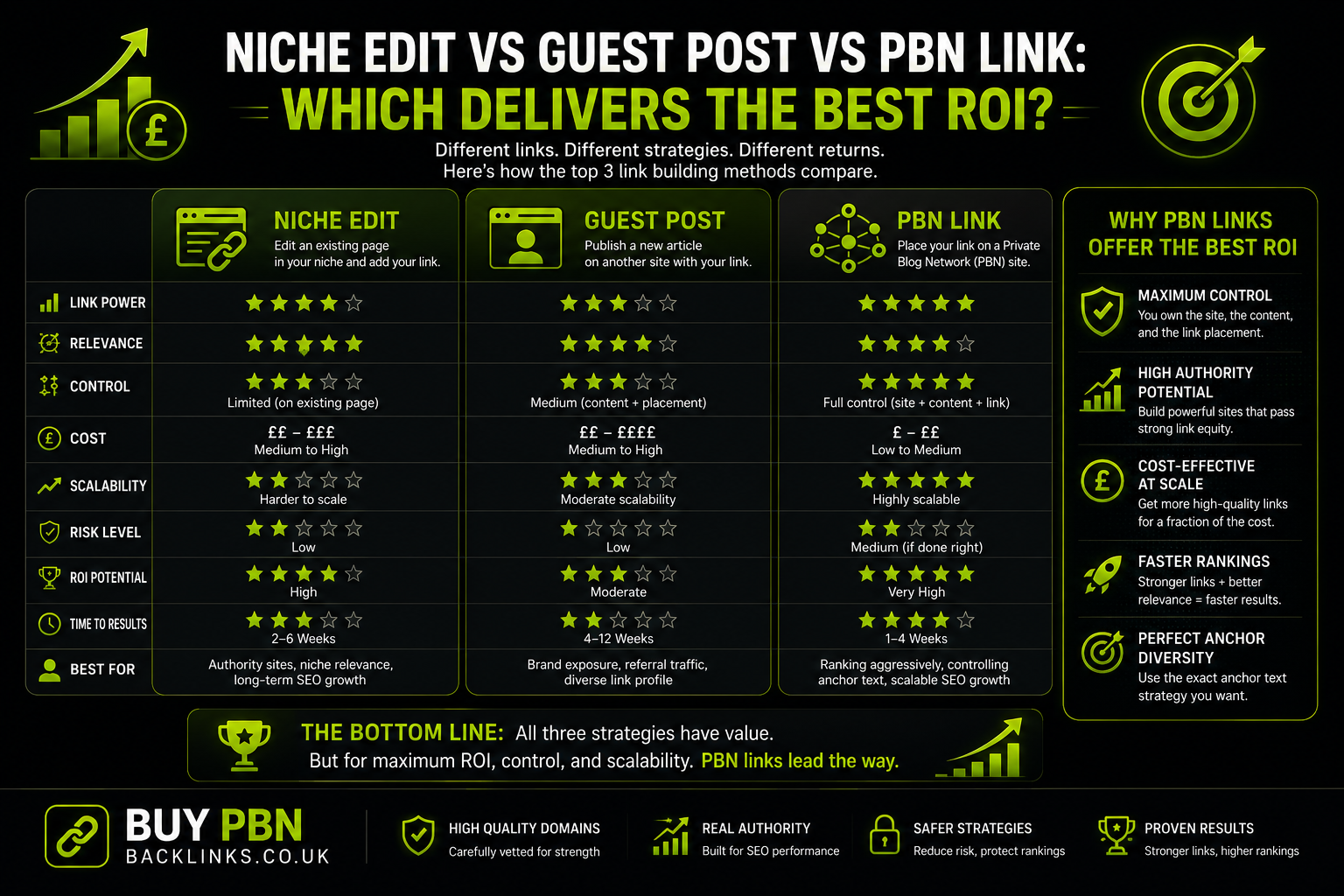
Blog Post Links vs. Niche Edits
| Situation | Better Choice | Reason |
|---|---|---|
| You need topical precision for a specific niche | Blog post link | Full control over surrounding content |
| Speed of authority is the priority | Niche edit (aged page) | Page has history; authority transfers faster |
| Anchor text strategy is critical | Blog post link | Context can be written around your anchor |
| Budget is tight | Niche edit | Lower content creation cost |
| Tier 2 amplification | Either | Both work; blog post often cheaper |
The Value of Contextual Placement
A link is truly contextual when three conditions are met simultaneously: the linking domain covers the same or adjacent topic as your target page; the article in which the link appears is focused on a topic semantically related to your target page; and the passage surrounding the link references the linked concept naturally. All three conditions can be satisfied by a well-executed blog post PBN link. Google Helpful Content and link spam systems have progressively refined the ability to distinguish between links that flow naturally from genuine editorial decisions and links that were placed artificially.
Best Anchor Text Types for Blog Post Links
Anchor text strategy is more important for blog post PBN links than for almost any other link type, because you have full control over what the anchor says. If you are new to PBN placements, start with our complete buyer’s guide to PBN links before ordering. The most common mistake buyers make is over-optimising with exact-match anchors on every placement.
The most common mistake buyers make is over-optimising: choosing exact-match anchors for every placement because they feel like the most direct path to ranking for a specific keyword. In practice, a page receiving multiple exact-match PBN links triggers anchor text over-optimisation signals that can suppress rather than improve rankings.
The Five Anchor Types and When to Use Each
1. Exact Match
Example: “buy PBN blog post backlinks”
Use sparingly — ideally no more than 10–15% of your total anchor profile for a given target page. Exact-match anchors from PBN links are one of the clearest algorithmic signals of manipulative link building when they appear in clusters. Reserve them for high-value placements on the strongest domains in a seller’s inventory.
2. Partial Match
Example: “PBN blog post links for SEO campaigns”
The most versatile and safest anchor type for blog post placements. Partial-match anchors include your target keyword as a component but embed it within a natural phrase that reads like something a human editor would write. They pass strong topical signals without the over-optimisation risk.
3. Topical / Semantic Anchor
Example: “contextual backlinks from private blog networks”
Topical anchors signal relevance to Google’s semantic understanding of your page’s topic without referencing your target keyword directly. They are particularly valuable for building the semantic authority of a page that targets multiple related keywords rather than a single phrase.
4. Branded Anchor
Example: “BuyPBNBacklinks.co.uk”
Branded anchors build entity recognition and look completely natural in editorial content. They pass domain-level authority signals and help establish brand association in Google’s understanding of your site. Aim for branded anchors on at least 20–30% of your total PBN placements.
5. Naked URL Example: “https://buypbnbacklinks.co.uk“
Naked URL anchors look natural in contexts where a writer is simply directing a reader to a resource. They diversify anchor profiles and are a low-risk choice when you want the link equity without touching the keyword.
| Anchor Type | Recommended % of Blog Post Links |
|---|---|
| Partial match | 35–45% |
| Topical and semantic | 20–30% |
| Branded | 15–25% |
| Naked URL | 10–15% |
| Exact match | 5–10% |
Real-World Use Case Scenarios

Scenario 1: Supporting Content Page on a Commercial Site
A business selling legal services has a pillar article sitting at position 8 with a thin backlink profile. Three to five blog post placements on PBN domains covering business law, commercial property, and small business topics — with partial-match and topical anchors pointing directly at the pillar article — deliver the topical authority signal that homepage links to an inner page cannot credibly provide.
Scenario 2: New Product Page in a Competitive Niche
An e-commerce site has launched a product page for industrial safety equipment. Four to six blog post placements on health and safety, manufacturing, or workplace compliance-themed PBN sites — with longer articles discussing product safety standards and the client page linked as a resource — reinforce both relevance and authority transfer at all three contextual levels.
Scenario 3: Tier 2 Authority Amplification
An SEO agency has placed a high-quality guest post on a DR55 industry publication for a client. That guest post links to the client money site but the guest post page itself has few external links pointing to it. Three to four cheap entry-level blog post PBN links pointing at the guest post URL — not the money site — amplify the authority of the guest post page, which then passes a stronger signal to the money site through the existing editorial link.
Blog post PBN link strategy: Three to four cheap entry-level blog post PBN links pointing at the guest post URL (not the money site). This amplifies the authority of the guest post page itself, which then passes a stronger signal to the money site through the existing editorial link.
Why blog post over niche edit for Tier 2: At Tier 2, the priority is link equity volume, not topical precision. Blog post placements at entry-level pricing offer the most cost-effective way to build referencing links to a target URL without the complexity of managing niche edit inventory.
FAQ
Do PBN blog post backlinks still work in 2026?
Yes, when placed correctly. The key conditions are topical relevance between the PBN domain and your target page, genuine content quality in the article surrounding the link, and a natural anchor text strategy that does not cluster exact-match phrases. Links meeting these conditions continue to move rankings in competitive niches.
What is the difference between a PBN blog post link and a niche edit?
A blog post link is placed inside a newly created article published specifically for the placement. A niche edit inserts your link into a pre-existing published article. Blog post links offer more control over context and anchor text; niche edits offer the authority of an aged indexed page.
How long does it take for a PBN blog post link to affect rankings?
Most quality placements on actively maintained PBN sites index within three to ten days of publication. Ranking movement, if the page has the right on-page fundamentals, typically becomes visible within three to six weeks. If there is no movement after eight weeks, investigate whether the link is indexed or whether the competitive gap requires more link volume.
Should I use exact-match anchors for PBN blog post links?
Only sparingly. Keep exact-match anchors below 10 to 15 percent of your total anchor profile for any given target page, and use partial-match, topical, and branded anchors for the majority of your blog post PBN placements.
Can I provide my own article for a PBN blog post placement?
Many sellers accept or prefer buyer-supplied content. This is worth doing when topical precision matters — you understand your niche better than a general content writer, and you can craft the article and anchor passage to maximise contextual alignment. Confirm word count minimums and formatting requirements before submitting.
Conclusion
Blog post PBN links remain one of the most controllable and contextually coherent link types in the PBN market. The ability to shape the topic, anchor text, and surrounding passage around your specific target page gives this placement type an edge over homepage links and niche edits in scenarios where relevance precision matters more than raw authority volume. The answer to whether they still work is straightforward: yes, for practitioners who understand what makes them work. For a head-to-head comparison between this placement type and niche edits, see our buy niche edits vs PBN links guide.
To explore vetted placements that meet the contextual and quality standards this guide describes, visit the buy PBN blog post backlinks options available and apply the anchor text framework above to your order brief.
About the Author
Louis Dobbler is a PBN link building strategist and off-page SEO specialist with deep expertise in private blog network construction, domain acquisition, and authority link campaigns. At BuyPBNBacklinks, Louis oversees network quality, domain vetting, and campaign strategy — ensuring every PBN backlink placed meets the highest standards for authority, footprint safety, and long-term SEO performance.

Louis Dobbler is a PBN link building strategist and off page SEO specialist with deep expertise in private blog network construction, domain acquisition, and authority link campaigns. With years of experience working across competitive verticals including iGaming, crypto, finance, and CBD, Louis has helped hundreds of SEO agencies and affiliate marketers engineer rankings that hold through every Google core update.
At BuyPBNBacklinks, Louis oversees network quality, domain vetting, and campaign strategy ensuring every PBN backlink placed meets the highest standards for authority, footprint safety, and long term SEO performance.