For SEO agencies and power users who need consistent, scalable link building across multiple client campaigns, buying a PBN network represents a fundamentally different investment model from purchasing individual link placements. Instead of paying per link indefinitely, you pay once to build or acquire infrastructure that generates link equity repeatedly at near-zero marginal cost per placement. This guide covers practical network architecture, minimum viable network size, full build versus buy cost comparison, management tools and workflows, and footprint avoidance — the dimension of network construction that most determines whether it remains effective long-term.
Key Takeaways
- A minimum viable PBN network for a single money site campaign is 7–10 sites; for multi-client agency use, 20–30+ sites across diverse topical clusters.
- Buying a pre-made network is typically faster but requires thorough vetting — quality of existing infrastructure varies enormously.
- Annual operating cost for a well-maintained 20-site network is approximately £4,000–£8,000 excluding domain acquisition.
- Footprint avoidance — different IPs, registrars, themes, and nameservers — is the single most important technical dimension of network longevity.
Network Architecture Basics
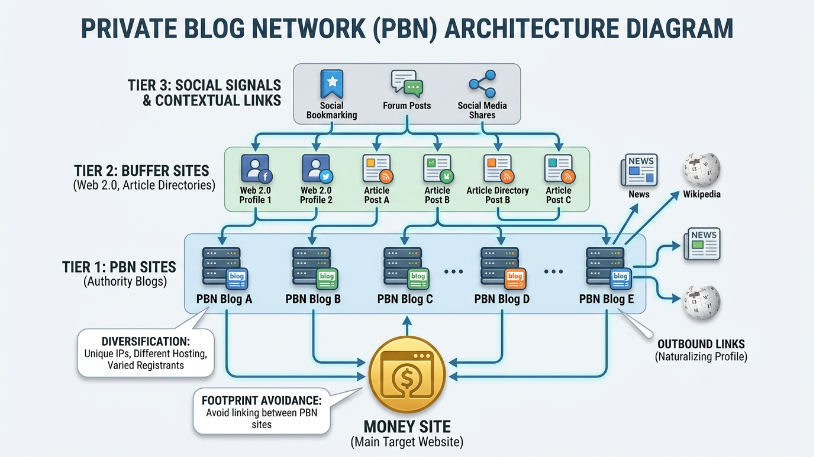
A well-constructed PBN uses a three-layer architecture.
Layer 1 — Money Sites: target sites with no visible connection to the PBN.
Layer 2 — Tier 1 PBN Sites: highest-quality domains linking directly to money sites, with each domain linking to only 2–3 money sites.
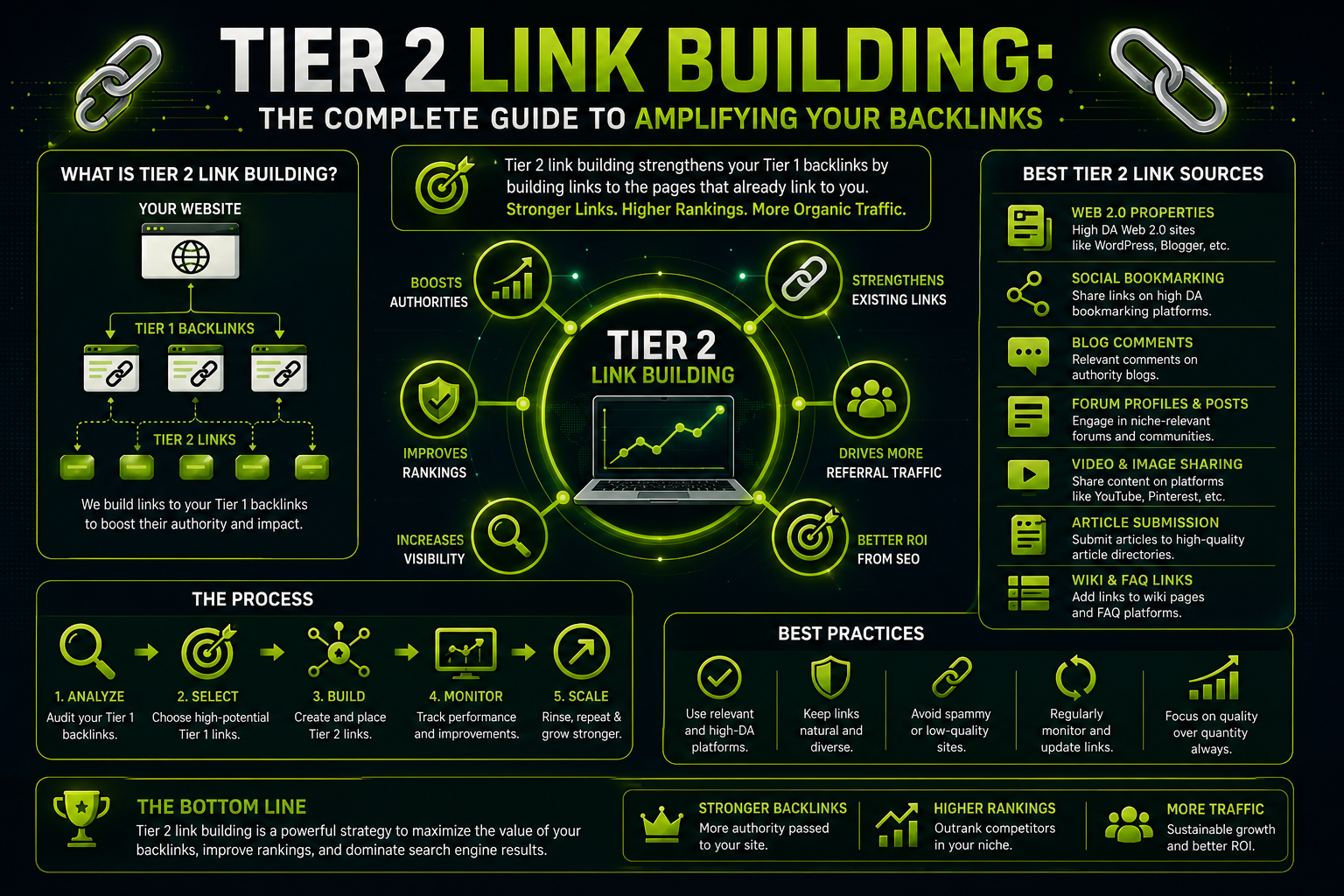
And Layer 3 — Tier 2 Support Sites: lower-quality domains linking to Tier 1 sites to amplify their authority. Within Tier 1, organise into topical clusters aligned with client niches — business/finance, technology/SaaS, health/lifestyle, local/services — for maximum topical relevance signals.
Topical Cluster Structure
Within the Tier 1 network, organise sites into topical clusters aligned with client niches. A 20-site network serving multiple clients might be structured as:
- 5 sites covering business/finance topics
- 5 sites covering technology/SaaS topics
- 5 sites covering health/lifestyle topics
- 5 sites covering local/services topics
This topical organisation allows each client’s money site to receive links from thematically relevant domains — increasing the topical authority signal — while maintaining diversity across the full network.
Minimum Network Size for Meaningful Impact
For a Single Money Site
The minimum viable network for a single money site campaign is 7–10 sites. Below this threshold:
- The footprint concentration risk is high — multiple links from only 3–4 domains is a detectable pattern
- The topical diversity is insufficient to build meaningful topical authority signals
- The link volume is too low to meaningfully close authority gaps against competitive targets
For competitive terms (DR50+ competition), 7–10 sites represents a starting point rather than a complete solution. Significant competitive campaigns typically require 20–40+ quality network sites or supplement the PBN with other link acquisition methods.
For Agency Multi-Client Use
For agencies running concurrent campaigns across 5–10 clients, a minimum of 20–30 sites is needed to avoid cross-contamination between clients’ link profiles. Using the same 7 PBN sites for ten different clients creates a pattern where all client sites share referring domains — potentially surfacing during competitive analysis.
The practical rule is: each client should receive links from domains not used for any other client. This requires a network large enough to partition the inventory by client without running out of available domains.
Build vs. Buy Cost Comparison
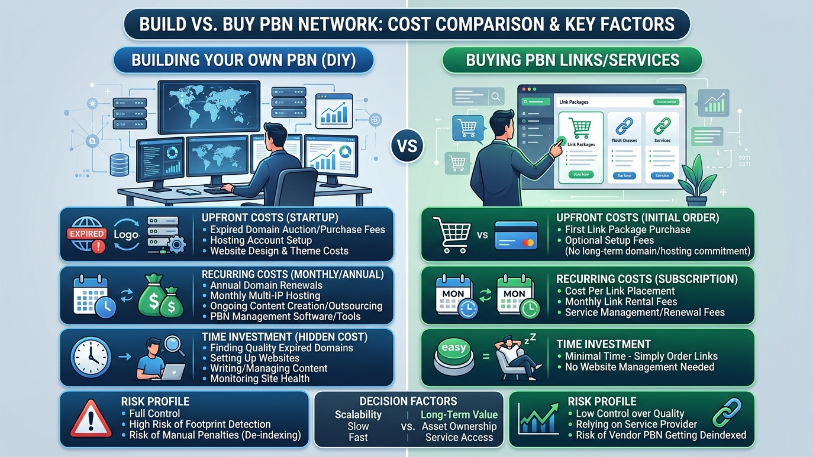
Building From Scratch
Year 1 cost for a 20-site network at mid quality:
- 20 domains at auction: £80–£200 each = £1,600–£4,000
- Hosting for 20 sites: £200–£600/year
- Initial content (10 articles/site at £15–£40/article): £3,000–£8,000
- Tools (Spamzilla subscription, Ahrefs, Majestic): £150–£400/year
- Setup time (40–80 hours): value depends on your hourly rate
Total hard cost: £5,000–£13,000 in year one
Buying a Pre-Made Network
Pre-made PBN networks are sold by professional builders and occasionally by agencies scaling down operations. Typical pricing:
| Network Size | Quality Level | Buy Pre-Made | Build from Scratch |
|---|---|---|---|
| 5–7 sites | Entry | £800–£2,000 | £675–£2,345 |
| 10–15 sites | Mid | £2,500–£6,000 | £3,250–£9,000 |
| 20–30 sites | Mid-Premium | £6,000–£15,000 | £6,500–£18,000 |
Management Tools and Workflows
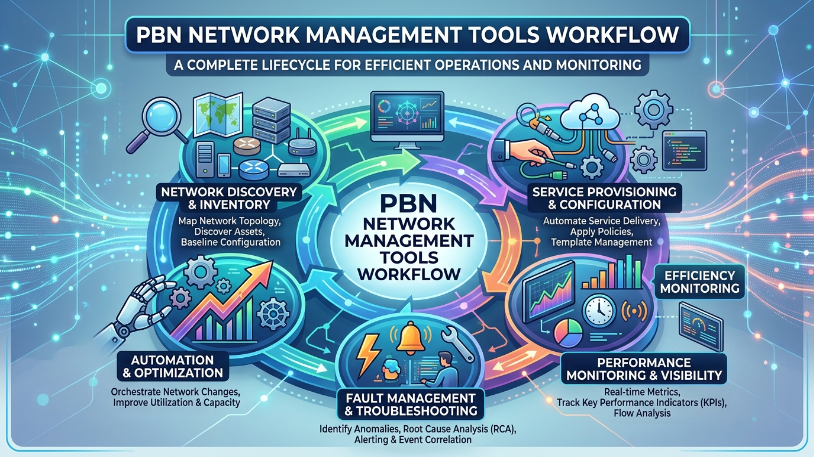
Efficient network management is what makes the difference between a network that remains effective long-term and one that gradually deteriorates without your awareness.
Core Tool Stack
Domain monitoring: Track domain expiry dates, WHOIS changes, and hosting account status. Tools: DomainHunter Plus, manual spreadsheet tracking, or a dedicated domain management platform.
Link monitoring: Verify that placed links remain live and indexed. Tools: Ahrefs (backlink monitoring), LinkChecker, or custom Google Alerts for placed article URLs.
Rank tracking: Track money site keyword positions to correlate with link placements. Tools: Ahrefs, Semrush, or dedicated rank trackers.
Content management: Schedule and manage ongoing content publication across network sites. Tools: WordPress editorial calendars, Trello/Notion for content tracking, or a VA management workflow.
Indexation tools: Ensure new articles and new domains get indexed quickly. Tools: Omega Indexer, Rapid URL Indexer, or Google Search Console manual URL submission.
Minimal Viable Management Workflow
For a 20-site network with monthly maintenance:
| Task | Frequency | Time per 10 sites |
|---|---|---|
| New content publication (1 article/site/month) | Monthly | 2–3 hours |
| Link placement and delivery management | Per campaign | 30 min/placement |
| Indexed status checks on recent placements | Monthly | 1 hour |
| Domain expiry review | Monthly | 30 minutes |
| Deindexation checks and replacement | Monthly | 1–2 hours |
| Total monthly management time per 10 sites | 5–7 hours |
Risk Compartmentalisation and Footprint Avoidance
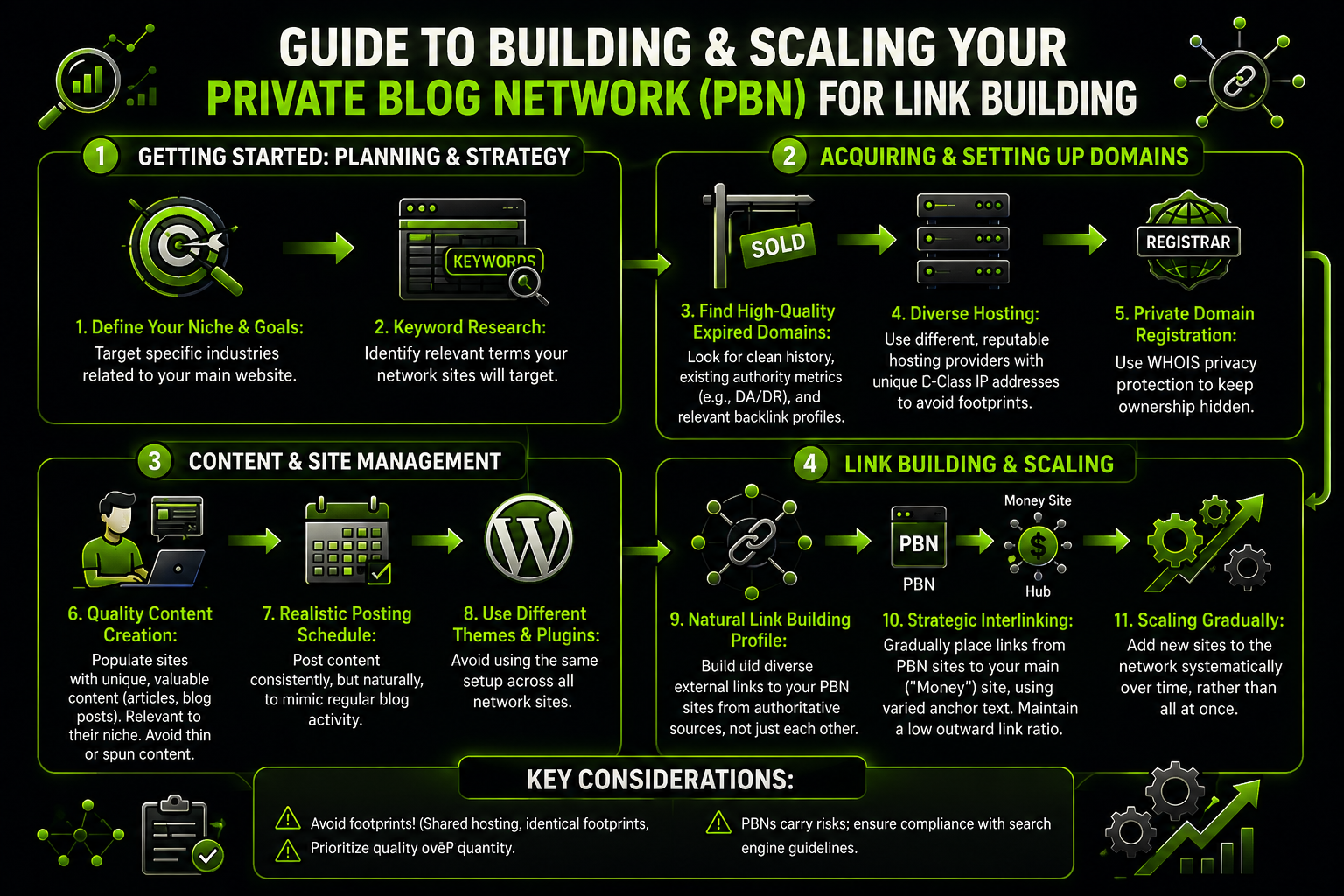
Footprint avoidance is the technical dimension of PBN network construction that most determines whether the network remains usable long-term. Every point of commonality between network sites is a potential discovery vector.
The Five Footprint Dimensions
1. IP Address Diversity No two network sites should share the same /24 IP block. Use different hosting providers for each site, or use different accounts on hosting providers that offer IP diversity (cloud hosting, dedicated IPs). If multiple sites share the same IP range, a technical audit of one site exposes the others.
2. Registrar Diversity Spread domain registrations across at least 4–5 different registrars: Namecheap, GoDaddy, Porkbun, Cloudflare Registrar, Name.com. A single registrar holding all PBN domains is a single discovery point.
3. Nameserver Diversity Use different nameservers across the network. Default Cloudflare nameservers on every site creates a consistent pattern. Mix in hosting provider nameservers, custom nameservers, and alternative DNS providers.
4. Theme and Design Diversity Every site should use a different WordPress theme. Identical visual templates across 20 sites is the most easily visible footprint pattern in a manual review. Use a mix of free and paid themes from different developers.
5. Content and Publishing Pattern Diversity Each site should have a distinct publishing cadence, article length profile, and topical focus. Networks where every site publishes exactly two 500-word articles per month on alternating Tuesdays have an obvious programmatic fingerprint.
Risk Compartmentalisation by Client
For agency networks, never allow links from the same domain to point to two different client money sites. Maintain a domain-to-client mapping that enforces this separation. If a client leaves or their campaign ends, retire those domains from active use before reassigning them to a new client.
When Network Ownership Makes Sense for Agencies
Network ownership reaches positive ROI for agencies at approximately the point where the cost of purchasing individual placements on external networks exceeds the annualised cost of owning equivalent infrastructure.
The Break-Even Calculation
An agency spending £2,000/month on external PBN placements at £50/link (40 links/month) is paying £24,000/year. A 30-site mid-quality network built for £12,000 with £5,000/year in maintenance costs has an all-in cost of £17,000 in year one and £5,000/year ongoing — saving £7,000 in year one and £19,000/year from year two onwards.
The break-even is roughly: at 30+ links per month needed consistently, infrastructure ownership becomes more economical than buying placements.
Below that volume, the simplicity and flexibility of buying placements — no management overhead, no infrastructure commitment, no capital investment — typically outweighs the cost premium.
The Five Footprint Dimensions
1. IP Address Diversity: No two network sites should share the same /24 IP block. Use different hosting providers for each site.
2. Registrar Diversity: Spread domain registrations across at least 4–5 different registrars.
3. Nameserver Diversity: Mix hosting provider nameservers, custom nameservers, and alternative DNS providers.
4. Theme and Design Diversity: Every site should use a different WordPress theme.
5. Content and Publishing Pattern Diversity: Each site should have a distinct publishing cadence, article length profile, and topical focus.
FAQ
How many sites do I need in a PBN network to see results?
A minimum of 7–10 sites for a single money site campaign. For agency multi-client use, 20–30+ sites to avoid cross-contamination between client link profiles.
Is it better to buy a pre-made PBN or build from scratch?
Buying is faster; building gives more quality control. The decision depends on time constraints and technical capability. DIY provides better long-term economics for practitioners who can build quality domains.
What tools do I need to manage a PBN network?
Domain expiry tracker, link monitoring (Ahrefs or LinkChecker), rank tracker, content management workflow, and indexation tools. Budget £150–£400/month for a comprehensive stack.
How do I avoid footprint issues?
Diversity across IP addresses, registrars, nameservers, WordPress themes, publishing cadences, and content structures. Each site should appear independently operated.
Can I sell a PBN network?
Yes — networks are sold regularly between practitioners. Value depends on domain quality, traffic profiles, placement history, and whether the network has been maintained without visible footprint issues.
Conclusion
Network ownership is an infrastructure investment decision. The economics favour ownership at scale — particularly for agencies running sustained campaigns across multiple clients. The footprint avoidance section of this guide is the most critical for long-term network value. For agencies and experienced link builders ready to explore infrastructure ownership, visit buy PBN network for professional network setup services and pre-vetted domain inventory.
About the Author
Louis Dobbler is a PBN link building strategist and off-page SEO specialist at BuyPBNBacklinks, with deep expertise in private blog network construction, domain acquisition, and authority link campaigns.

Louis Dobbler is a PBN link building strategist and off page SEO specialist with deep expertise in private blog network construction, domain acquisition, and authority link campaigns. With years of experience working across competitive verticals including iGaming, crypto, finance, and CBD, Louis has helped hundreds of SEO agencies and affiliate marketers engineer rankings that hold through every Google core update.
At BuyPBNBacklinks, Louis oversees network quality, domain vetting, and campaign strategy ensuring every PBN backlink placed meets the highest standards for authority, footprint safety, and long term SEO performance.