Building a private blog network from scratch requires more planning, investment, and ongoing management than most first-time builders expect. Done correctly, a well-constructed PBN gives you a controllable, scalable link building infrastructure that compounds in value with every quality domain added. Done incorrectly, it creates a fragile system that collapses under Google scrutiny and wastes significant time and money. This guide covers every step of the PBN building process from finding and evaluating quality domains through to hosting setup, content strategy, and footprint avoidance with the specific standards that separate networks that hold up in 2026 from those that do not.
Step 1 — Decide Your Network Size and Structure
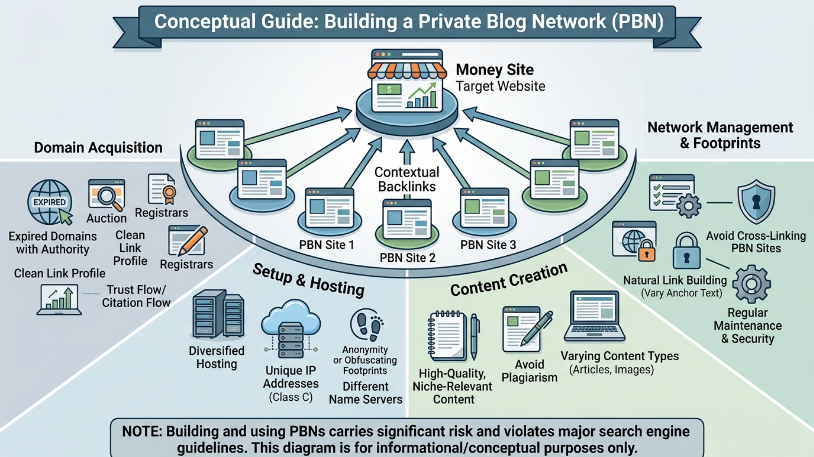
Before sourcing a single domain, define the network structure you are building toward. This determines the domain sourcing criteria, hosting budget, and content strategy for the entire project.
Minimum Viable Network Sizes
| Use Case | Minimum Sites | Recommended Sites | Notes |
|---|---|---|---|
| Single money site, low-KD keywords | 5 | 7–10 | Enough diversity for low-competition targets |
| Single money site, mid-competition | 10 | 15–20 | More authority depth needed |
| Agency, 3–5 clients | 20 | 25–35 | Separate domains per client |
| Agency, 10+ clients | 40 | 50+ | Topical clusters across all niches |
Topical Cluster Planning
Organise your planned network into topical clusters aligned with your money site niches. A 15-site network serving three client verticals might be structured as five finance-adjacent domains, five technology-adjacent domains, and five local/service-adjacent domains. This topical planning determines which expired domains to pursue at the sourcing stage — a finance domain is far more useful for a finance client than a generic lifestyle blog domain.
If you are not ready to build a full network, a professional PBN setup service can deliver a configured network faster and often more cost-effectively than a first-time DIY build. Read the full comparison before committing to the DIY route.
Step 2 — Source Quality Expired Domains
Domain sourcing is the most time-intensive step and the most consequential for long-term network quality. Every placement the network ever makes depends on the quality of the domains it is built on.
Where to Find Expired Domains
GoDaddy Auctions — The largest single source of expiring domains with traffic and authority. Filter by Majestic TF, Ahrefs DR, and domain age. Set up saved searches for your target niche keywords and check daily during auction closing periods. Competition for quality domains is high — budget for domain costs of £80 to £300+ for genuinely strong domains.
Spamzilla — An aggregator specifically designed for PBN domain sourcing that pulls from multiple auction sources and applies pre-filtering by TF, DR, and spam indicators. Spamzilla is the most time-efficient sourcing tool for practitioners building networks at scale. It allows filtering by live referring domain count — particularly valuable for identifying pre-linked domains as covered in our PBN domains with backlinks guide.
DomCop and DomainHunter Plus — Additional aggregators with slightly different domain pools. Cross-referencing multiple sourcing tools surfaces opportunities that any single tool misses.
Expiry monitoring for real content sites — Domain expiry monitoring services alert you when specific types of sites approach expiry. Real content sites — niche blogs, local business sites, industry publications — that are being abandoned by their owners represent the highest-quality acquisition opportunities when caught at expiry. These sites have genuine organic traffic histories and real editorial content that no auction aggregator can replicate at scale.
Sourcing Filters to Apply
Set these minimum filters in your sourcing tool before reviewing any domain:
- Majestic Trust Flow: 15 or above
- Ahrefs Domain Rating: 20 or above
- Referring domains: 15 or above (live, not historical)
- Domain age: 3 years or older
- Spam Score (Moz): below 30 percent
These filters narrow the field significantly but prevent the most common expensive mistake: buying a domain that looks adequate in one metric but fails in all the others.
Step 3 — Evaluate Domains Before Buying
Every domain that passes your initial sourcing filters needs individual evaluation before purchase. This process takes 10 to 15 minutes per domain and prevents the majority of costly mistakes.
The 5-Step Domain Evaluation
Check 1 — Organic traffic (Ahrefs). Open the domain in Ahrefs Site Explorer → Organic Search → Traffic. Any genuine monthly traffic confirms Google trust. Zero traffic at any DR level means the domain has not demonstrated editorial quality to Google and should be skipped unless it passes all other checks exceptionally well. For guidance on what makes a domain genuinely authoritative see our high DA PBN links guide.
Check 2 — Backlink quality (Ahrefs with spam filter). Open Referring Domains in Ahrefs with the spam filter on. Count real, diverse referring domains — not just the total. Look at the anchor text report. Anchor text dominated by casino, pharma, or adult keywords in foreign languages signals the domain was previously used in a link scheme and carries residual spam associations.
Check 3 — Content history (Wayback Machine). Enter the domain at web.archive.org. Confirm genuine, topically coherent content exists across multiple years. A domain with five years of finance blog history is a legitimate authority source. A domain with parking page history or frequent niche changes was never a real editorial site.
Check 4 — Trust Flow and spam score. Check Trust Flow in Majestic — TF 15 or above with TF:CF ratio above 0.4 minimum. Check Spam Score in Moz — below 30 percent. These together confirm the domain link profile connects to trusted web properties rather than just other link farms.
Check 5 — Google index check. Search site:domain.com in Google. The domain should have indexed pages returning. Zero results means the domain is deindexed — disqualify immediately regardless of other metrics.
Step 4 — Set Up Hosting With Genuine IP Diversity
Hosting setup is where most amateur PBN builders create the footprint that eventually exposes their network. The temptation to put all sites on one convenient hosting account is understandable — it is cheaper and simpler. It is also the fastest route to network-wide exposure.
The Five Hosting Rules
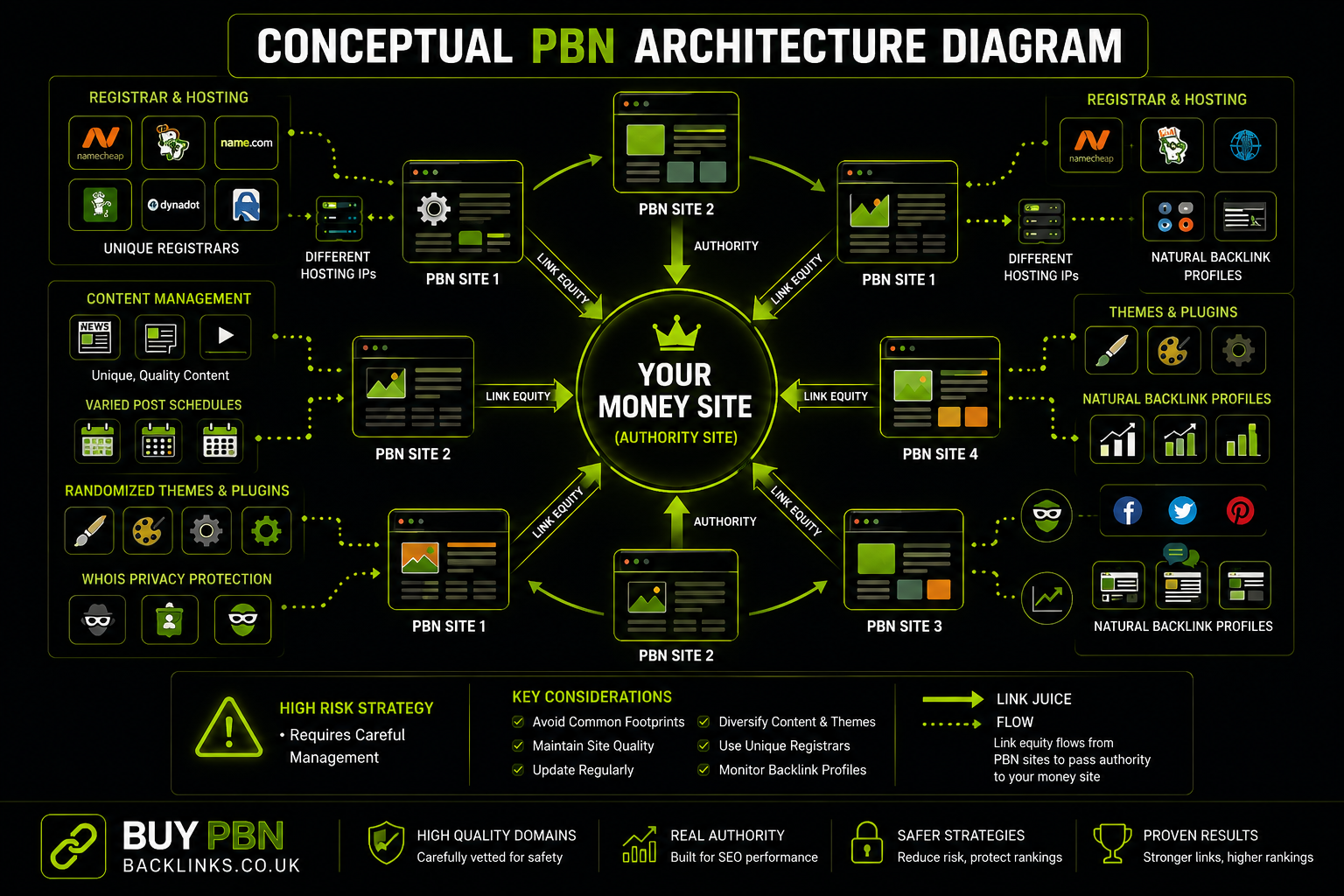
Rule 1 — One site per hosting account. Never host multiple PBN sites under the same cPanel or hosting account. If one account is flagged, all sites on it are exposed simultaneously.
Rule 2 — Different /24 IP block per site. No two network sites should share the same /24 IP range. Sites at 185.62.147.X and 185.62.147.Y are on the same discoverable block. Use hosting providers with genuinely diverse IP allocation or spread sites across multiple providers across different geographic regions.
Rule 3 — Different registrars across the network. Spread domain registrations across at least four to five different registrars: Namecheap, Porkbun, GoDaddy, Cloudflare Registrar, and Name.com cover sufficient diversity. All domains at one registrar is a single account that exposes the full network.
Rule 4 — Different nameservers per site. Mix hosting provider nameservers, Cloudflare, and custom nameservers across the network. Default Cloudflare nameservers on every site creates an easily identifiable pattern.
Rule 5 — Different WordPress themes and configurations. Every site should use a different theme from different theme developers. Identical themes across 20 sites is the most visually obvious footprint pattern in a manual review.
Recommended Hosting Setup
For genuine IP diversity at manageable cost, combine:
- Budget cPanel hosting at different providers (Hostinger, Namecheap Hosting, DreamHost) — one account per site or per two to three sites maximum
- Cloud VPS instances (DigitalOcean, Vultr, Linode) — dedicated IPs with full configuration control
- Regional hosting providers in different countries — UK, US, EU, and AU-based providers produce natural IP range diversity
For a complete guide to network architecture and hosting infrastructure see our buy PBN network guide.
Step 5 — Install WordPress and Configure Each Site
WordPress is the standard CMS for PBN sites because it is easy to configure, supports diverse themes and plugins, and is indistinguishable from legitimate editorial blogs when properly set up.
WordPress Configuration Checklist Per Site
- Install a unique theme different from every other site in your network
- Install Yoast SEO or RankMath for sitemap and meta management
- Install a caching plugin (WP Super Cache or W3 Total Cache) for load speed
- Create an About Us page, Contact page, and Privacy Policy page
- Set permalink structure to /%postname%/ for clean URLs
- Configure sitemap and submit to Google Search Console
- Set a unique site title and tagline reflecting the domain niche
- Add a site logo appropriate to the niche
- Create a named author with a plausible bio relevant to the site topic
Each of these details contributes to the site appearing as a legitimate independent editorial operation rather than a network node. The more each site looks like a real stand-alone website, the harder the network is to identify through manual review.
Step 6 — Content Strategy and Initial Population
Content quality is the variable that most directly determines whether your PBN sites maintain their indexation long-term. Google Helpful Content systems actively evaluate whether pages are created for users or for search engine manipulation. Sites that pass this evaluation maintain their rankings and crawl frequency. Sites that fail it get deindexed or suppressed — taking every money site link they host with them.
Initial Content Requirements Per Site
Publish a minimum of eight to ten articles before placing any money site links. This initial content establishes topical coherence and gives Google enough content to evaluate the site positively before it receives or passes outbound link signals.
Article specifications:
- Minimum 500 words per article — 600 to 800 is better
- Human-written or high-quality AI with editorial review — not raw AI output
- Topically coherent with the domain history and niche
- Internal links between articles on related topics
- At least one image per article with descriptive alt text
- No duplicate or substantially similar content between network sites
Ongoing Content Schedule
Publish one to two new articles per month on each site after initial population. This signals ongoing editorial activity to Google crawlers, which increases crawl frequency and ensures new money site links are discovered and processed quickly. Sites that stop publishing after initial setup gradually lose crawl attention, slowing the authority transfer from any links placed on them.
Step 7 — Place Money Site Links
With domains acquired, hosting configured, WordPress installed, and initial content published, your network is ready to place money site links. Apply these standards to every placement.
Link Placement Standards
Contextual placement only. Your money site link must appear within the body of an article, embedded naturally in a paragraph covering a related topic. Never place links in footers, sidebars, author bios, or link lists. Contextual placement signals editorial endorsement; non-contextual placement signals manufactured link schemes.
One to two money site links per PBN article. Each article should contain no more than two external links total, with your money site link as one of them. An article with ten external links distributes its PageRank across all ten destinations — your link receives a fraction of what it would in an article with one to two outbound links.
Maximum two to four money site links per PBN domain. Each PBN domain should link to your money site from no more than two to four different articles. Concentration of links from a single domain — even a quality one — creates a detectable pattern and passes diminishing returns beyond the first few links.
Anchor text following safe distribution. Keep exact-match keyword anchors below 10 percent of your total money site link profile. Use branded, generic, topical, and partial-match anchors across the majority of placements. For the full anchor text framework see our buy backlinks for SEO strategy guide.
Step 8 — Index, Monitor, and Maintain
A PBN is not a set-and-forget system. Ongoing maintenance determines whether the network retains its value or gradually decays without your awareness.
Indexation
After publishing each money site link article, submit it to Google Search Console via URL Inspection. Use an indexation service (Omega Indexer, Rapid URL Indexer) to accelerate discovery. Confirm indexation via site:articleurl in Google before counting the link as active in your tracking records. An unindexed article passes zero authority regardless of the domain strength.
Monthly Maintenance Tasks
- Check domain expiry dates — renew any expiring within 60 days
- Publish one to two new articles per site
- Spot-check placed links via site:articleurl in Google — flag any deindexed pages
- Review money site rankings and correlate movements with placement dates
- Update your placement tracking spreadsheet with any status changes
When a PBN Site Gets Deindexed
Deindexation happens. A previously trusted domain may lose indexation due to content quality issues, algorithm updates, or hosting problems. When it does, the links hosted on it pass zero authority until the site is re-indexed or replaced. Your monthly spot-checks catch these events early. Options when a site deindexes:
- Improve content quality significantly and resubmit for indexation
- Migrate the domain to better hosting if infrastructure was the cause
- Replace the domain with a new quality acquisition if the domain has lost Google trust permanently
- Move any active money site links to another network domain in the interim
DIY vs Buying Links From a Service: The Decision Point
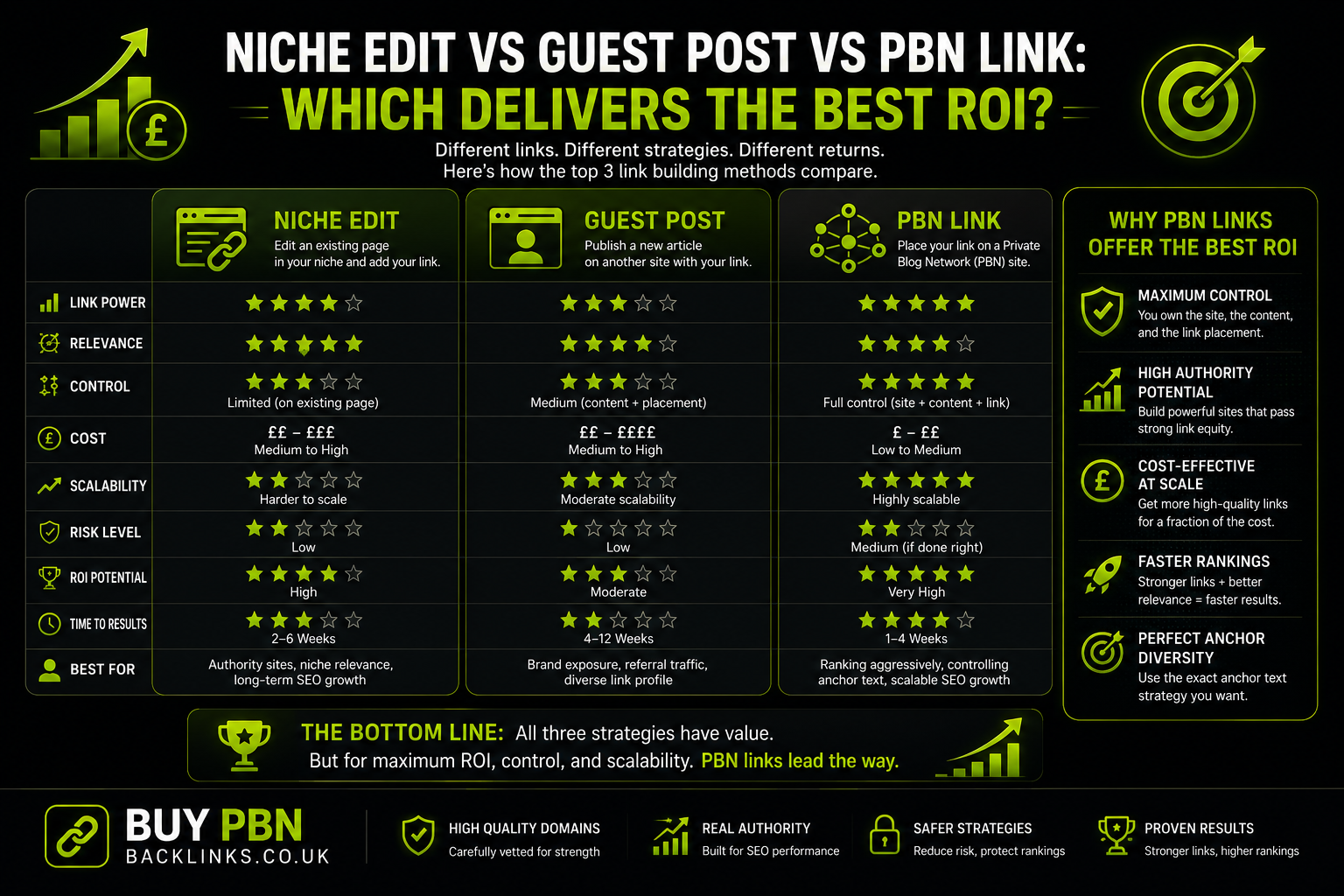
After reading this guide, many practitioners realise that building and maintaining a quality PBN is a significant ongoing operational commitment — not a one-time project. The economics of DIY vs buying links from a specialist service come down to scale and time.
| Factor | DIY PBN | Buying from Service |
|---|---|---|
| Upfront cost | High (£2,000–£8,000 for 10-site network) | Low (per-placement pricing) |
| Ongoing cost | Medium (hosting, content, renewals) | Per link only |
| Time to first link | 6–12 weeks | 3–7 days |
| Control | Maximum | Limited to brief specifications |
| Management overhead | 3–5 hours/month per 10 sites | Zero |
| Best for | High-volume long-term campaigns | Focused campaigns, testing, fast results |
For most practitioners running campaigns across one to three money sites, buying quality placements from a verified specialist service delivers better cost-per-ranking-improvement than building proprietary infrastructure. DIY becomes clearly justified at 30+ links per month needed consistently over 12+ months, or when full topical control is essential for highly specific niche campaigns.
For placement options without the infrastructure overhead, explore our complete PBN buyer guide and the available link placement options.
FAQ
How long does it take to build a PBN?
A 5 to 10 site PBN built from scratch typically takes 6 to 12 weeks. Domain sourcing takes 2 to 4 weeks, hosting and WordPress setup takes 1 to 2 weeks, and initial content creation takes 2 to 4 weeks. The timeline is primarily driven by domain sourcing speed and content production capacity.
How many sites do I need in a PBN?
Minimum 5 to 7 sites for a single money site campaign targeting low to mid-competition keywords. For competitive national keywords or agency multi-client use, 15 to 30 sites across diverse topical clusters is more appropriate. Below 5 sites the footprint concentration risk is high.
What metrics should I look for when buying PBN domains?
In order of importance: organic traffic in Ahrefs, Majestic Trust Flow 15 or above with TF:CF ratio above 0.4, Ahrefs DR 20 or above, Moz Spam Score below 30 percent, and clean backlink anchor text history. Organic traffic is the single most important signal.
How do I avoid PBN footprints?
Each site needs a unique IP in a different /24 block, different registrar, different nameservers, different WordPress theme, and distinct topical content with a different publishing cadence. Every shared element between network sites is a potential discovery vector.
Should I build my own PBN or buy links from a service?
Build your own when you need high-volume links consistently over a long period and want maximum quality control. Buy from a service when you need links quickly, are running focused campaigns, or the build economics do not justify proprietary infrastructure investment.
What content should I publish on PBN sites?
Human-written articles of 500 to 800 words on topics coherent with the domain history. One to two articles per month to maintain crawl frequency. Supporting pages including About, Contact, and Privacy Policy. No AI-spun or duplicate content across the network.
Conclusion
Building a quality PBN requires genuine investment — in domain acquisition, hosting infrastructure, content creation, and ongoing management. The networks that deliver durable ranking results are built on quality expired domains with real authority histories, hosted with genuine IP diversity, populated with human-quality content, and maintained with consistent publishing cadences and quarterly monitoring.
The shortcuts — cheap domains, shared hosting, AI content, no maintenance — produce networks that either never work or fail quickly when Google quality systems evaluate them. The investment in doing it properly is justified by the compounding returns of a network that grows in value with every quality domain added and holds up through algorithm updates that systematically eliminate the cheaper alternatives.
If the operational commitment of DIY PBN building does not fit your current capacity, quality PBN link placements from specialist providers deliver the same ranking benefits without the infrastructure overhead — explore the available options and apply the quality standards in this guide to evaluate any provider before committing.
About the Author
Louis Dobbler is a PBN link building strategist and off-page SEO specialist at BuyPBNBacklinks, with deep expertise in private blog network construction, domain acquisition, and authority link campaigns across iGaming, finance, and SaaS verticals.

Louis Dobbler is a PBN link building strategist and off page SEO specialist with deep expertise in private blog network construction, domain acquisition, and authority link campaigns. With years of experience working across competitive verticals including iGaming, crypto, finance, and CBD, Louis has helped hundreds of SEO agencies and affiliate marketers engineer rankings that hold through every Google core update.
At BuyPBNBacklinks, Louis oversees network quality, domain vetting, and campaign strategy ensuring every PBN backlink placed meets the highest standards for authority, footprint safety, and long term SEO performance.