Starting link building on a brand new website is one of the most common — and most badly executed — tasks in SEO. Most new site owners either do nothing and wait months for rankings that never come, or they buy 50 cheap links in the first week and trigger an algorithmic review that sets their site back before it has even started. Neither approach works. This guide gives you the structured, realistic roadmap that actually does: what types of links to build, in what order, at what velocity, and with what budget across a 12-month timeline. Link building for a new website is fundamentally different from building links to an established site — the rules around velocity, anchor text, and link diversity are stricter, and the margin for error is smaller. Get it right from month one and you build a compounding asset. Get it wrong and you spend six months trying to recover.
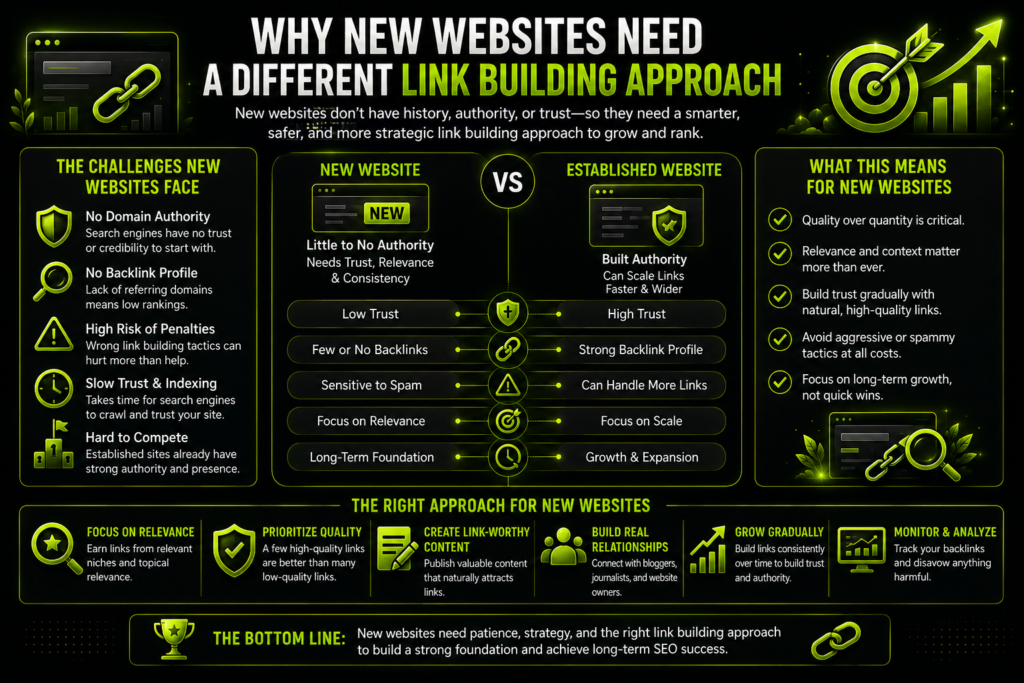
An established website with a two-year history, 50 referring domains, and consistent organic traffic has a baseline that absorbs new links naturally. A brand new domain has none of that context. Every link it receives in its first months is evaluated against a blank slate, which means two things: the right links move rankings faster than on established sites, and the wrong links create problems faster too.
Google applies what practitioners call a sandbox effect to new domains — a period of increased scrutiny where the site is evaluated for trust signals before its links are fully weighted. This period typically lasts three to six months for most niches, though it is shorter for low-competition niches and longer for YMYL verticals like finance and health. During this period, the quality and topical coherence of early links matter disproportionately — they form the trust foundation that determines how quickly the site graduates out of the sandbox.
The most common mistake in new site link building is building links before the site is ready to benefit from them. In months one and two, the priority is creating the on-page infrastructure that makes every future link more effective.
What to do:
Links to build in months 1–2: Zero to two. A small number of branded citations only. No PBN links yet — the site needs indexed content before PBN link placements have maximum effect.
By month three, your site has indexed content, a baseline crawl history, and Search Console data showing which pages are getting impressions. This is the right time to begin targeted link building.
What to build:
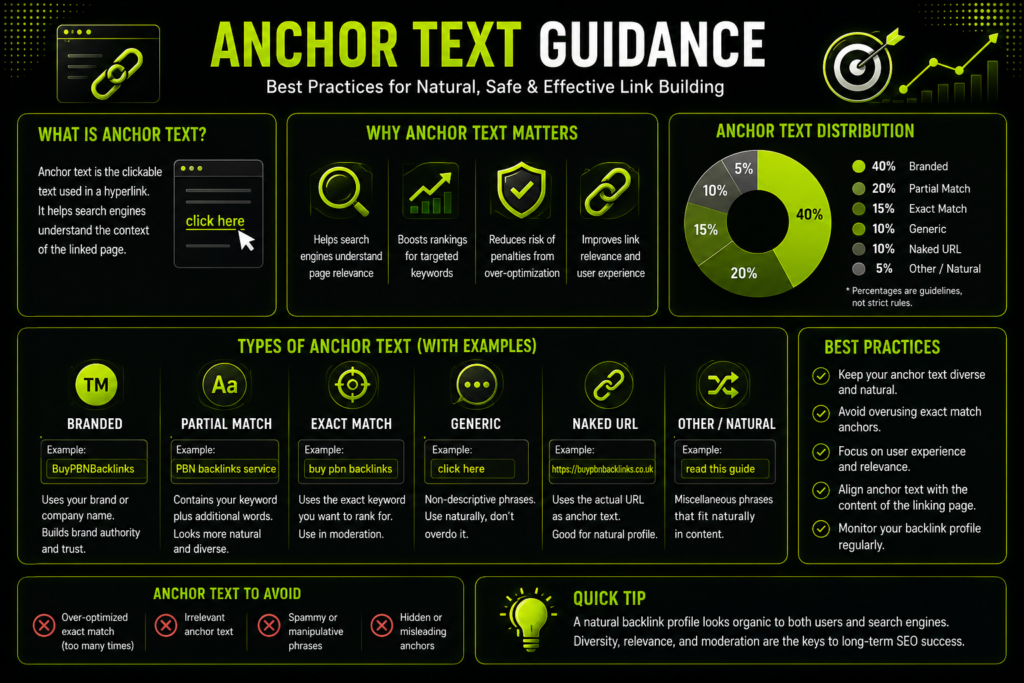
Anchor text guidance for months 3–4: 70% branded (your site name), 20% generic (visit here, read more), 10% URL anchors. Zero exact-match keyword anchors at this stage.
Velocity: One to two links per week maximum. Space placements across the full two months rather than ordering all five in one batch.
With five to seven quality links indexed and some early ranking movements visible in Search Console, months five and six focus on building topical depth — creating a cluster of thematically related links that signals niche authority to Google rather than just raw link count.
What to build:
Anchor text evolution: By month five you can introduce partial-match anchors. Suggested mix: 50% branded, 25% generic, 15% partial-match, 10% URL. Still no pure exact-match.
For a comparison of how niche edits complement PBN links at this stage, see our guide on buy niche edits vs PBN links.
By month seven, most new sites targeting low to mid-competition keywords will have several pages ranking on pages two to four of Google. The goal now is pushing those rankings into the top ten with more concentrated authority injection.
What to build:
Anchor text: At this stage you can begin introducing selective exact-match anchors on your highest-authority placements. Keep exact-match below 10% of your total link profile.
By month nine you have enough ranking data to identify which keyword clusters are responding to your link building and which need more investment. Focus your budget on doubling down on the pages and keywords already showing movement.
What to build:
The final phase of your first-year roadmap is about positioning against direct competitors rather than just climbing the rankings. By month twelve you should have 40–80 quality referring domains and be ranking in the top ten for multiple low to mid competition keywords.
What to build:
Link velocity — the rate at which new backlinks are acquired — is the most important risk management variable for a new site. Google does not expect new sites to acquire 30 links in a week. When it sees that pattern, it flags the acquisition as unnatural regardless of individual link quality.
| Site Age | Max Monthly Links | Safe Weekly Rate | Notes |
|---|---|---|---|
| 0–2 months | 0–2 | 0–1 | Citations only, no PBN |
| 3–4 months | 3–6 | 1–2 | First quality PBN links |
| 5–6 months | 5–10 | 1–3 | Topical cluster building |
| 7–8 months | 8–15 | 2–4 | Authority injection phase |
| 9–12 months | 10–25 | 3–6 | Scale based on competition |
The key principle is consistency over volume. A site that acquires five to eight links every month for twelve months has a better algorithmic profile than one that acquires 60 links in two burst campaigns even if the total link count is identical.
PBN blog post links are the most controllable link type available to new sites. You specify the anchor text, the surrounding topical context, and the placement timing. For a new site that needs to build topical authority signals efficiently without relying on outreach success rates, PBN links fill the role that would take months of guest post pitching to achieve organically.
The key for new sites is quality over quantity. Three links from DR25–35 domains with genuine organic traffic are worth more than 15 links from zero-traffic DR15 sites. Start with our complete buy PBN links guide to understand what quality looks like before placing your first order.
Niche edits on aged, indexed pages provide concentrated page-level authority that new PBN articles cannot immediately replicate. They are particularly effective from months five onwards when you need to push rankings from page two to page one. The aged page has existing link equity and crawl frequency — your link benefits from both immediately rather than waiting for indexation.
Niche-relevant directory listings in your first months serve a different function from authority links — they confirm to Google that your site is a legitimate business in a real industry. A small number of well-chosen citations (five to ten maximum) contribute to the trust foundation that helps new sites emerge from the sandbox faster.
Genuine editorial links from industry publications and high-DR sites are the most valuable long-term link type but the hardest to acquire for new sites. Most editorial sites require the linking site to have some existing authority before accepting submissions. Target these from month six onwards as your site builds credibility, and prioritise quality over volume — one DR60 editorial link outweighs ten DR20 PBN links in the long run.
| Phase | Monthly Budget | Links Per Month | Focus |
|---|---|---|---|
| Months 1–2 | £0–£50 | 0–2 citations | On-page foundation |
| Months 3–4 | £150–£300 | 3–5 PBN links | First authority signals |
| Months 5–6 | £250–£500 | 5–8 mixed | Topical cluster |
| Months 7–8 | £300–£600 | 6–10 mixed | Authority injection |
| Months 9–12 | £400–£800 | 10–20 mixed | Competitive scale |
| Year 1 Total | £3,000–£7,000 depending on niche competitiveness | ||
Mistake 1 — Buying links before the site has content. Links to a site with only one or two thin pages have nowhere to flow their authority. Build at least five solid pages before the first link placement.
Mistake 2 — Starting with exact-match anchor text. A new site with its first ten links all using exact-match keyword anchors sends an unmistakable over-optimisation signal. Start with branded and generic anchors and introduce keyword anchors gradually from month five.
Mistake 3 — Velocity spikes from bulk orders. Ordering 20 links at once looks nothing like organic reference accumulation. Space every order across weeks, never days.
Mistake 4 — Using the cheapest available PBN links. For a new site especially, one quality link on a maintained domain with real traffic is worth ten links from zero-traffic zero-content sites. Use our 7-point quality checklist before every purchase.
Mistake 5 — Not tracking placements from day one. Every link should be recorded in a tracking spreadsheet the day it goes live. Without a baseline and placement log, you cannot attribute ranking movements and you cannot identify deindexed links before they cause unnoticed profile decay.
For low-competition keywords with KD under 20, five to fifteen quality links from topically relevant domains is often enough to reach page one. Quality and relevance matter far more than count, especially in the first six months.
Most quality links begin affecting rankings three to six weeks after they are indexed. For low-competition keywords, expect meaningful movement within six to ten weeks. Competitive national keywords take three to six months of sustained building.
PBN links are well suited to new websites because they provide full anchor text and timing control at a budget that works for early-stage sites. Start with three to five quality placements from maintained domains with genuine organic traffic — not bulk cheap packages.
A diversified approach: quality PBN links for topical authority, citations for trust signals, and occasional earned editorial links as content matures. Avoid exact-match anchor saturation, velocity spikes, and bulk low-quality links from any source.
A budget of £150–£400 per month is sufficient for meaningful progress in low to mid competition niches. This covers three to eight quality mid-tier PBN placements. Scale the budget as site authority grows and targets become more competitive.
Start with topically relevant PBN blog post links for foundational authority, add a small number of niche-relevant citations for trust signals, and create informational content that can attract natural links over time. Hold off on guest post outreach until month four to six when the site has enough baseline authority to be accepted.
Link building for a new website is not a sprint — it is a structured 12-month programme with clear phases, controlled velocity, and a deliberate progression from branded trust signals to topical authority to competitive positioning. The sites that rank consistently within their first year are the ones that follow a plan rather than reacting to rankings month by month.
The PBN link layer is the most controllable and scalable part of that plan — giving you authority, topical context, and anchor precision that outreach cannot deliver at the speed a new site needs. Start with quality over volume, track every placement from day one, and build the kind of profile that looks earned because it largely is.
For quality PBN links for your new website — with full metrics transparency, indexed delivery confirmation, and detailed placement reports — explore the available options and apply the roadmap in this guide from your first order.
Louis Dobbler is a PBN link building strategist and off-page SEO specialist at BuyPBNBacklinks, with deep expertise in private blog network construction, domain acquisition, and authority link campaigns across iGaming, finance, and SaaS verticals.

Louis Dobbler is a PBN link building strategist and off page SEO specialist with deep expertise in private blog network construction, domain acquisition, and authority link campaigns. With years of experience working across competitive verticals including iGaming, crypto, finance, and CBD, Louis has helped hundreds of SEO agencies and affiliate marketers engineer rankings that hold through every Google core update.
At BuyPBNBacklinks, Louis oversees network quality, domain vetting, and campaign strategy ensuring every PBN backlink placed meets the highest standards for authority, footprint safety, and long term SEO performance.