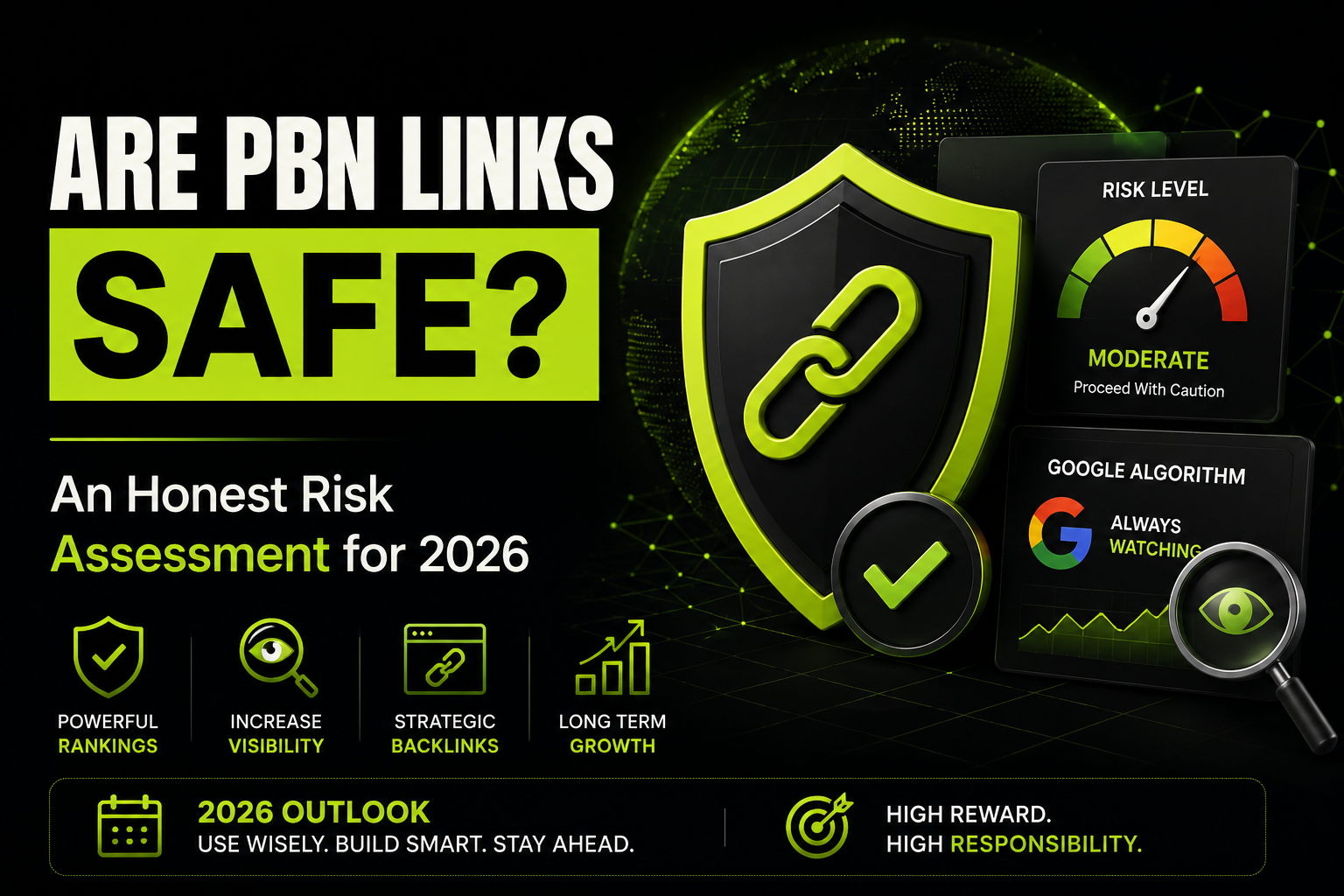
The question of whether PBN links are safe is one of the most searched and least honestly answered questions in link building. SEO forums produce two extreme positions: practitioners who insist PBN links are fine and use them at scale, and commentators who insist they will destroy your site. Neither position is accurate in its extreme form. This guide provides the honest, calibrated answer — based on what actually happens to real campaigns rather than on either promotional interest or alarmist generalisations. Are PBN links safe? The answer is: it depends on five specific factors, and this guide explains exactly what those factors are, why they matter, and how to manage them to a risk level that the majority of competitive SEO campaigns accept as a reasonable operating assumption.
The Risk Spectrum: Why PBN Safety Is Not Binary
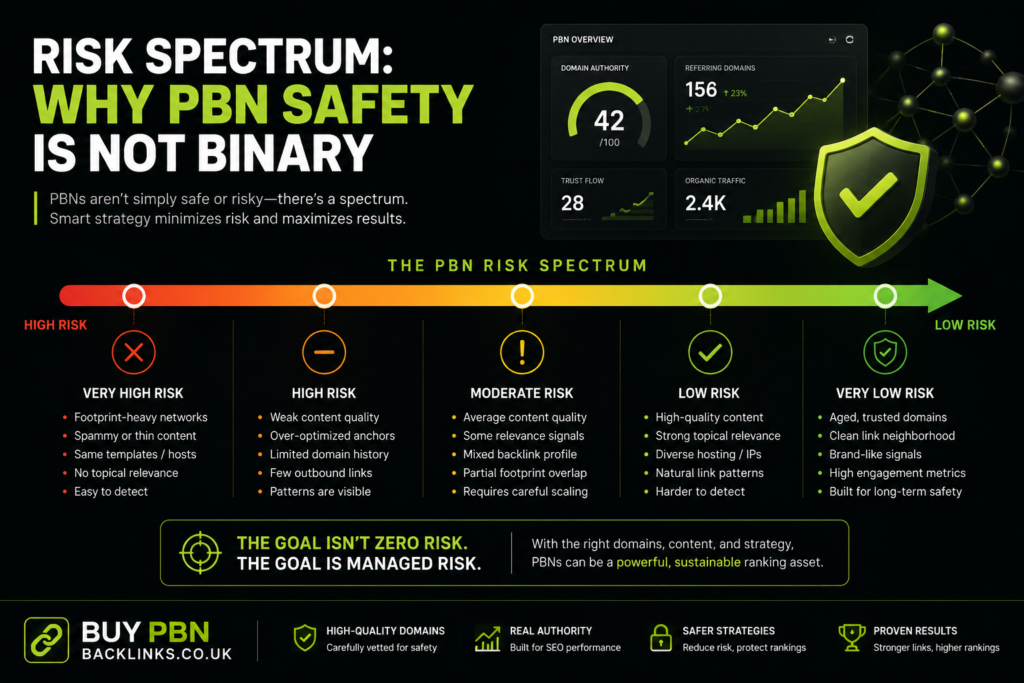
PBN link risk does not work like a switch — on or off, safe or unsafe. It works like a spectrum with five primary variables, each of which independently influences how likely Google is to identify and action a given link as part of a manipulative scheme.
At one end of this spectrum: a zero-traffic domain on shared hosting with 30 other PBN sites, AI-generated 200-word articles, exact-match keyword anchors across every placement, and 50 links ordered in one week. This profile will almost certainly be identified and actioned by Google spam systems — it matches every pattern they are specifically built to detect.
At the other end: a DR30 domain with 150 monthly organic visitors, hosted on a unique IP with separate registrar and nameservers, publishing 600-word human-written topical articles, with natural anchor text distributed across branded, generic, and partial-match variants, acquiring five to eight links per month consistently. This profile is significantly harder to distinguish algorithmically from a site that has earned its links through genuine content quality. The detection risk is real but low enough that most competitive practitioners accept it as a reasonable trade-off for the ranking benefits delivered.
The five factors below determine where any specific PBN campaign sits on this spectrum.
The Five Factors That Determine PBN Link Safety
Factor 1 — Domain Quality and Organic Traffic
The single most important safety variable is whether the linking domain has genuine organic traffic. A domain that ranks for real queries in Google has passed its content quality assessment, its backlink quality review, and its topical relevance evaluation. Google trusts it enough to rank it. A link from that domain sits within a context Google has already validated.
A zero-traffic domain — regardless of its DR or DA — has never demonstrated to Google that it produces content worth ranking. Links from such domains are algorithmically more suspicious because the domain has no verified editorial purpose. When Google spam systems analyse link patterns, domains with zero organic footprint that exist only to link to other sites are a primary detection target.
Risk reduction: Only use PBN domains with verified organic traffic, even if modest. Use our 7-point quality checklist to verify every domain before purchase. A domain with 50 monthly organic visits is significantly safer than one with zero, regardless of DR.
Factor 2 — Hosting Footprint
Network footprint is the technical dimension of PBN safety that most fundamentally determines whether Google can identify multiple sites as part of the same coordinated scheme. If ten PBN domains all share the same IP range, the same hosting account, the same WordPress theme, and the same registrar, they create a machine-readable pattern that Google technical analysis can identify as a network without needing to evaluate content or link patterns at all.
The footprint problem is structural: a single shared hosting account with 20 PBN sites on it is discoverable through standard technical audit. Once discovered, all 20 sites and all the money sites they link to are simultaneously at risk. Footprint management is not optional for safe PBN operation — it is the foundation everything else builds on.
Risk reduction: Each PBN domain on a unique IP block, separate registrar, different nameservers, different WordPress theme. No two sites in your network should share any single infrastructure element. For a complete guide see our buy PBN network infrastructure guide.
Factor 3 — Anchor Text Distribution
Anchor text over-optimisation is the most common cause of manual review for paid link campaigns. When Google evaluates a page backlink profile and finds that 40 percent of anchors are the exact target keyword, this pattern does not match how organic links are acquired. Real editorial links use diverse anchor text — the site name, the URL, generic phrases, and occasional keyword-relevant anchors — because editors choose their own language rather than following a buyer specification.
A healthy, safe anchor text profile for a PBN campaign looks like this across the full link profile:
| Anchor Type | Safe Percentage | Examples |
|---|---|---|
| Branded | 35–45% | Site name, brand URL variants |
| Generic | 20–25% | click here, read more, visit site, this page |
| Topical / semantic | 15–20% | link building service, SEO authority guide |
| Partial match | 10–15% | quality PBN links for SEO, best link building |
| Naked URL | 5–10% | https://domain.com |
| Exact match | 5–10% | buy PBN links, link building service UK |
Risk reduction: Track every anchor in a spreadsheet. Calculate percentages before every new order. Stop adding exact-match anchors when you approach 10 percent of your total profile. Never order all links with the same anchor text regardless of how keyword-relevant it seems.
Factor 4 — Link Velocity
Natural link acquisition does not look like 40 links acquired in one week after three months of zero new links. Real editorial links accumulate gradually — a new site earns occasional references as it publishes content, establishes credibility, and gets discovered by writers and publishers in its field. The rate is relatively consistent over time with occasional spikes around newsworthy events.
When Google sees a new domain acquire 40 links in one week with no corresponding editorial event — no viral content, no press coverage, no product launch — the velocity pattern itself is anomalous. Even if each individual link is from a quality domain, the acquisition pattern triggers algorithmic review that gradual, consistent link building does not.
Safe velocity guidelines by site age:
| Site Age | Maximum Monthly Links | Notes |
|---|---|---|
| 0–3 months | 0–3 | Citations only. No PBN until indexed content exists. |
| 3–6 months | 3–8 | First PBN placements. Space across the full month. |
| 6–12 months | 8–20 | Steady building. Never all in one week. |
| 12+ months | 15–40 | Match or slightly exceed competitor acquisition rate. |
Factor 5 — Content Quality on Network Sites
Google Helpful Content systems specifically evaluate whether pages are created primarily for search engines rather than for users. A PBN site publishing 200-word AI-generated articles with no real information value is classified as low-quality content created for manipulation purposes. Links from such pages are weighted less heavily — and in some cases actively suppressed — by the same quality systems that evaluate the content hosting them.
Conversely, a PBN site publishing 500–800 word articles that genuinely cover its topic area, include useful information, maintain topical coherence, and read as written by a human familiar with the subject passes the basic quality review that most Google content classifiers apply. The link sits within content that Google has evaluated positively, which means it is processed more like an editorial link than a manufactured one.
Risk reduction: Minimum 500-word human-quality articles. Topically coherent with the domain history. No duplicate or spun content. Regular publishing cadence of at least one to two new articles per month to signal ongoing editorial activity.
The Difference Between Algorithmic and Manual Risk
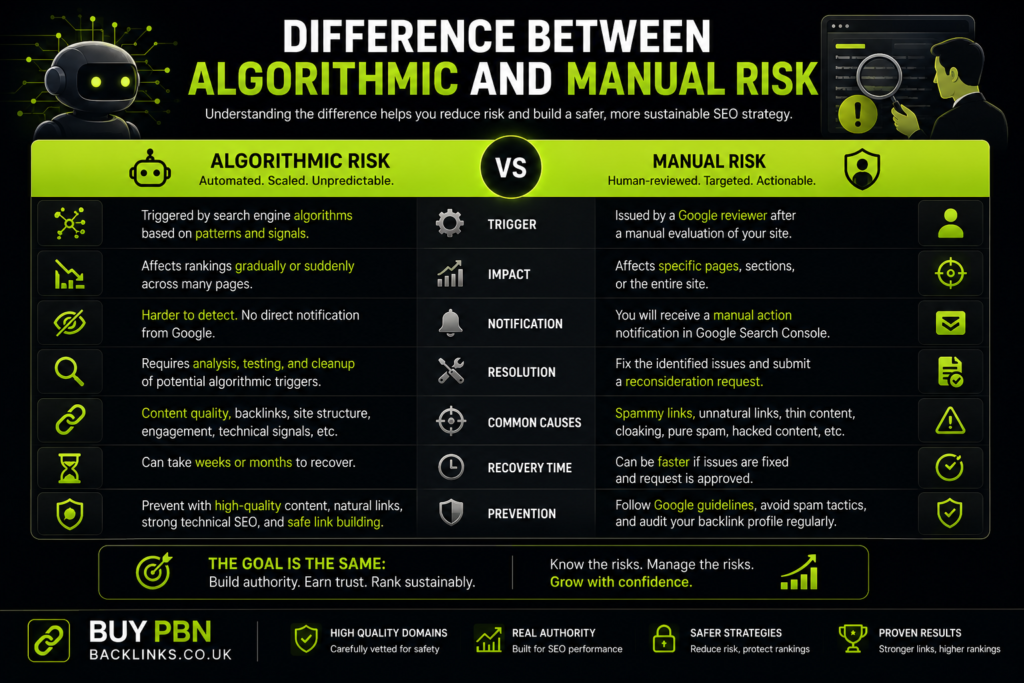
There are two distinct types of Google action that PBN campaigns can trigger, and understanding the difference helps calibrate risk management priorities.
Algorithmic Devaluation
Google algorithms continuously evaluate link profiles and can reduce the weight assigned to links that match spam patterns. This is not a penalty — it is an automated quality signal adjustment. The result is that certain links pass less authority than they should, and rankings may be lower than they would be with a cleaner profile. Algorithmic devaluation is the most common outcome for moderate-quality PBN campaigns and is generally recoverable by improving link quality over time.
Manual Actions
Manual actions are applied by Google spam reviewers who have specifically evaluated a site and found clear evidence of guideline violations. These are recorded in Google Search Console and cause more significant ranking suppression than algorithmic devaluation. Manual actions for unnatural link building are typically triggered by: obvious bulk link schemes, extreme anchor over-optimisation, or specific spam reports from competitors. Recovery requires a reconsideration request documenting the corrective steps taken.
For most quality PBN campaigns managed according to the five factors above, manual action risk is low. The campaigns most commonly penalised match the highest-risk end of the spectrum — obvious bulk schemes with multiple compounding risk factors rather than carefully managed quality campaigns.
PBN Link Risks vs Other Paid Link Types
| Link Type | Algorithmic Risk | Manual Action Risk | Primary Risk Factor |
|---|---|---|---|
| Quality PBN (maintained domain, traffic) | Low–Medium | Low | Anchor over-optimisation |
| Cheap bulk PBN (zero traffic, shared hosting) | High | Medium–High | Footprint + content quality |
| Guest post (genuine editorial) | Very Low | Very Low | Paid link disclosure |
| Niche edit (quality domain) | Low | Low | Anchor over-optimisation |
| Link farm / bulk directory | Very High | High | Spam pattern matching |
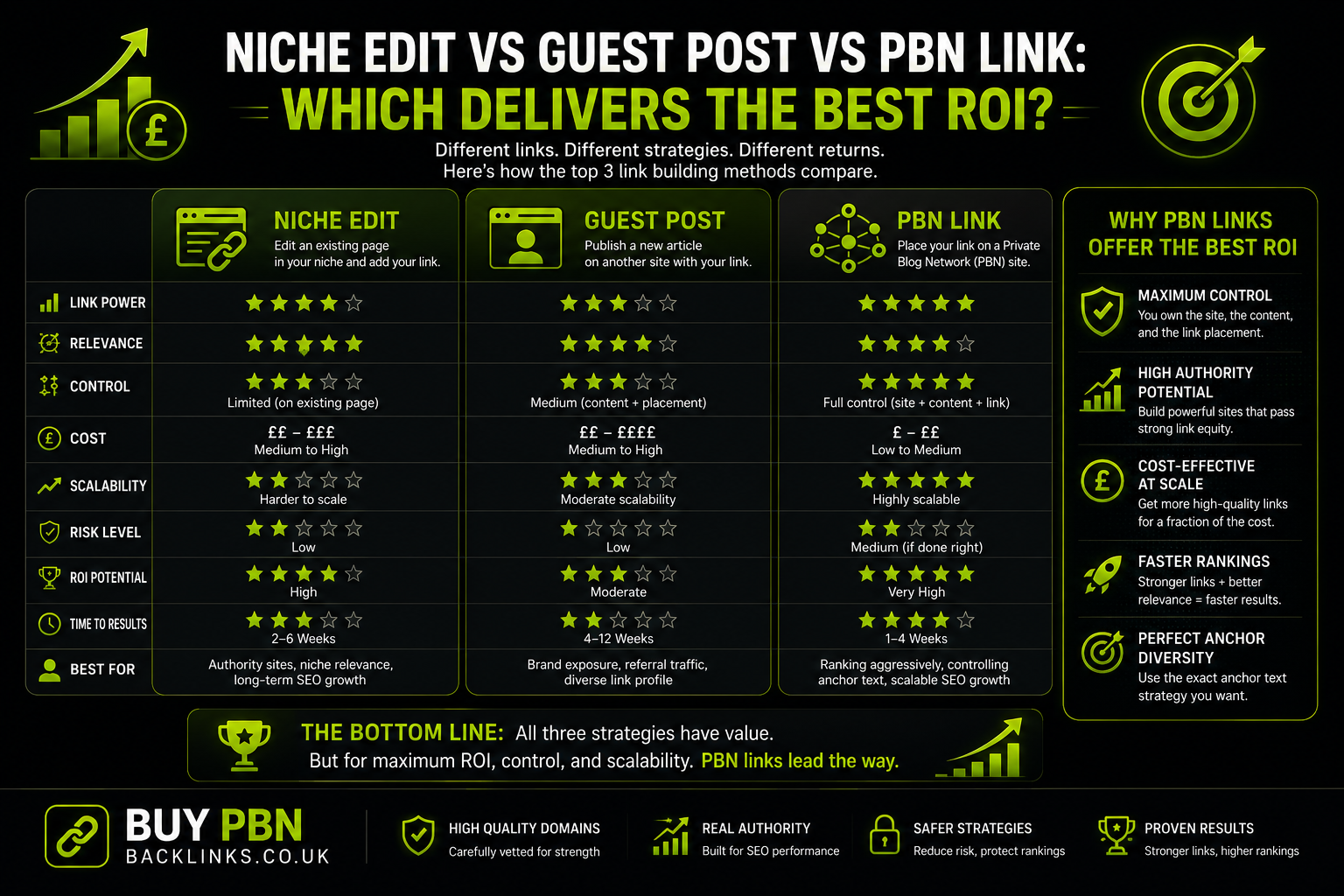
Quality PBN links sit in the medium-risk range alongside niche edits — significantly below bulk link farms and comparable to the algorithmic risk of most paid link types when properly managed. The comparison to guest posts is the most important: genuine editorial guest posts carry lower risk because they more closely resemble organic link acquisition. However, they are also slower, more expensive, and structurally inaccessible in many niches. For a full comparison see our niche edit vs guest post vs PBN comparison.
How to Structure a Safe PBN Campaign
Apply these principles from your first placement and the risk profile of your PBN campaign is as low as current quality standards can make it.
1. Verify every domain before purchasing. Check organic traffic in Ahrefs, Trust Flow in Majestic, content history in Wayback Machine, and Spam Score in Moz. Only use domains that pass all four checks. See our complete PBN buyer guide for the full evaluation process.
2. Manage anchor text from placement one. Set up a tracking spreadsheet before your first link goes live. Record every anchor text used. Calculate your profile percentages and update them with every new placement. Never add exact-match anchors when they approach 10 percent of your total profile.
3. Build at consistent velocity. Space orders across weeks, never days. Match your monthly acquisition rate to your site age and competitive context. Consistency over 12 months is algorithmically safer than equivalent volume concentrated in burst campaigns.
4. Diversify link types alongside PBN. A profile consisting entirely of PBN links is more algorithmically anomalous than one that includes PBN links alongside niche edits, citations, and occasional editorial placements. Mixed profiles are harder to classify as coordinated schemes because they look like multiple acquisition channels operating simultaneously.
5. Monitor quarterly and replace deindexed links promptly. Check every placement with a site search in Google every three months. Deindexed PBN article pages pass zero authority — and their silent failure can cause ranking declines that look like algorithm updates. Replace deindexed placements immediately per your seller replacement policy. For guidance on what replacement policies should look like see our buy permanent backlinks guide.
What to Do If You Receive a Manual Action
Despite best efforts, manual actions can occur — particularly in competitive niches where Google spam reviewers focus more attention. If you receive a manual action for unnatural link building:
Step 1 — Identify the problematic links. Use Google Search Console link data and your placement tracking spreadsheet to identify which links are most likely to have triggered the action — typically the lowest-quality domains, highest exact-match anchor concentration, and most obvious network footprints.
Step 2 — Remove what can be removed. Contact sellers of identified problem placements and request removal. Document all removal requests and responses.
Step 3 — Disavow what cannot be removed. Use Google Search Console Disavow Tool to disavow remaining problematic links. Disavow at the domain level for obvious network sites, at the page level for individual problem placements on otherwise acceptable domains.
Step 4 — Submit a reconsideration request. Document the corrective steps taken: what links were removed, what was disavowed, what operational changes were made to prevent recurrence. Reconsideration requests require genuine evidence of corrective action — not just assurances.
Step 5 — Rebuild with quality. After reconsideration approval, rebuild your link profile gradually using the quality standards and velocity controls that the original campaign lacked.
FAQ
Are PBN links safe to use in 2026?
Not risk-free, but manageable. The practical risk for quality campaigns using maintained domains with genuine traffic, independent hosting, natural anchor distribution, and controlled velocity is significantly lower than most warnings suggest. The risk exists on a spectrum — quality management moves it toward the low end.
What makes PBN links unsafe?
Zero-traffic domains, shared hosting footprints, exact-match anchor saturation above 15 percent, bulk velocity spikes, and AI-generated content on network sites. Any one of these raises risk. Multiple together make detection near-certain.
Has Google ever penalised sites for PBN links?
Yes. Manual actions for unnatural link building including PBN schemes are well-documented. The sites most commonly penalised share consistent characteristics: obvious footprints, extreme anchor over-optimisation, and bulk low-quality links. Quality campaigns without these characteristics are penalised significantly less commonly.
What is the difference between a safe and unsafe PBN link?
Safe: maintained domain with organic traffic, independent hosting, human-written topical content, natural anchor text, seller replacement policy. Unsafe: zero-traffic domain on shared hosting, AI content, exact-match anchor, no editorial standards. The difference is quality and structure, not the link type.
How do I reduce the risk of using PBN links?
Verify domain quality before every purchase, maintain natural anchor distribution with exact-match below 10 percent, build at consistent velocity, diversify with other link types, and monitor placements quarterly. These five steps reduce risk to the level most competitive campaigns accept.
Is it possible to recover from a PBN link penalty?
Yes. Manual actions are recoverable through Google Search Console reconsideration requests after identifying and removing or disavowing problematic links. Recovery takes four to twelve weeks after a successful reconsideration. Prevention through quality management is always preferable to recovery.
Conclusion
PBN links are not safe in an absolute sense — they violate Google guidelines and Google has the tools and incentive to detect and action them. But “not absolutely safe” is not the same as “inevitably dangerous.” The actual risk profile of a quality PBN campaign managed according to the five factors in this guide is significantly lower than most warnings imply — low enough that practitioners across every competitive niche accept it as a reasonable operating assumption in exchange for the ranking benefits that quality PBN placements deliver.
The campaigns that get penalised almost universally share the same characteristics: obvious footprints, extreme anchor over-optimisation, bulk low-quality links, and velocity spikes. The campaigns that rank stably for years avoid all five. The choice between these outcomes is largely within your control.
For PBN links built on quality maintained domains with genuine organic traffic, independent hosting infrastructure, and natural content standards — apply the risk management framework in this guide and explore the available options with full domain-level transparency before every order.
About the Author
Louis Dobbler is a PBN link building strategist and off-page SEO specialist at BuyPBNBacklinks, with deep expertise in private blog network construction, domain acquisition, and authority link campaigns across iGaming, finance, and SaaS verticals.

Louis Dobbler is a PBN link building strategist and off page SEO specialist with deep expertise in private blog network construction, domain acquisition, and authority link campaigns. With years of experience working across competitive verticals including iGaming, crypto, finance, and CBD, Louis has helped hundreds of SEO agencies and affiliate marketers engineer rankings that hold through every Google core update.
At BuyPBNBacklinks, Louis oversees network quality, domain vetting, and campaign strategy ensuring every PBN backlink placed meets the highest standards for authority, footprint safety, and long term SEO performance.