The phrase “authority backlinks” is used so broadly in link building that it has almost lost meaning. Every seller claims their links are high authority. Every listing quotes an impressive DR or DA. And yet rankings fail to move, campaigns underperform, and buyers conclude either that link building does not work or that they bought the wrong thing. In most cases, it is the latter — they bought the appearance of authority rather than the thing itself. This guide explains exactly what genuine authority means in 2026, which metrics actually predict ranking impact, what you should pay at each authority tier, and how to verify every claim independently before a single pound leaves your account.
What Does “Authority” Actually Mean for Backlinks?
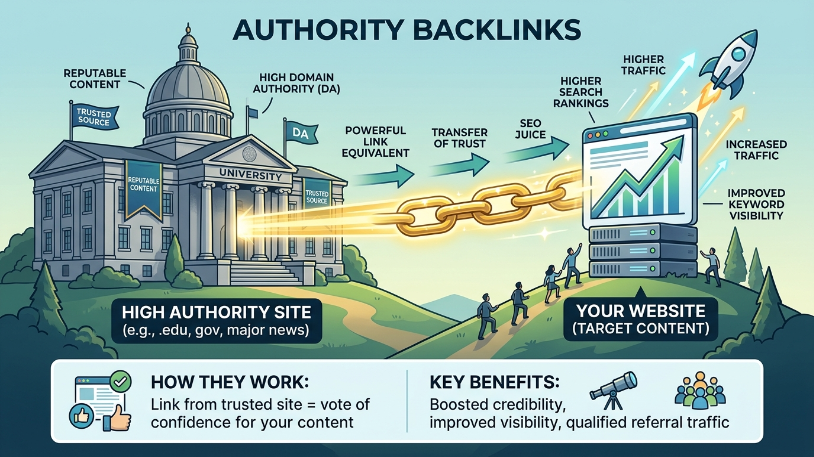
In the context of backlinks, authority means one thing: how much does Google trust the linking domain? A high-authority backlink comes from a domain that Google actively crawls, ranks in its index, and considers a credible source within its topic area. A low-authority backlink comes from a domain Google either ignores, distrusts, or has never meaningfully engaged with.
The challenge is that Google does not publish its trust scores. Every metric buyers use to evaluate authority — DR, DA, TF, CF — is a third-party estimate constructed from observable signals. None of them are Google metrics. None of them are guaranteed to correlate precisely with what Google actually weighs. This is why relying on a single metric number, however impressive, is a consistently unreliable way to evaluate link quality.
The most reliable proxy for Google trust available to outside observers is organic search traffic. A domain that ranks for real queries in Google has demonstrably passed Google quality assessments. Its content has been evaluated, its backlink profile reviewed, and its topical relevance confirmed sufficiently to appear in search results. That demonstrated trust is far more meaningful than any calculated metric score.
The Authority Metrics That Actually Matter
Organic Traffic — The Gold Standard
Check the domain in Ahrefs or Semrush under Organic Search → Traffic. Any genuine monthly organic traffic — even 30 to 50 visits — confirms Google is actively ranking the domain for real queries. A domain with zero organic traffic has never demonstrated to Google that it produces content worth ranking. Links from such domains pass authority more slowly and less reliably than links from ranked domains, regardless of their DR or DA scores.
Trust Flow (Majestic) — The Spam Filter
Majestic Trust Flow measures how topologically close a domain is to a set of seed sites Majestic has identified as highly trusted — major news outlets, university domains, government sites, established industry publications. A TF of 20 or above indicates the domain has a genuine link graph connection to trusted web properties. TF is harder to inflate than DR because it depends on the quality of the sites linking to you, not just the quantity.
Also check the TF:CF ratio. Trust Flow divided by Citation Flow should be 0.4 or above. A low ratio (0.2 or below) indicates the domain has many links but they are largely from low-trust sources — a common pattern in inflated metric domains.
Domain Rating (Ahrefs) — The Volume Measure
DR measures the strength of a domain backlink profile on a logarithmic scale. It is a useful floor check — a DR 10 domain almost certainly lacks the authority to meaningfully move competitive rankings — but it is gameable through reciprocal link exchanges within PBN networks and should never be the primary authority indicator. Use DR as a minimum threshold check, not as an authority certificate.
Spam Score (Moz) — The Risk Check
Moz Spam Score identifies domains with link profiles that resemble known spam patterns. A Spam Score above 50 to 60 percent indicates the domain has accumulated links from sources associated with manipulative link schemes. High spam scores reduce a domain effective authority and can introduce association risk to your link profile. Keep this below 30 percent for any placement you consider authoritative.
Authority Tiers: What Each Level Delivers
| Tier | DR | TF | Organic Traffic | Price Range | Best For |
|---|---|---|---|---|---|
| Entry | DR 15–25 | TF 10–18 | 10–50/mo | £25–£60 | New sites, Tier 2, low-KD keywords |
| Mid | DR 25–40 | TF 18–28 | 50–300/mo | £60–£150 | Mid-competition campaigns, local SEO |
| High | DR 40–55 | TF 28–40 | 200–800/mo | £150–£350 | Competitive national keywords, finance, SaaS |
| Premium | DR 55+ | TF 38+ | 500+/mo | £350–£700+ | Top-3 rankings in highly competitive niches |
The most important thing this table communicates is that price and authority are genuinely correlated at the mid tier and above. Sellers offering “high authority DR 40+ links” for £15 to £20 are not selling the same product as a seller charging £150 for a verified DR40 domain with 200 monthly organic visits. The cheap listing is describing a metric; the expensive one is describing a demonstrated Google trust relationship.
How Sellers Fake Authority Metrics
Understanding the most common metric inflation tactics is the fastest way to stop paying for fake authority.
DR Inflation via Network Cross-Linking
Within a PBN network, it is straightforward for an operator to link their own sites to each other. If 40 sites all link to each other, each site shows an inflated DR because it has 39 referring domains — all from the same operator. The DR looks strong in Ahrefs, but the actual external authority feeding those links is minimal. The tell is always zero organic traffic alongside impressive DR.
DA Screenshot Misrepresentation
DA changes over time and Moz updates it monthly. A seller showing you a DA 45 screenshot from eight months ago may be showing you a domain that has since been updated to DA 22. Always verify DA live in Moz Link Explorer immediately before purchasing, not from screenshots.
Purchased DR Through Link Farms
Some sellers bulk-buy cheap links from link farms specifically to inflate the DR of their PBN domains before selling placements. The DR rises, the organic traffic stays at zero, and the Trust Flow stays low. Checking all three metrics simultaneously exposes this pattern immediately — genuine DR elevation from real links almost always comes with at least some organic traffic.
Traffic Injection
Bot traffic services can artificially inflate the reported traffic of a domain in Semrush and Ahrefs estimates for a period. The tell is in the keyword-level data — open the Organic Keywords report in Ahrefs. If the domain shows 500 monthly visits but ranks for zero keywords above position 50, the traffic data is unreliable. Real traffic always traces to real ranking keywords.
The 5-Step Authority Verification Process
Run these checks on every domain before paying, regardless of what the seller claims.
Step 1 — Organic traffic check (Ahrefs). Open Ahrefs Site Explorer, enter the domain, go to Organic Search → Traffic. Any genuine traffic confirms Google trust. Zero traffic disqualifies the domain from the “authority” category regardless of DR.
Step 2 — Trust Flow check (Majestic). Open Majestic, enter the domain. Look for TF 15 or above and TF:CF ratio above 0.4. Low TF on a claimed high-authority domain is the most reliable signal of an inflated profile.
And Step 3 — Content history check (Wayback Machine). Open web.archive.org and enter the domain. Confirm genuine, topically coherent content history exists across multiple years. Domains rebuilt recently on previously parked or spam domains will show thin or incoherent archive history.
Step 4 — Spam score check (Moz). Open Moz Link Explorer. Spam Score below 30 percent is acceptable. Above 50 percent is a significant red flag that the domain backlink profile includes large volumes of spam-associated links.
Step 5 — Google index check. Search site:domain.com in Google. If zero or near-zero pages return, the domain is deindexed or suppressed. An authority backlink from a deindexed domain passes no value whatsoever regardless of its stated metrics.
This five-step process takes under 10 minutes per domain and identifies the overwhelming majority of inflated-metric authority claims. For a more complete framework including seven criteria, see our 7-point quality checklist for buying backlinks.
How PBN Links Fit Into the Authority Backlink Stack
When buyers search for authority backlinks, they are often imagining editorial links from DR 60+ publications. These are the most valuable links available — and also the hardest to acquire, slowest to scale, and least controllable in terms of anchor text and placement timing.
In practice, a well-constructed authority backlink profile uses multiple link types across a three-layer structure:
Layer 1 — Editorial anchor links (5–15% of profile). High-DR links from genuine publications. Acquired through PR, original research, or highly linkable content. These are the hardest to get but carry the most durable authority signal.
Layer 2 — Quality PBN authority links (50–65% of profile). DR 25–50 PBN links on maintained domains with genuine organic traffic. This is where most paid link building investment goes and where PBN links perform most effectively. They provide topical relevance, anchor text control, and volume that editorial outreach cannot match at scale. For a detailed guide to this tier, see our complete PBN buyer guide.
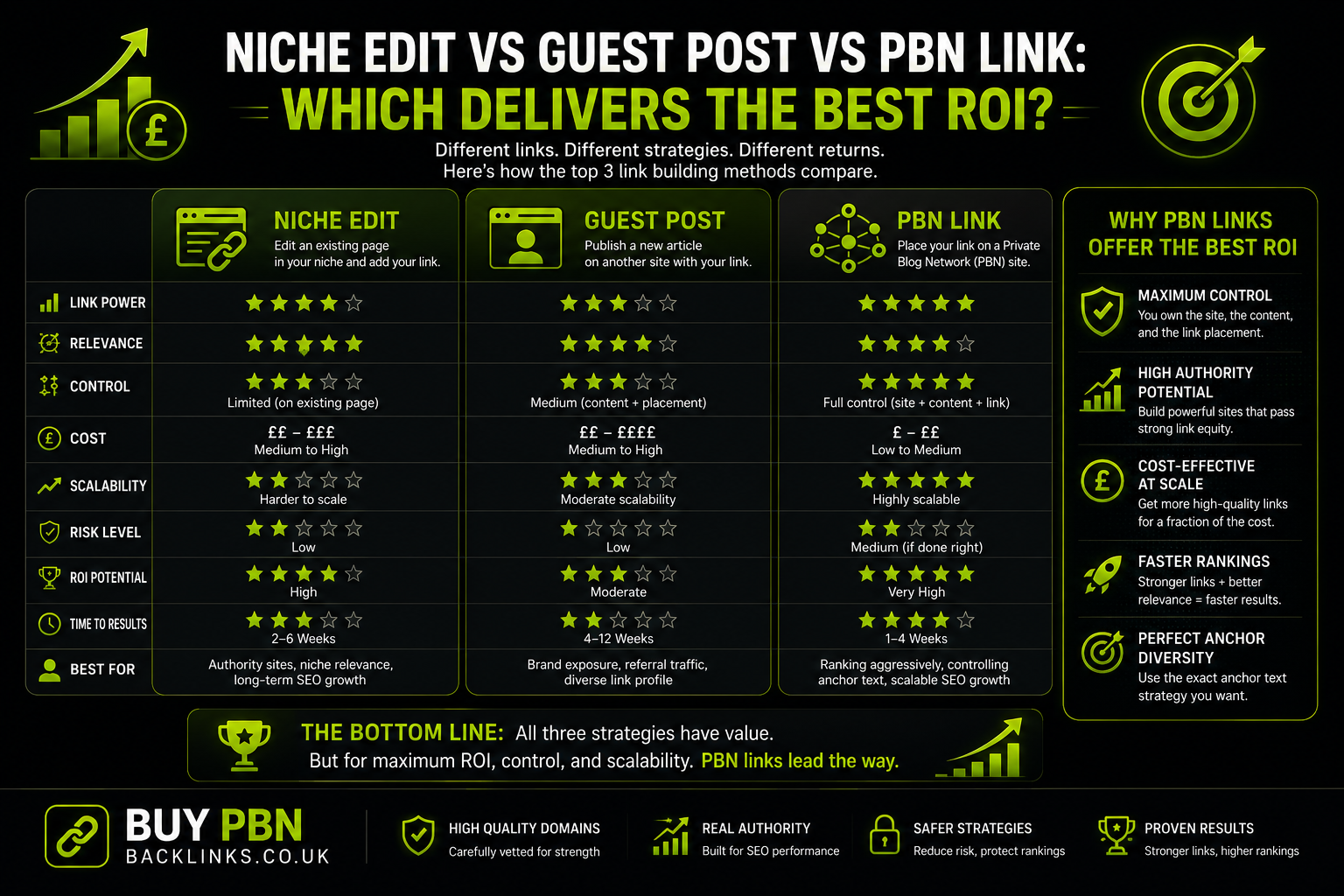
And Layer 3 — Supporting topical links (20–35% of profile). Lower-DR but topically coherent links including niche edits, directory citations, and community mentions. These contribute topical density and profile diversity. For a comparison of niche edits vs PBN links at this layer, see our niche edits vs PBN links guide.
The authority stack is not one link type — it is a deliberate combination. Sites that rank stably in competitive positions almost always show all three layers, with PBN links forming the scalable mid-layer that outreach alone cannot build at the required volume.
What to Pay and What to Expect at Each Budget Level
Under £50 Per Link
At this price point, genuine authority is rare. Most placements in this range come from DR 10–25 domains with minimal or zero organic traffic. These links have their place — building profile diversity, supporting Tier 2 campaigns, or targeting very low-competition keywords — but they should not be described as authority backlinks and should not be the primary investment in a competitive campaign.
£60–£150 Per Link
This is the realistic floor for genuine authority link building. At this tier you should be receiving DR 25–40 domains with 50–300 monthly organic visits and TF 15–25. These links move rankings on low to mid-competition keywords and form the effective mid-layer of most campaign profiles. The majority of quality PBN authority links price in this range.
150–£350 Per Link
At this tier you are accessing DR 40–55 domains with consistent organic traffic of 200–800 visits monthly and TF 28–40. These links move rankings on competitive national keywords and provide the sustained authority that lower-tier links alone cannot deliver in highly competitive niches. Appropriate for finance, legal, SaaS, and high-value affiliate campaigns.
£350+ Per Link
Premium authority placements on DR 55+ domains with strong organic profiles. Appropriate for very high-competition campaigns where the top three ranking pages have extensive high-authority backlink profiles and the authority gap cannot be closed with mid-tier links alone.
FAQ
What makes a backlink high authority?
A genuinely high-authority backlink comes from a domain Google actively trusts and ranks. The most reliable indicators are organic search traffic, Trust Flow of 20 or above, DR of 25 or above, and a clean backlink profile. Organic traffic is the single most important signal.
What DR should authority backlinks have?
DR 25 or above for entry-level authority, DR 35–50 for most mid-competition campaigns, and DR 50 or above for national competitive terms. Always verify organic traffic and Trust Flow alongside DR — DR alone can be inflated and is not sufficient as a sole authority indicator.
How much do authority backlinks cost?
Entry-level (DR 20–30, some traffic): £40–£100. Mid-tier (DR 30–45, consistent traffic): £80–£200. Premium (DR 45+, strong traffic and TF): £200–£500+. Anything below £20 for claimed authority links almost always reflects inflated or unverifiable metrics.
Are authority PBN links better than cheap bulk links?
Yes, significantly. Three authority PBN links from DR 35 domains with genuine traffic outperform fifty cheap links from zero-traffic sites in virtually every competitive context. Google weights links by source domain trust — a single trusted ranked domain passes more ranking signal than dozens of domains Google has no trust relationship with.
How do I verify a backlink is genuinely high authority?
Ask for the domain URL. Check organic traffic in Ahrefs (any traffic = Google trust confirmed). Check Trust Flow in Majestic (TF 15+ minimum). Check Spam Score in Moz (below 30%). Verify content history in Wayback Machine. Run a site search in Google to confirm indexation. A domain failing any of these checks is not genuinely high authority regardless of stated DR or DA.
What is the difference between DR and DA?
DR is Ahrefs Domain Rating — updated frequently, based on the Ahrefs link index. DA is Moz Domain Authority — updated monthly, based on the Moz link index. Both are third-party estimates, not Google metrics. DR is generally more current and harder to inflate. Neither should be the sole authority indicator — use both alongside organic traffic and Trust Flow for a complete picture.
Conclusion
Genuine authority in a backlink is not a metric number — it is a demonstrated relationship between the linking domain and Google trust systems. The five-step verification process in this guide closes the gap between what sellers claim and what domains actually deliver, protecting your budget from the most common authority misrepresentation patterns.
For most campaigns the optimal authority strategy is a structured mix: a base of verified mid-tier PBN links at DR 25–45 with genuine traffic, supplemented by occasional higher-authority placements on the most competitive target keywords. The combination delivers the topical depth and authority concentration that moves rankings in competitive niches without the editorial link timelines that no paid campaign can match.
For authority backlinks with full domain-level transparency — organic traffic verified, Trust Flow confirmed, and indexed delivery guaranteed — explore the available options and apply the verification process above before committing to any placement.
About the Author
Louis Dobbler is a PBN link building strategist and off-page SEO specialist at BuyPBNBacklinks, with deep expertise in private blog network construction, domain acquisition, and authority link campaigns across iGaming, finance, and SaaS verticals.

Louis Dobbler is a PBN link building strategist and off page SEO specialist with deep expertise in private blog network construction, domain acquisition, and authority link campaigns. With years of experience working across competitive verticals including iGaming, crypto, finance, and CBD, Louis has helped hundreds of SEO agencies and affiliate marketers engineer rankings that hold through every Google core update.
At BuyPBNBacklinks, Louis oversees network quality, domain vetting, and campaign strategy ensuring every PBN backlink placed meets the highest standards for authority, footprint safety, and long term SEO performance.